
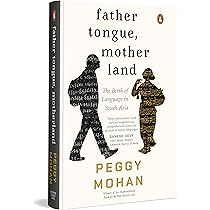
The fascinating thing about Peggy Mohan’s writings is that there is always a yearning to put the story of the ‘little people’ back into the history of languages. For decades it has been a dictum of language historians to give credit to powerful elites of the past and the present for developing and preserving languages. But Peggy doesn’t believe in this dictum at all.
Peggy Mohan’s new book Father Tongue, Mother Land: The Birth of Languages in South Asia (published by Penguin Random House in 2025) can be seen as a sequel to her earlier work Wanderers, Kings and Merchants: The Story of India through Its Languages (2021), where she explored the development of languages in India while looking into the waves of migration of ‘men’ into the subcontinent from the ancient times. In her new work, Peggy is looking into a more remote past to get to the root of the modern Indian languages.
It has been a recurring argument in Peggy’s works that Indian language experts and scholars should look beyond the standard European model of language development where the roots of vernacular languages are traced to classical languages like Latin and Greek. Indian linguists have imposed this model on India and they have carved out a convenient ‘mother–daughter’ relationship where Sanskrit is seen as a mother to all the Indo – Aryan languages of North India. In place of this convenient model, Peggy suggests a model of creolisation through which our languages might have come to us.
In ‘Wanderers, Kings and Merchants’, she tried to draw a parallel between the birth of languages in India and the birth of creoles in the Caribbean. But the issue was the importance of ‘Pidgins’ which are said to predate the birth of creole languages which could not be the case in India. In ‘Father Tongue, Mother Land’, Peggy has challenged the classical model of creolisation. She says that Pidgins do not necessarily predate the Creole languages and Pidgins should only be considered as trade languages which came up during the times of slave trade and which were spoken only among European and African traders and the slaves on ships. Creole languages took their vocabulary directly from the European languages. Due to the emergence of this new fact, Peggy’s argument of looking at Indian languages as Creole languages looks more promising.
The Hybridity of ‘Dakhini’?
Peggy Mohan sketches a historical picture of the emergence of ‘Dakhini’ in the Hyderabad region in the 12th and 13th centuries which she calls ‘a language in the twilight zone’. Dakhini shares most of its vocabulary with Urdu but in grammar, it is close to Telugu which is its substratum language. A substratum is the source through which a new language gets its base. Dakhini lacks ergativity which means that we cannot change an active sentence in the language to a passive sentence by adding a subject marker as we do in Hindi. This is a characteristic of all Dravidian languages. But Dakhini also has grammatical gender which makes it close to Indo – Aryan languages. According to Peggy, people who adopted Dakhini after the twelfth century were earlier speakers of Telugu. Hence, they kept their new language an ergativity-free language but the grammatical gender of Urdu slipped in the new language.
Through the example of Dakhini, Peggy shows that every new language in India has two parental streams – paternal and maternal. The languages which came to India with the influx of migrants from time to time have acted as the paternal stream as most of these migrants have been mostly males who inbred with the females of the local people in the subcontinent. On the other hand, the languages of the ‘little people’ or local people which existed from before the advent of the migrants, have worked as the maternal stream for new languages.
In Search of ‘Language X’
Peggy devotes a large part of ‘Father Tongue, Mother Land’ to finding the skeleton of ‘language X’ which according to her can be credited with being the substratum of all languages that have emerged in India in the past thousand years. To get to language X, Peggy analyses a number of languages that are now found in the Indus Valley Region. She studies the language structure of Burushaski, Brahui, Pashto, Punjabi, etc. and she reaches some conclusions about the structure of her language X. According to her, the probable features of language X might include natural gender (which differentiates between animate – inanimate objects but it doesn’t assign gender to every object and subject), retroflexion, full ergativity (where markers are applied to both object and subject and in all tenses), and some other features.
However, the conclusions that she reaches about her language X are mostly speculative. The reason is that Peggy tries to find a language which exists no more. Hence, we cannot know how that language was spoken by people. Still, Peggy underlines the fact that language X was being spoken by the locals in the Indus Valley Region much before the coming of the Dravidians and later Vedic Aryans to the region. The people who were speaking the language X were the ‘First Indians’ whose roots can be traced to the Africans who migrated out of Africa 65,000 years ago.
Looking at Munda Languages Beyond the Label of ‘Austro–Asiatic’:
In ‘Wanderers, Kings and Merchants’, Peggy Mohan looked at the influence of the ‘Austro – Asiatic people, who had migrated to the Magadha region in 2,000 BC from East Asia, on the Magadhan languages. She was able to show how Magadhan languages differ from the western Indo – Aryan languages as they don’t have grammatical gender and ergativity. But in her new work, Peggy goes past the ‘Austro Asiatic’ influence on these languages.
She looks into the Munda languages of the ancient tribals who have been living in the forests of East India for thousands of years. Mundas trace their ancestry to the ‘First Indians’. Their languages have lost much of their vocabulary and have also taken some new features from the languages of the ‘Austro–Asiatic’ migrants like numeral classifiers. But still, the Munda languages have endured as their speakers have held on to the base of their languages. Peggy argues that the Magadhan languages have got their vocabulary from Prakrits like Ardha-Magadhi and Pali but their basic structure is, to a large extent, a product of Munda languages.
The Other Meaning of ‘Dravidian’
In ‘Father Tongue, Mother Land’, Dravidian is not the word which refers to the people or languages of South India. Instead, here the term refers to the people and the languages which had come from the Zagros region of Iran to India in 7,000 BC. These migrants were mostly males who had settled in the Indus Valley region and they inbred with the females of the ‘First Indians’. Later on, these Dravidians founded the early Indus Valley civilisation.
There is a dispute about whether these early Dravidians migrated to South India after the decline of Indus Valley Civilisation around 2,000 BC or before. But Peggy states this fact with more surety that the Dravidians who moved down south were men who had left their earlier habitation in search of new lands to settle in. These Dravidian male migrants married the local women of South India. This fact is important to remember that the languages that are brought by male migrants cannot be sustained on their own. They need the cooperation of the local women to sustain. Hence, the First Indian languages must have worked as the substratum for the present Dravidian languages of South India.
Conclusion
For a long time, languages in South Asia have been treated as passive objects of study which lacked any kind of history before the coming of Sanskrit and Aryans into the subcontinent. Peggy Mohan in her new work challenges this viewpoint. She denies Sanskrit any direct role in the emergence of Indo – Aryan or Magadhan languages in India. New languages have not even taken their vocabulary directly from Sanskrit but only via Prakrits. On the other hand, the old First Indian, Dravidian and Munda languages have provided the base structure for new languages. This gives a serious blow to the Aryan-centric viewpoint of languages which projects Sanskrit as the mother of all languages in India.
Peggy chooses to go in the direction of finding an unnamed language which she thinks was the language of the people before the coming of Aryans and Sanskrit. However, her findings about the ancient language X can only be said to be haphazard and inconclusive because most of the features that she outlines are probabilistic only. Peggy’s approach is to find out the commonalities among India’s languages through their structures and reach an outside reference point from which she can see our languages taking their present shape through different sources. Reaching this outside reference point is not always easy. It looks like Peggy Mohan has reached very close to this reference point but still, she cannot easily pinpoint the ancient sources of our present languages as many of these sources are still shrouded in mystery of the past and whose clear unravelling would require some more time.
***
Kislaya Priyadarshi is a research scholar at the Department of Political Science, University of Hyderabad.