

The term “gentrification” was first coined in the 1960s by British sociologist Ruth Glass in 1964 to describe the displacement of the working-class residents of London neighbourhoods by middle-class newcomers (Lin-Arlow, 2022).[i] Since its inception, gentrification has been recognized as a type of neighbourhood transformation which is in favour of newcomers from a wealthier class at the cost of eviction of longtime inhabitants of one socioeconomic class and culture.
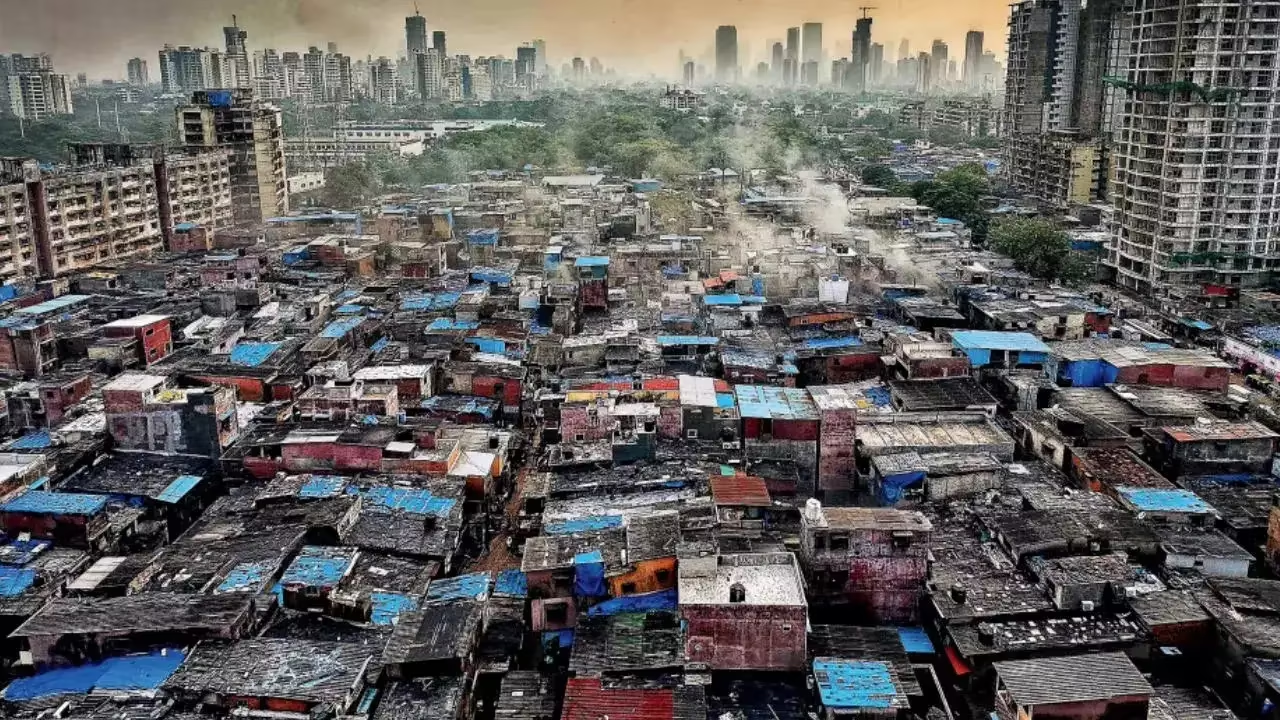
Dharavi, situated in Mumbai, India, is one of Asia’s largest slums, frequently invoked in dialogues surrounding urban development, gentrification, and poverty mitigation (UN-Habitat, 2018).[ii] The phenomenon of gentrification within Dharavi has become a contentious subject, particularly amid Mumbai’s swift economic expansion and urban sprawl (Ghertner, 2014).[iii] Dharavi traces its origins to the late 19th century, evolving from a humble fishing village into a densely populated enclave marked by a mosaic of residential, industrial, and commercial endeavours (Echanove & Srivastava, 2009).[iv] This enclave, which is primarily home to migrants from rural hinterlands seeking employment opportunities in Mumbai, is a microcosm of the city’s socioeconomic dynamics.
Implemented by a joint effort between public and private entities, the Dharavi Redevelopment Plan (DRP) is a project led mostly by private developers to rejuvenate the Dharavi slum area. With the help of borders thought to symbolize the neighbourhoods of the population, 32 distinct sectors or units, or sectors, are created within Dharavi (Reporter, 2024).[v] As part of the DRP’s first phase, five sectors have been chosen.
Problems with the DRP
The Dharavi residents originally supported the redevelopment process, such that 70 per cent of the population agreed to the redevelopment. However, the project was postponed because of the absence of the community participation and the dereliction of the duty of local government in DRP and DPR would essentially benefit the developers and government but not the squatters, which would deviate from the purpose of the project.
The residents claimed that the institutions had never surveyed nor asked for the residents’ opinions regarding the DRP, instead, they had directly declared the residents’ agreement to the plan (Express News Service, 2024).[vi] The failure of the plan is manifest through the dispossession of more than 50,000 families. In addition, the residents were promised houses of more than 400 square feet after the redevelopment, but instead were only given 269 square feet; moreover, the DRP had agreed to provide public institutions such as schools and health centres, but there was no transparency provided to explain how the institutes would be developed nor was there any mention on how it would be made affordable to the peoples most affected.
For more than fifty years, the residents of Dharavi have effectively asserted their entitlement to urban living within its 239 hectares of urban terrain. Multiple generations of slum dwellers have established 85 distinct neighbourhoods, organizing themselves within a complex and intricate physical layout centred around mixed-use dwelling arrangements. In 2006, the BBC estimated that Dharavi’s thriving informal economy generates an annual business turnover exceeding £350 million (approximately USD 541 million) (The Slum Redevelopment Project in Dharavi, n.d.).[vii] As highlighted by Echanove and Srivastava in their July 2009 article in The New York Times, Dharavi’s prosperity has been entirely shaped over decades by successive waves of migrants fleeing rural impoverishment, political persecution, and environmental calamities (Echanove & Srivastava, 2009).[viii] Numerous inhabitants of slums face challenges in meeting the eligibility criteria for housing provided by the Slum Rehabilitation Authority (SRA), compelling them to engage in negotiations with developers and politicians to secure compensation. This process, characterized as a “politics of compensation,” underscores significant disparities between notions of equality and inclusion within Mumbai, as it consolidates power in the hands of developers, often leading to monopolistic dynamics. Furthermore, it is imperative to acknowledge that the SRA represents a housing solution modelled after Western frameworks, highlighting the necessity for solutions grounded in indigenous geographical insights.
Adani’s role in DRP and question of Plebiscite
The redevelopment plans for Dharavi have resurfaced, with the Maharashtra government approving the Adani Group’s bid on July 13 (Gokhale, 2023).[ix] The selection of Adani to supervise the revamp of Dharavi has received final approval from the Maharashtra Housing and Area Development Authority (MHADA). Eight months ago, Adani Realty took first place in the bidding process with an initial investment of Rs 5,069 crore, which was more than the Rs 1,600 crore base price. The survey commenced by assigning a unique identification number to each dwelling, followed by a Lidar survey, a remote sensing technique that employs rapid light pulses from a near-infrared laser to gather measurements of each alleyway. Subsequently, a survey team visited each tenement to collect data from the respective holders, as stated by an official associated with the Dharavi Redevelopment Project (DRP). SVR Srinivas, the CEO of DRP, emphasized the importance of community cooperation in facilitating a smooth and efficient survey process. Additionally, a socio-economic survey was to be conducted, with data centralized for storage. Srinivas highlighted that this project marks the first instance in slum redevelopment where occupants residing on higher floors of hutments will also be eligible for housing under a rental housing scheme.
In 2021, the Minneapolis City Council enacted an inclusionary zoning ordinance mandating developers to allocate a specified portion of units in new developments for affordable housing. However, the ordinance faced legal challenges, prompting a proposed ballot question for voter consideration. Yet, the Minnesota Supreme Court determined that the issue was unsuitable for a referendum. These instances illustrate that while direct public votes on gentrification matters are infrequent, residents maintain avenues to influence community development through grassroots organizing and active engagement in local governance processes (Croman, 2021).[x]
Socio-Economic Implications and Challenges
The redevelopment of Dharavi presents numerous advantages and challenges for the Adani Group, as well as potential socio-economic implications for the area’s residents. Firstly, Dharavi’s strategic location, surrounded by affluent neighbourhoods such as Bandra Kurla Complex, Dadar, and Mahim, offers a unique juxtaposition of poverty and wealth, making it an attractive investment opportunity (Bloomberg, 2024).[xi] Additionally, Dharavi would benefit from excellent connectivity, being close to Mumbai Airport and well-connected by train lines, including the upcoming underground metro station and the future Mumbai to Ahmedabad bullet train route.
Dharavi serves as a thriving hub of micro-enterprises and small-scale industries, with approximately 80% of its population both residing and working within its confines (Boano et al., 2013).[xii] This industrial advantage, combined with its prime location, makes Dharavi one of the most expensive real estate markets globally. For the Adani Group, acquiring the redevelopment project presents an opportunity to leverage these advantages, potentially yielding significant profits through the development of commercial properties. However, the project also poses several challenges.
Relocating Dharavi’s estimated one million residents presents challenges that are logistical and also related to fixing eligibility criteria. This included concerns about housing eligibility and business disruptions during the rehabilitation process (Staff, 2023).[xiii] These socio-economic considerations would lead to objections from residents and potential gentrification concerns. Further, the project faces legal challenges, with a dispute over the government’s decision to award the project to the Adani Group being contested in the Bombay High Court by a rival bidder. Despite these challenges, the Adani Group has expressed a commitment to providing eligible residents with new homes and preserving Dharavi’s cultural identity throughout the transformation process.
Public Policy Recommendations
The public policy formulated claims that it would instil Affordable Housing Mandates for the concerned authorities. There should be enforcement of regulations stipulating that developers must allocate a portion of newly constructed housing units for affordable housing, thereby ensuring the retention of the existing low-income population within the locality despite escalating property values (UN-Habitat, 2018).[xiv] A specific number of affordable housing units was to be included by developers in new construction under inclusionary zoning regulations. Inclusionary zoning, for instance, has been used by cities like San Francisco and New York to improve the availability of affordable housing. To stabilize gentrifying communities, the system for affordable housing also needs to devote more resources to encouraging homeownership (City Observatory, 2019).[xv] Supporting the promotion of mixed-use development plans that incorporate residential, commercial, and industrial elements in Dharavi would preserve the neighbourhood’s social structure and ongoing economic activity while promoting opportunity and diversity in the economy. Preserving Dharavi’s cultural legacy and identity while recognizing its historical importance and the vital roles its citizens play in the city’s cultural and economic fabric ought to be the goals of policy. Giving top priority to investments in infrastructure upgrades, including healthcare, education, and transportation networks, as well as water and sanitation facilities, to improve living conditions and the general standard of living for the people living in Dharavi. In addition, providing support to Dharavi’s microbusinesses and small-scale industries to guarantee their continued existence in the face of continuous reconstruction projects. To boost entrepreneurship and job opportunities, this means launching training programs, making financial resources more accessible, and offering technical assistance. It would be important to bolster tenant rights and protections to lessen the chance of eviction and guarantee fair treatment of occupants throughout the redevelopment process.
The government could formulate mechanisms for legal aid, conflict resolution, and the provision of affordable housing alternatives for individuals impacted by redevelopment activities. There could also be partnerships and collaborations among governmental entities, private developers, non-profit organizations, academic institutions, and community-based associations to harness resources, expertise, and collective efforts in addressing gentrification concerns within Dharavi.
Giving Dharavi locals the first option or right to rebuild houses within the community would protect them from forced relocation and allow them to profit from rising property prices. Government initiatives can also concentrate on offering skill development courses that are matched to the new economic opportunities that arise from rebuilding projects. Additionally, the creation of unbiased courts with independent oversight responsibilities could guarantee fair and open land purchase processes that respect locals’ rights and offer just compensation. Therefore, to promote a more just and sustainable future, long-term sustainability and resilience considerations must be incorporated into redevelopment plans that take into account environmental, social, and economic factors.
[i] Lin-Arlow, J. (2022, April 19). For Those Who Remain: Gentrification, Cultural Displacement, and Sense of Home. Medium. https://medium.com/community-mental-health/for-those-who-remain-how-cultural-displacement-from-rapid-gentrification-affects-the-psyche-7230020cceb9.
[ii] UN-Habitat. (2018). SDG Indicator 11.1.1 Training Module: Adequate Housing and Slum Upgrading [Training module]. In Monitoring and Reporting the SDGs. United Nations Human Settlement Programme (UN-Habitat). https://unhabitat.org/sites/default/files/2020/06/indicator_11.1.1_training_module_adequate_housing_and_slum_upgrading.pdf
[iii] Ghertner, D. A. & Department of Geography, Rutgers University, USA. (2014). India’s Urban Revolution: Geographies of Displacement Beyond Gentrification. In Environment and Planning A. 46: 1554–1571.
[iv] Echanove, M., & Srivastava, R. (2009). Dharavi: Mumbai’s Shadow City. The New York Times. https://www.nytimes.com/2009/02/21/opinion/21srivastava.html
[v] Reporter, B. (2024). Dharavi Redevelopment Project: Adani Group Signs Planner, Designer Up. Business Standard. https://www.business-standard.com/companies/news/dharavi-redevelopment-project-adani-group-signs-planner-designer-up-124010100715_1.html
[vi] Express News Service. (2024). Dharavi Redevelopment Project: Survey Work Of Area Begins, ID Numbers Assigned to Each House. The Indian Express. https://indianexpress.com/article/cities/mumbai/dharavi-redevelopment-project-survey-work-of-area-begins-9221403/.
[vii] The Slum Redevelopment Project in Dharavi – Land, Housing and Gentrification in Mumbai. (n.d.). https://blogs.ubc.ca/geog352economics2017/the-slum-redevelopment-project-in-dharavi/
[viii] Echanove, M., & Srivastava, R. (2009). Dharavi: Mumbai’s Shadow City. The New York Times. https://www.nytimes.com/2009/02/21/opinion/21srivastava.html
[ix] Gokhale, O. (2023). Dharavi Redevelopment: No Undue Favour to Adani Group, Tender Process was Transparent, Maharashtra tells HC. The Indian Express. https://indianexpress.com/article/cities/mumbai/dharavi-redevelopment-no-undue-favour-adani-group-tender-process-transparent-maharashtra-hc-8916234/#:~:text=The%20Adani%20Group%20had%20made,bid%20to%20redevelop%20the%20slum..
[x] Croman, J. (2021). Minnesota Supreme Court rules Minneapolis Rent Control Ballot Question is “Improper.” KARE 11 News. https://www.kare11.com/article/news/politics/minnesota-supreme-court-rules-minneapolis-rent-control-ballot-question-is-improper/89-7c5b0c7d-2b6b-4f89-8c8e-6b1f2b2e2b6e
[xi] Bloomberg. (2024). Adani Group to Start Mapping Mumbai’s Dharavi Slum in Weeks. The Economic Times. https://economictimes.indiatimes.com/industry/services/property-/-cstruction/adani-group-to-start-mapping-mumbais-dharavi-slum-in-weeks/articleshow/106901676.cms?from=mdr#.
[xii] Boano, C., Hunter, W., & Newton, C. (2013). https://www.ucl.ac.uk/bartlett/publications/2013/jul/contested-urbanism-dharavi-writings-and-projects-resilient-city
[xiii] Staff, B. N. T. F. I. (2023). Dharavi Redevelopment: Can Adani Really Do It? Forbes India. https://www.forbesindia.com/article/take-one-big-story-of-the-day/dharavi-redevelopment-can-adani-really-do-it/87045/1.
[xiv] UN-Habitat. (2018). SDG Indicator 11.1.1 Training Module: Adequate Housing and Slum Upgrading. United Nations Human Settlement Programme (UN-Habitat). https://unhabitat.org/sites/default/files/2020/06/indicator_11.1.1_training_module_adequate_housing_and_slum_upgrading.pdf
[xv] City Observatory. (2019). How Gentrification Benefits Long-Time Residents of Low Income Neighborhoods. https://cityobservatory.org/how-gentrification-benefits-long-time-residents-of-low-income-neighborhoods/
***
Aashish Gaur is an Assistant Professor of Sociology at Symbiosis Law School, Nagpur and Natasha Mittal is a third-year law student from Rajiv Gandhi National University of Law, Punjab.