
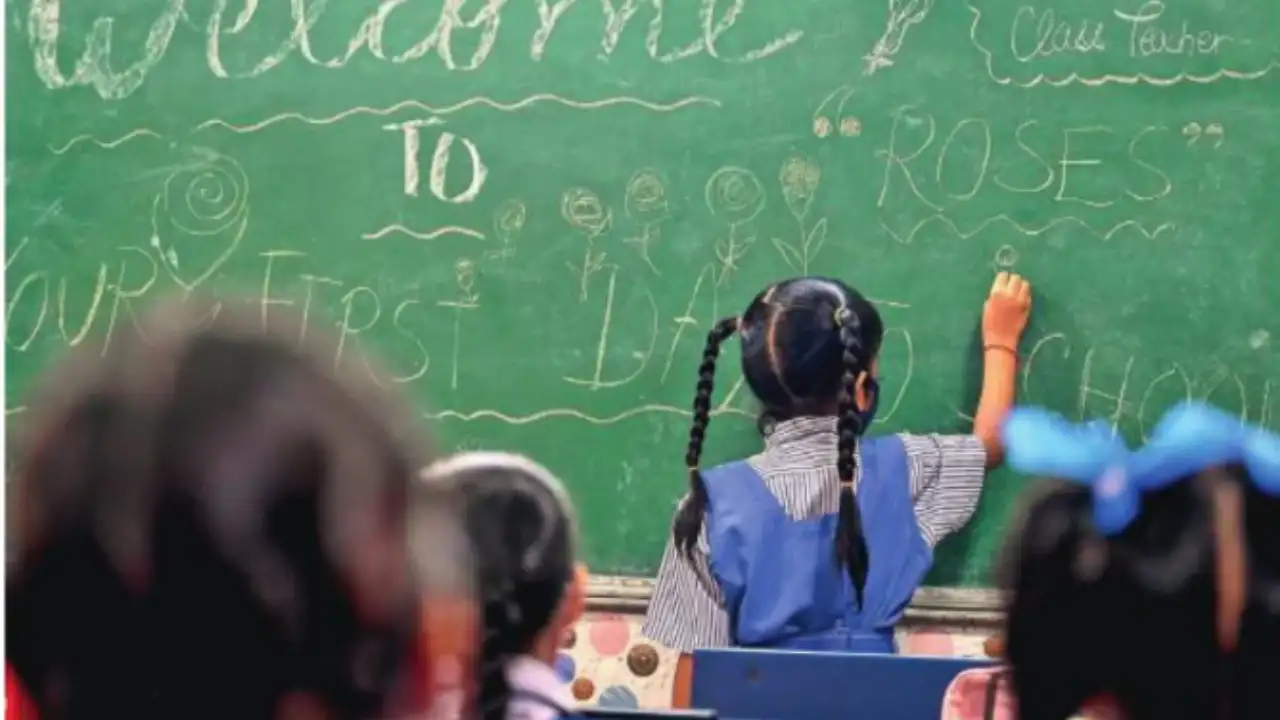
Recently, India has been witnessing debates on language. It has often turned into heated arguments and led to violence. People of different regional and linguistic backgrounds are disputing over making their dialect the cardinal language. India is a multilingual nation with 22 officially recognised languages under the Eighth Schedule of the Indian Constitution. In the country, each language signifies its identity, culture and history. Ironically, India’s diversity of languages frequently serves as a hindrance to education. Priyaranjan Kumar (2025) highlights how marginalised communities from rural areas and lower castes experience the disconnect between the language spoken at home and in the formal education system.
Colonial Influence: Origin of English as a Medium of Instruction
One can trace this linguistic no-win situation from the colonial period. The complicated history of colonisation is entwined with the English language’s dominance. The aim behind the colonial rulers’ introduction of English in Indian society was to communicate. Kaur and Prasad (2023) describe India as a diverse land with many languages and cultures, and English helped to unite the nation to some level. With the publication of Macaulay’s Minute on Indian Education in 1835, English education was first offered in India in the 19th century. In India, numerous English-language schools were established. Local learning methods and Indigenous languages were marginalised in the process of implementing this strategy, which was intended to establish an English-learned society. Its influence endures to this day since English has established itself as a vital communication tool and is used in many facets of Indian culture.
Post Colonial Period: Policies and Commissions on Linguistic Diversity
Following independence, India established a number of committees and programs to address the problems and difficulties faced by the country’s educational system. Among such challenges was the linguistic diversity in the education system. Kaur & Prasad (2023) reflect that India’s language policies have evolved, reflecting the country’s linguistic diversity, historical context and educational goals. In order to investigate the operation of the current public education system and to consider expanding it based on public demand, the Indian government established the Education Commission in 1882. This commission determined that primary schools would receive instruction in Indian languages, while secondary schools would receive instruction in English. In 1917, the Calcutta University Commission made the recommendation that English be used as a medium of instruction for students in higher secondary school. Following independence, the establishment of the University Education Commission, chaired by Dr. S. Radhakrishnan, was the first significant step the Indian government took in the sphere of education. This commission suggested that both secondary and university education should focus on learning the national language in Devanagari script as well as English and regional languages. On September 23, 1952, the Secondary Education Commission was founded by the Indian government, with Dr. Lakshmanaswamy Mudaliar serving as its chairman. This commission suggested a two-language formula rather than the three-language formula that the Radhakrishnan Commission had suggested. Additionally, it suggested that state-level services be provided in each state’s official language.
The Indian government created the Kothari Commission to restructure the country’s educational system. The commission underlined the value of maintaining and advancing Indian languages while acknowledging the country’s linguistic diversity. It advocated multilingualism and the incorporation of regional languages in the educational system, and it suggested a balanced approach to language learning The Commission suggested that states implement a three-language formula in relation to language in education. Its goal was to encourage the use of a Southern language in states that speak Hindi. In places where Hindi is not the primary language, it aimed to promote Hindi, English, and a regional language. It also suggested encouraging international languages, ideally English, as well as regional languages, including Sanskrit. This strategy sought to promote linguistic variety while guaranteeing fluency in Hindi, the country’s official language.
The significance of language instruction in India was emphasised by the Indian Education Commission (1882) and the Slader Commission (1917–19). They suggested that educational institutions provide an adequate basis in the mother tongue so that learners may also speak other languages with ease. National Curriculum Framework (2005) highlights the value of learning in one’s native tongue or regional language and promotes multilingual education.
Numerous other policies have emphasized language policies in the Indian educational system, including the three-language formula, which mandated that students learn Hindi, English, and a regional language, and the National Educational Policies of 1968 and 1986, which placed a strong emphasis on Hindi as a medium of instruction.
National Education Policy (2020)
India’s educational system is undergoing a radical change with the National Education Policy (NEP) 2020, which places a high priority on diversity, adaptability, and cultural rootedness. The multilingual approach is one of its most distinctive characteristics; it encourages the use of the mother tongue or regional language. Although the goal of the policy is to maintain linguistic diversity and enhance basic learning, there are a number of obstacles and drawbacks to its execution, especially in a multilingual and complex nation like India as shown by Gargi Gayan (2025) who examines the unresolved issue of mother tongue in a multi-ethnic context.
One of the main problems with the multilingual method is that there are insufficiently qualified teachers who communicate in different regional languages. The number of teachers in many states who are capable of teaching subjects in many languages is limited. Furthermore, there is a severe lack of standardised learning resources and textbooks in many Indian languages. The approach is very difficult to implement practically because of these logistical obstacles, especially in government schools and under-resourced locations.
The policy’s focus on teaching regional languages could inadvertently result in unequal educational prospects. Early regional language instruction may put students at a disadvantage in later life, particularly when it comes to competitive exams and higher education, which are primarily taught in Hindi or English. Given that metropolitan institutions are more likely to implement English-medium instruction from an early age, this could increase the educational and professional divide between pupils in urban and rural areas.
Although early mother language instruction may improve conceptual understanding, there is a gap between elementary and higher education. The majority of colleges and technical institutions still use English as their main language of instruction. Kaur & Prasad (2023) argue that language poses a significant barrier to effective learning in English medium classrooms, particularly for students who come from a non-English speaking background. Academic and career options may be limited for students who have not been exposed to English from an early age, since they may struggle to make a smooth transition to higher educational institutions.
Timely intervention
Nilesh Christopher highlights in his work from 2022 how language obstacles have a major effect on university student retention. The requirement that many students learn in languages that they are not fluent in adds to their academic load. Some find this difficulty to be too much to handle, which results in high dropout rates, even at esteemed universities. The issue is particularly severe for children from underprivileged backgrounds, who frequently do not have access to sufficient language resources and assistance. Dropout rates can therefore rise to 60% in these groups. Christopher’s findings highlight how urgently inclusive language policies are needed in Indian higher education.
As a result of globalisation, English is now the most widely used language for communication worldwide. The advantage of using English is that it helps us communicate with the world’s advanced nations without causing delays. The ability to communicate in English is essential for everyday communication if one wishes to relocate or travel abroad.
Measures should be adopted which enable learners to understand the concepts and lectures with ease. But simultaneously, English should be taught to them to have a connection with the world. This debate of language is never-ending in the linguistically diverse land, but the country needs to come to a mutual understanding where the rights of citizens from varied regional and language backgrounds are not left out.
References:
Christopher, N. (2022, November 10). Why Indian universities are ditching English-only education. Rest of World. https://restofworld.org/2022/indian-universities-are-ditching-english-only-education/
Gargi, G. (2025). Learning through a language: The unresolved question of mother tongue in a multi-ethnic society. Sociological Bulletin, 74(2).
Kaur, G., & Prasad, R. (2023). Language as a barrier in higher education for Hindi medium students in bilingual courses. FOERA, 1, 47–57.
Kumar, P. (2025). Language barriers in education: Challenges and opportunities for marginalised, rural, and lower caste students in India.
Sanikop, P. I., & Nayak, M. R. (2022). Language policy in education in India and National Education Policy 2020. International Journal of Applied Research, 8(6), 38–42.
***
Nalini Bhattar is a Research Scholar at the Advanced Centre for Women’s Studies, Aligarh Muslim University (AMU), Aligarh.