
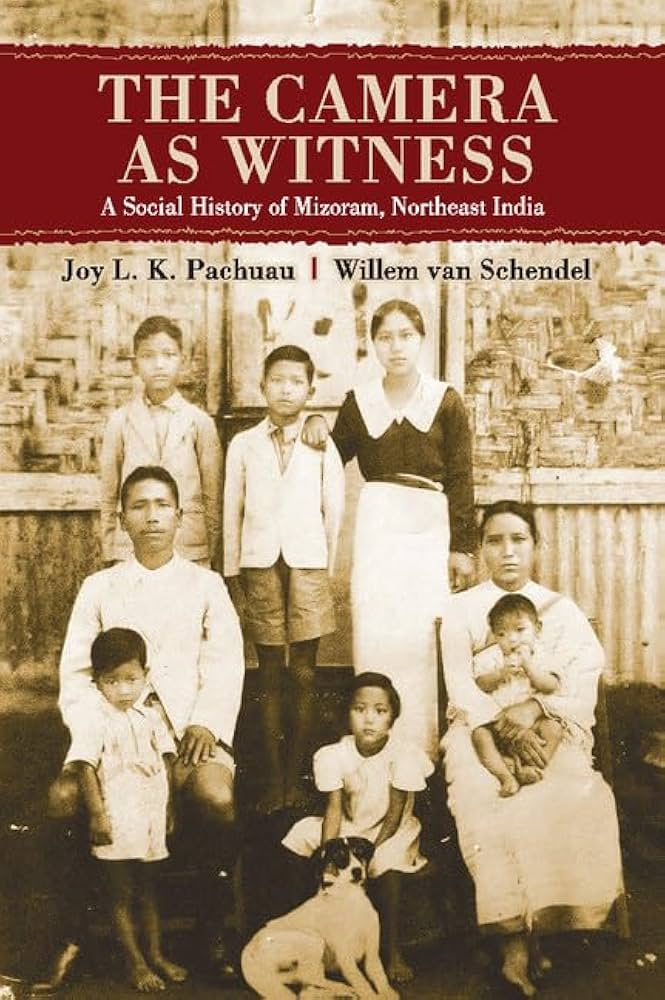
In The Camera as Witness: A Social History of Mizoram, North East India (published in 2015 by Cambridge University Press), Joy L.K Pachuau and Willem van Schendel offer a necessary intervention into regional historiography by placing visual archives at the centre of historical narration in Mizoram, a state long peripheral to Indian national imaginary. Challenging reductive external framings of Mizoram, the authors foreground ‘local agency in the creation of vibrant contemporary societies that have as little to do with obsolete ethnographies as they have to do with the security gaze’(4). By doing so, their analysis repositions Mizoram as an active site of self-representation, memory-making and modernity.
Structured across 24 chapters and four thematic sections, the book draws on a remarkable archive of 17,000 photographs spanning the 1860s to the 2010s, alongside sketches, journal entries, and oral testimonies. Yet it is the photographs—treated as material objects, historical evidence, and cultural texts—that form the methodological core, revealing evolving Mizo identities.
The first section, Becoming Mizo, (1-10 chapters), sets the socio-political context of Lushai Hills (the main regional focus of the book) from the mid-nineteenth to mid-twentieth centuries. The authors critically interrogate the role of early photography in constructing colonial knowledge. Particularly compelling is the re-reading of portraits, especially of colonial administrator T.H. Lewin, whose images are shown to depart from the exoticized framing typical of the period. Unlike the objectifying portrayal of other hill communities—such as the Nagas—these photographs convey a striking sense of personhood and reciprocity, offering what the authors call “acts of recognition” within a visual era typically defined by ethnographic distance.
What distinguishes the book is its refusal to treat the spread of Christianity and colonial education as linear narratives of civilizing progress. Instead, it emphasizes the selective and agentive ways Mizos navigated these incursions. The adaptation of Welsh choral music and the persistence of Indigenous practices like the gayal sacrifice exemplify how Christianity was not imposed but vernacularized within existing Mizo cosmological logic. Pachuau and Schendel also carefully show how the advent of education, closely tied to missionary activity, became a domain of Mizo self-making, generating desires for higher education and prompting Mizo students to travel to Shillong and even abroad. Photographs of these students—poised, formally dressed, and proudly assembled—visually assert education as a new axis of identity and mobility. In a similar tone, military involvement during the World Wars became a time of global exposure and cultural encounters. Throughout their illustrative descriptions of historical changes, the authors iteratively show how change and influence were vernacularized.
The second section, Mizoram in the New India, (11-16 chapters) situates the region in the wider political framing and imagining of postcolonial India. The collections illustrate the shifting relationships between the Mizo people, missionaries and the emerging Indian state. Photographs documenting the respectful departure of missionaries—who initially chose to remain in Mizoram—capture the affective ties that lingered until the growing reach of state bureaucracy eventually forced them out. Strikingly, the group portraits in these chapters reveal evolving hierarchies of authority: colonial officers give way to Assamese bureaucratic elites, while Mizo figures remain symbolically peripheral in the visual field. The authors are especially attentive to “state-induced tribalization,” and performative strategies that came to frame the Mizo population as a tribal constituency within the Indian nation. In this context, the revival of cultural forms—often taking place in church services and public festivals—emerges as a deliberate counter-gesture. These postcolonial public displays of indigeneity, as they demonstrate, were not nostalgic revivalisms, but strategic assertions of a distinct collective identity under conditions of modern statehood.
The third section, Visions of Independence, (Ch 17-20), touches upon the 1959 ‘bamboo famine’ and the Assam bureaucracies’ neglect and the subsequent rise of Mizo discontent that culminated in calls for an independent Mizoram. Archival photographs of the Young Lushai Association and the Mizo Union visually map the emergent political formations and assertions of the Mizo agency. The figure of the destruction of Aizawl (Fig 17.7, 305) is haunting, capturing the Indian government’s little-known (and only) air strike on its citizens. While more illustrative accounts and narratives of the Mizo uprising and everyday life during the 20 years of Buai or ‘The Troubles’ would have been welcome, the authors acknowledge that the much of the photographs of this time were completely damaged or lost when the Indian Armed Forces took over the state, bringing turmoil, chaos and forced resettlements. Yet, the start of ‘repressive portraiture’ – the Indian military imposed identification and surveillance of Mizoram’s people – vividly marks this era.
The final section, Mizo Modernities, (Ch 21-24) compellingly traces the ’emergence of a youth culture and a strong interest in being ‘modern’ in a distinctively local way’ (379) through music, fashion and photography. Music becomes a lens to explore how Mizo youth adapted global idioms to articulate regional sentiments around identity and aspiration. Fashion, similarly, becomes another thematic lens through which the author’s chart shifts in Mizo youth modernity; the images show how new aesthetic codes developed, inspired and underscored the hybridity of youth expression in the region. Rather than portraying youth modernity as derivative and apolitical, the chapters reflect Gaonkar’s (2001) notion of ‘alternative modernities’, in tracing how Mizo young people constructed complex cultural identities amid the 1960s Mizo nationalism, militarized governance and the circulation of global media.
Throughout, Pachuau and Schendel effortlessly anchor each image within its historical and cultural moment in Mizoram. From shifts in the village chiefs’ dress styles after colonial annexation to bustling 1850s weekly markets and meticulously captioned group portraits, the authors approach the visual element with remarkable care and methodological precision, bringing Mizo voices and presences to the forefront.
This emphasis has ensured the book’s enduring relevance. Nearly a decade since its publication, The Camera as Witness: Social History of Mizoram remains a seminal work in shaping contemporary visual methodologies in Northeast India. In a region where the writing of history has long been challenged by a lack of written word(s), scarcity of historical records, and colonial and environmental erasures, this book has opened new pathways for engaging with local pasts. We see this in the growing number of photography collectives and archival initiatives across the region that focus on community-based narratives. For example, Sikkim’s Confluence Collective and their visual ethnographic projects or North East Lightbox’s archival work on the Tezpur Mahila Samiti, exemplify how family/community photographs tucked away in personal collections are being mobilized to write histories otherwise excluded from dominant accounts.
Pachuau and Schendel have succeeded in showing that photographs, with contextual sensitivity and historical depth, can serve as rigorous sources for tracing cultural modernities. In this sense, the camera is not merely an observer but a participant – a witness – to everyday lives, transitions and negotiations of identity and modernity in the region. The strength of this book, thus, lies in its ability to cross-disciplinary, regional, and methodological boundaries. It will speak to scholars of South Asian history and visual studies, researchers from/on Northeast India and also to curators, archivists and cultural practitioners invested in ethical and community-based archival work. In bringing academic and visual literacy together, The Camera as Witness urges us to rethink how histories are told—and who gets to be seen and remembered.
References:
Gaonkar, D. P. (ed.). (2001). Alternative Modernities. Durham, NC: Duke University Press.
***
Anali A. Baruah is a PhD researcher at the Department of Cultural Studies, Tezpur University. She is also a photographer and digital photo restorer working on preserving old family albums of Assam.