
“..the use of popular culture by the Hindu right-wing has been barely studied, even less understood. This book hopes to lay the first brick in addressing this critical void.” (p. xvii)
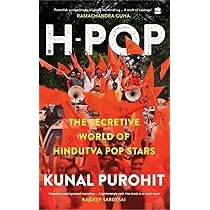
Published by HarperCollins in 2023, Kunal Purohit’s incisive book H-Pop: The Secretive World of Hindutva Pop Stars takes a timely and paramount dive into the right wing’s ecosystem of utilising popular cultural and artistic methods to translate Hindutva’s ideology into everyday sentiment in the masses. Despite the growing presence of Hindutva ideology in India’s cultural and political life, this terrain where art and ideology are fused together remains largely underexplored.
The book has primarily analysed three types of popular culture mediums—music, poetry, and book publishing—that have been deployed at the service of Hindu nationalism in north and central India. While rooted in the author’s journalistic examination and shaped by anecdotal and investigative detail, the book nonetheless reflects a sincere attempt to stitch together three years of field reportage with relevant research. Despite the non-academic nature, the book holds great potential to inform a sociological and interdisciplinary inquiry into the aesthetic and emotional mobilisation of Hindutva and similar right-wing populist movements turning processions and populace into bloodthirsty mobs.
To analyse the three forms of Hindutva pop culture, the book covers the lives of three protagonists—Kavi Singh, Kamal Agney, and Sandeep Deo—with each catering to each form of art. Part I revolves around the duo of Kavi Singh, a 25-year-old Haryanvi Hindutva pop singer, and her adoptive father, Ramkesh, who are both dedicated to furthering the Hindutva cause. Kavi Singh got her breakthrough in 2019 when her song on the Pulwama terror attack came out. Just as it was out, it went viral across social media and could be heard being hummed everywhere. However, what stands out is the content of the song vis-à-vis the lyrics. The song on the Pulwama attack wasn’t a form of art channelling grief but fostering demonisation of local Kashmiri Muslims and perhaps advocating violence against them. The resonance of such a song in the masses was crystalised by what followed. Soon, India witnessed a countrywide series of communal attacks against Kashmiri Muslims.
Purohit analyses a plethora of her songs that had acquired immediate virality almost most of the time. Interestingly, the lyrics and the content revolve around similar themes but different topics. These songs are crafted around Hindutva talking points: “love jihad,” population control, Article 370, the Ram Mandir dispute, and anti-Muslim narratives. Her songs, often devoid of subtlety and full of repetitive points, position Muslims as internalenemies, calling for retaliation, discipline, and Hindu pride. The effect of such songs is described by the author as “What makes Kavi potent are not these prejudices and beliefs, but her ability as an influencer to propagate them, reiterate them as facts, help normalize them, and radicalize her listeners.” (p. 42)
Part II centres on Kamal Agney, a 28-year-old poet whose career encapsulates how Hindutva uses performance poetry as a vehicle of propaganda, communal hatred, and political mobilisation. Kamal is portrayed as a leading figure in a genre of digital Hindutva poetry that blurs the lines between entertainment and ideological indoctrination. With the realisation of poetry as his penchant since his childhood, his poetry has progressively grown closer to the Hindutva movement and shares the same ideological ground. The thematic grounds and content of Kamal’s poetry remain similar to that of Kavi insofar as it is focused on reinventing the past, pitting historical figures against each other, propagating Islamophobia, and attacking the critics of the government. Creating grossly simplistic and historically inaccurate binaries of good-bad and Hindu-Muslim is a very intrinsic part of his poetry. Another characteristic is that the content is repetitive—told again and again until it is met with bigger applause from audiences across states at Kavi Sammelans.
Purohit states that “(Such poetry)….appeals to the innermost emotional fears and deeply submerged prejudices and stereotypes that they (audience) harbour” (p. 84). He does this by painting bright imagery of an imagined glorious past whilst simultaneously fear-mongering about a grim future. The author, through his fabulous journalistic fervour, is able to very vividly draw the realness of Kamal’s reach in the masses and how it is efficaciously utilised by Hindutva leaders to mobilise political support in the form of mobs.
Part III shifts focus from performance to publishing as a tool of Hindutva’s ideological expansion, centring on the figure of Sandeep Deo—a writer, entrepreneur, and activist committed to building a cultural ecosystem to propagate Hindu nationalism through books and media platforms. His politics belongs to the hard-line Hindutva thought, where he begins by disliking Modi for being soft on minorities and ‘appeasing’ them. Thus, he bids his support to Yogi, who he thinks to be an unapologetic Hindutva leader and doesn’t compromise with his ideals. However, soon disillusioned by the Bharatiya Janata Party (BJP), he opened his far-right political party dedicated to Hindutva. He has published books, opened up an e-commerce site, and runs a YouTube channel—all dedicated to spreading falsified history as facts, essentially normalising communal hatred and irrational conspiracy theories in the name of independent views.
The book, while going into great detail about the lives of these three people, also complements the reporting with research from pertinent historical and contemporary examples examining the material role of art when used by right-wing movements for mobilisation. The crux of the analysis presented remains that these are not artists operating in a vacuum nor merely propagandists; they are architects of a new emotional grammar of the nation. Here, Bertolt Brecht’s insight rings especially true: “Art is not a mirror held up to reality, but a hammer with which to shape it.”
However, the book can benefit from turning to thinkers like Theodor Adorno, Max Horkheimer and Wilhelm Reich to better understand how such repetitive, ritual-like cultural production engineers a politics of emotion—transforming art into an instrument of affective control, where pleasure becomes a medium of obedience and hatred a collective rhythm. Horkheimer and Adorno’s (1972) critique of the culture industry—particularly in Dialectic of Enlightenment—offers a useful framework for understanding how H-Pop does not merely entertain but instructs. By relying on standardised tropes, emotional saturation, and predictable moral binaries, the art described in the book pacifies thought and prepares its audience to internalise Hindutva’s ideological certainties. In this context, the listener is not a consumer of art but a subject being trained—one chant, one rhyme, one video at a time— something that he refers to as mass deception.
Wilhelm Reich (1946), in his book The Mass Psychology of Fascism, helps us grasp the emotional structures that underpin such receptivity by referring to the phenomenon as ‘emotional plague.’ He argued that fascism does not impose itself upon the masses but arises from their repressed desires and unconscious anxieties-manifesting itself as a mass movement. In H-Pop, this finds resonance in the way musical and poetic forms appeal to the innermost fear, humiliation, and longing into moralised aggression and fantasies of purity. What matters is not lyrical brilliance but emotional choreography.
Taken together, these frameworks reveal the book’s deeper resonance: H-Pop is not just an exposé of the cultural right but a study of how fascism lodges itself not only in the institutions of the state but in the sensory life of its subjects. Purohit’s work thus makes an urgent intervention—not simply by documenting these cultural forms but by showing how affect, aesthetics and ideology entwine. In doing so, it reminds us that art is not peripheral to politics—it is one of its most potent weapons.
References:
Horkheimer, M., & Adorno, T. W. (1972). Dialectic of enlightenment (J. Cumming, Trans.). Herder and Herder. (Original work published 1944)
Reich, W. (1946). The mass psychology of fascism (T. P. Wolfe, Trans.). Orgone Institute Press.
***
Vansh Yadav is a student of Sociology at Dr B R Ambedkar University Delhi. His areas of research interests include history, fascism, urban studies, and caste.