
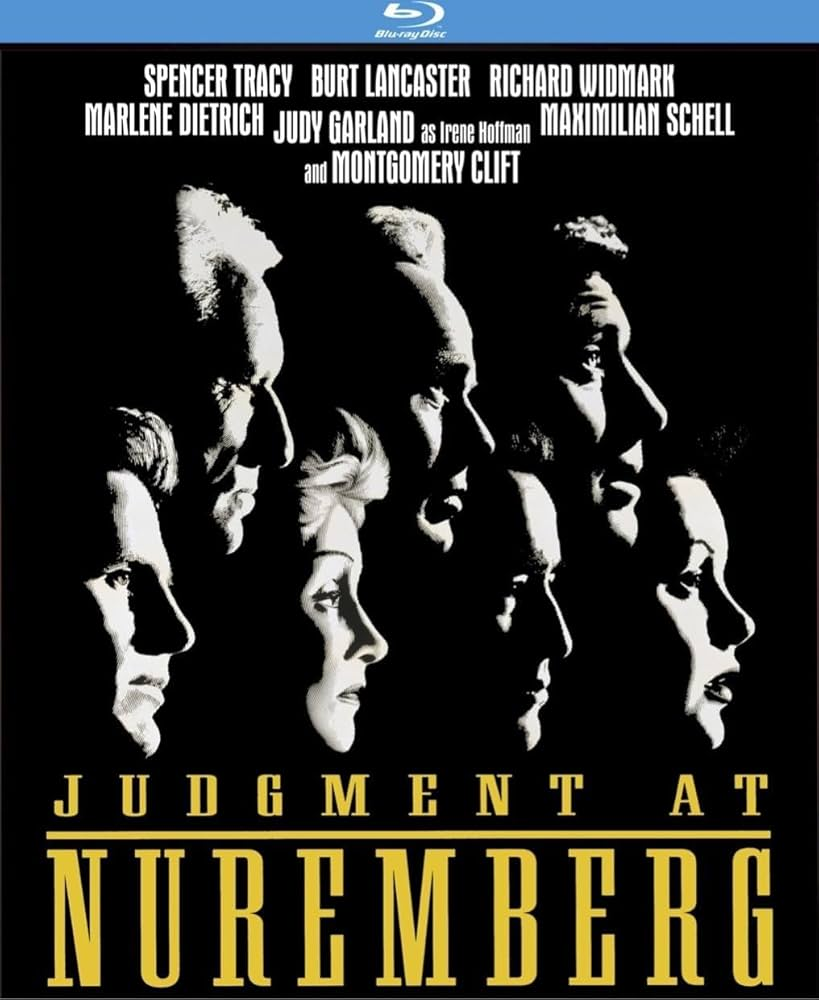
“Let it now be noted that here in our decision, this is what we stand for: justice, truth and the value of a single human being” (Kramer,1961)
Is there a difference between a judge and a historian? Perhaps the most intuitive answer that one can think of is ‘Yes, of course there is!’ In quite a literal sense the task of the judge involves a judgement which brings forth black and white binaries; good/bad, legal/illegal, right/wrong etc. The historian on the other hand is envisioned as a custodian of the past. The role of the historian is not constitutive of passing a verdict, rather it focuses on a reconstruction of the past. But if one thinks about it, the courtroom too becomes a site of history wherein both parties aim to reconstruct a contested event and it is the judge who presides over all this. In a film like Judgement at Nuremberg, the contested event itself is part of a larger historical period with socio-political consequences which makes the verdict a historical judgement, by itself. Keeping the film in mind this essay explores the intuitive difference between the judge and the historian and tries to break down this obvious binary, particularly in the context of understanding reality and reconstruction of the past.
Both the historian and the judge are at some level searching for this elusive objective truth, the reality of the past, of how things happened. Over time the discipline of history has acknowledged that there is no truth buried in the past that the historian has to just go and unearth and then they would’ve discovered the reality (Mink, 1987). Rather it is an exhaustive process of meaning-making. The judge too is presented with evidence and documents, all of which are by themselves not the end goal. Rather it is the dialogue that one has with these documents that helps one arrive at not ‘The Truth’ but a narrative (Ricœur, 2013). The film supplements this understanding when the defence lawyer Herr Rolfe quotes the jurist Oliver Holmes “This responsibility will not be found only in documents…It will be found in considerations of a political or social nature…most of all in the character of men” (Kramer, 1961). This then is one of the methods common to both the historian and the judge in their attempt to reconstruct the past.
The court scenes in the film elucidate another aspect of this method which is emplotment (White, 1978). Both the prosecution and the defence are working with the same documents, witnesses and other materials to essentially come up with a narrative which will make up a case for their client. Both the judge and the historian are aware that these narratives are not the reality of the past but of a reconfigured time. This comes out in a rather stark way in the case of the witness Rudolph Petersen who was forcibly sterilized. As the defence notes “the tribunal [did] not know how you were before,” acknowledging that there is a gap between past actuality and the narratives that are presented in the court (Kramer, 1961). A certain mimesis then takes place in three parts wherein there is the pre-configured time, the configured time of the narrative and then the reconfigured time which is where the role of the judge comes in (Ricœur, 2013). In their interpretation of the narratives presented before them, the judge undergoes the third stage of mimesis and this is where the verdict is delivered. If one contrasts this with the role of the historian then it is quite clear that the historian plays an active role in the second stage and the third stage is more up to the readers of their narratives.
This method that is being discussed, followed by both judges and historians, largely aims to embed events in contexts and view them in a total fashion rather than a narrow one. In Judge Haywood’s interactions with the common German people and the defence’s constant emphasis on the state of Germany before and during the Third Reich one can see this method coming to life. The argument here is to trace collectively shared ideas arising out of particular contexts rather than something individual and isolated (Febvre, 1982). As the final verdict of the tribunal beautifully elucidates, “If all the leaders of the Third Reich had been… monsters… then these events would have no more moral significance than…any other natural catastrophe” (Kramer, 1961). It is their contexts that lend the events their weight and value to be under the examination of either historian or judge, to begin with.
The difference that this essay began with, while being intuitive and common-sensical, is no longer strong enough to provide a clear separation between the role of the judge and the historian. Rather in discussing the method common to both, one can recognize that what they have in common is their approach in the reconstruction of the past. Where the judge then utilizes this reconfigured past to come up with a verdict which is another level of mimesis the historian’s interaction with the past is to the level of the reconfigured past only i.e. the second stage of mimesis. This is not to say that history is free of judgment or that verdicts have no historicity; they very much do, especially when one thinks about the precedence of verdicts and how they like historical narratives, allowing for a multiplicity of views.
References
Febvre, L. (1982). The problem of unbelief in the sixteenth century: The religion of Rabelais (B. Gottlieb, Trans.). Harvard University Press.
Kramer, S. (Director). (1961). Judgment at Nuremberg [Film]. United Artists.
Mink, L. O. (1987). Narrative form as a cognitive instrument. In B. Fay, E. O. Golob, & R. T. Vann (Eds.), Historical understanding (pp. 182–203). Cornell University Press.
Ricœur, P. (2013). Hermeneutics: Writings and lectures (D. Pellauer, Trans.). Polity Press.
White, H. (1978). The historical text as a literary artifact. In Tropics of discourse: Essays in cultural criticism (pp. 81–100). Johns Hopkins University Press.
***
Sulagna Moitra studies Sociology and Anthropology at Ashoka University. Their research interests include gender and queer studies, narratives and representation, and critical theory.