
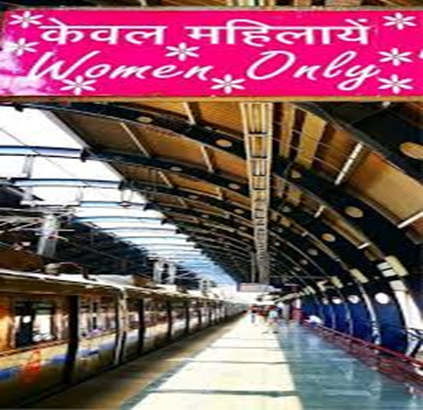
Public notices serve a purpose beyond merely delivering information; they play an active role in influencing how people perceive, engage with, and traverse public areas. Since 2010, the Delhi metro has allocated an entire coach in each train exclusively for women. Announcements on platforms, inside trains, and through public speaker systems state: “Reserved for Women. Men travelling in the women’s coach will face penalties” [Delhi Metro Rail Corporation,2010].
Moreover, in the general compartments, certain seats are designated as “Ladies Only,” providing women with reserved areas even in mixed-gender coaches. These designated seats are marked with a pink colour—an emblem typically linked to femininity. Likewise, the women-only coach largely features pink seats and signage, making gender segregation not just spatial but also highly conspicuous. The Delhi Metro Rail Corporation (DMRC) introduced these initiatives in light of growing concerns regarding women’s safety, presenting them as measures to create safer and more comfortable public transit for women.
The public sphere, as defined by Habermas, is a space in social life where people can gather as equals to engage in critical, logical discussion and form public opinion free from oppression [Habermas,1989]. According to him, everyone should have equal access to the public sphere so that everyone can take part. However, Habermas also acknowledged that the public sphere has historically been exclusive due to racial, class, and gender structures that have restricted genuine participation. The gendered compartment policy of the Delhi metro can be interpreted in this way: on the one hand, it aims to address the historical and current exclusions of women from accessible, safe public life; on the other hand, it recognizes that the general public is still inequality and characterized by gendered vulnerabilities. Instead of challenging Habermas, the “Ladies Only” notices highlight the ongoing, unresolved task of creating a public space that is truly inclusive.
However, this notion has been historically critiqued for ignoring the factors like class, gender, and race mediate access to this open space, and actually not been open to everyone, it shows conditional access. The Delhi metro’s women’s compartments reflect the tension between protection and segregation, highlighting structural exclusivity [Fraser, 1990].
The bright pink seats labelled “Ladies only” and the signage admonishing men not to enter the women’s section of the Delhi metro coach are the first things that catch the eye when one enters. Given its strong historical connotations of femininity, gentleness, and passivity, the colour pink is not a chosen one. It conveys, symbolically, who these areas are for and the social coding that surrounds them. Even seemingly insignificant symbolic communications are significant in Habermas terms because they influence the circumstances in which individuals interact with one another in public. Explicit rules are only one aspect of public life; other silent languages include colour, space, and body language. Public authorities are protecting women and upholding traditional gender roles at the same time by coding safety into pink. By marking out gendered zones, the Delhi metro simultaneously protects and disciplines women, reinforcing traditional gender expectations even as it claims to empower [Goffman, 1971]. It serves as a powerful but subtle reminder that cultural presumptions about gender subtly shape the potential for freedom and belonging, even in initiatives to broaden the public sphere.
By critically analysing my personal metro travel experiences, I see how ingrained these divisions have become. For many women, including myself, the women-only sections offer a much-needed sense of safety and a brief respite from the crowded, masculine cityscape. While Habermas’ theory helps frame this uneasiness, I can’t help but wonder why safety must be attained through separation and why the very ideal of free, public interaction should assume that half of the population is absent from the “common” spaces. If the public sphere is to be a place that everyone can access, then any structure that imposes segregation, even for safety reasons, indicates that the ideal is not fully realised. Because they both alleviate and crystallize existing inequality, the reserved compartments are both symptoms and solutions.
We do not have to act as though these conditions are already in place to share Habermas’ optimism regarding universality and rational-critical debate. Instead, his theory provides a critical diagnosis of why they don’t and makes suggestions for reforming public life. The gendered spaces in the Delhi metro thus indicate a need for gradual change: by establishing safe areas, government officials foster greater involvement from women who might otherwise shun public transportation entirely out of fear for their safety. This is seen by thinkers like Habermas as a practical step toward universal inclusivity rather than a betrayal. It is important to view protective measures, such as women-only sections, as temporary solutions that will eventually help build a more truly universal public life rather than as permanent elements of public space.
Furthermore, the metro notices show how material and spatial arrangements, in addition to free speech and deliberation, are issues in public life. The public sphere is created not only by newspapers and salons, as Habermas first proposed, but also by streets, parks, trains, and other physical locations where people come into contact. The very foundations of reasoned discussion and mutual recognition are weakened if particular bodies are made to feel insecure, unwanted, or invisible in these settings. The DMRC contributes to the larger democratization of urban life by enabling women to move around the city in a safer and more self-assured manner.
Despite the good intentions, these spatial tactics also highlight the boundaries of the public realm as a notion. Habermas’ model presumes that there are free and equal people having logical discussions, but what happens if participation is contingent on safety rather than free speech? Public areas like the subway are becoming more and more branded, optimized, and securitized in neoliberal cities; they are made for mobility and discipline rather than conversation. In this context, gendered bodies have to follow spatial scripts of caution and visibility. The public realm frequently turns into a place of regulated access, where vulnerability is controlled rather than treated, rather than encouraging equal participation. The policies of the Delhi metro show that embodied inequality, emotive experiences, and tangible realities need to be taken into consideration while rethinking the concept of the public realm.
In conclusion, the Delhi metro’s gendered spaces and notices are not deviations from the ideal of the public sphere; they are embodiments of its ongoing struggle toward realization. They show that access, safety, and equality are not automatic features of public life but achievements built through careful, often imperfect interventions. Far from dismissing Habermas as outdated, these reflections affirm the enduring relevance of his vision, a vision that demands we recognize public spaces as dynamic, contested arenas where freedom, inclusion, and mutual recognition must be fought for and continually renewed. In every reserved seat, every pink compartment, and every rule about who belongs where, we glimpse both the failures and the possibilities of public life. The making of the public sphere, it turns out, is everywhere, even on the morning train.
References:
Delhi Metro Rail Corporation. (2010). DMRC guidelines and policies.
Fraser, N. (1990). Rethinking the public sphere: A contribution to the critique of actually existing democracy. Social Text, 25/26, 56–80.
Goffman, E. (1971). Relations in public: Microstudies of the public order. Basic Books.
Habermas, J. (1989). The structural transformation of the public sphere: An enquiry into a category of bourgeois society. MIT Press. (Original work published 1962)
***
Prachi Shanker is a postgraduate student of Sociology at South Asian University (SAU), New Delhi.