
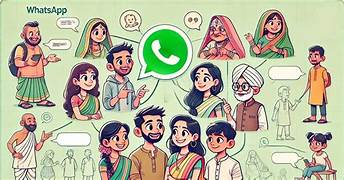
For many of us, the morning scroll is incomplete without that one picture of snow-capped mountains, a glowing sun, and the omnipresent “Good Morning” messages shared on the family WhatsApp group. Nestled between news alerts and Instagram stories lies this mundane, yet intimate digital space where everyday nationalism quietly blooms and resistance simmers beneath the surface. These groups have emerged as powerful infrastructures of digital kinship, especially after the COVID-19 pandemic, when physical proximity gave way to virtual presence. As Taipale (2019) suggests, family networks are increasingly becoming “digital families,” sustained less by shared geographies than by affective ties exchanged via platforms like WhatsApp. While these groups may appear as mundane zones of wedding photos, recipe forwards, and the occasional wife jokes, they are often saturated with undercurrents of patriarchy, nostalgia, and soft nationalism.
This form of nationalism is not always loud or spectacular. It doesn’t rely on the fervour of flag marches or grand political speeches. Instead, it is woven into everyday digital rituals: a tricolour embedded in a ‘Good Morning’ picture, a nostalgic meme lamenting the erosion of Indian values, or a forwarded clip glorifying ancient Indian achievements. These messages evoke a sense of belonging, often constructed through emotional cues, rather than explicit ideology. Drawing on Ahmed’s (2004) theory of affective economies, these forwarded messages are not just information transfers—they are emotionally charged acts. In forwarding a message about preserving Indian culture, a user may not just be sharing content, but expressing affection for elders, instilling pride in younger relatives, or affirming moral allegiance. Thus, soft nationalism in digital families is not simply consumed—it is felt, performed, and reproduced through emotionally charged acts of digital intimacy. Nationalist sentiments, in this context, become sticky: it clings not only to celebrated national symbols like the Taj Mahal or the national emblem, but also extends to more troubling forms of expression, including misogynistic jokes or exclusionary humour. These jokes, often framed as light-hearted or culturally specific, serve to police social boundaries and over time, these affective exchanges naturalise the conflation of culture, religion, and nationhood, making dominant ideologies appear commonsensical rather than contestable.
This quiet reinforcement of national identity aligns with Billig’s (1995) concept of banal nationalism: the reproduction of national belonging through everyday habits, language, and symbols. In this context, devotional greetings, patriotic emojis, and even the choice of language subtly reaffirm who belongs—and who doesn’t. Family WhatsApp groups become perfect vessels for this, as nationalist sentiments are embedded in seemingly apolitical content—festive greetings, devotional music, or calls to “respect Indian culture.” A forward claiming that India was the first to discover the speed of light, or that Western media is biased against Hinduism, gets passed along not as news, but as cultural reaffirmation. These messages perform dual work: they affirm a collective identity and subtly define who is not part of that collective, often minorities, secular liberals, or “westernised” youth. This isn’t to say that all WhatsApp activity is overtly ideological. Recipes, baby photos, and wedding invites coexist with political content in a kind of ‘digital thali’—everything served on the same plate. But it’s precisely this mix that makes the space so powerful: when nationalism is folded into the everyday, it feels natural, familial, even loving. As Mihelj & Jiménez‐Martínez (2020) argue, the digital environment has enabled banal nationalism to flourish, transforming ordinary users into everyday nationalists through symbolic participation.
Messages are rarely questioned because they come from trusted sources: elders, respected uncles or a beloved cousin. Yet, this digital space is not homogenous or uncontested. Resistance—while difficult—does exist in veiled forms. Younger members who are more likely to be familiar with the internet’s fact-checking tools, yet bound by respect for elders, transform this digital space to stir micro-resistance. Sometimes, silence itself becomes a strategy—an effort to refuse complicity without rupturing familial bonds. Drawing on Scott’s (1990) notion of “hidden transcripts,” resistance often manifests not through confrontation but through subtle acts: a cousin choosing not to forward a communal joke, an aunt fact-checking a historical claim, or a sibling responding with a dissenting meme. These may seem minor, but in this emotionally dense and hierarchically structured digital space, they can carry significant symbolic weight.
Ultimately, family WhatsApp groups remind us that nationalism is not only forged in parliaments or rallies, but also in the intimate spaces of kinship and memory. These groups become digital affective infrastructures where the love for family merges with the love for the nation, and where questioning the latter can feel like a betrayal of the former. To fully understand contemporary nationalism, we must turn our gaze toward these everyday domestic spaces. Amid the wedding pictures, nostalgic forwards and good morning messages, the nation is constantly being imagined, reinforced and sometimes, softly resisted.
References:
Ahmed, S. (2004). Affective economies. Social Text, 22(2), 117–139.
Billig, M. (1995). Banal nationalism. SAGE Publications.
Mihelj, S., & Jiménez‐Martínez, C. (2020). Digital nationalism: Understanding the role of digital media in the rise of ‘new’ nationalism. Nations and Nationalism, 27(2), 331–346.
Scott, J. C. (1990). Domination and the arts of resistance: Hidden transcripts. University Press.
Taipale, S. (2019b). Intergenerational connections in digital families. Springer.
***
Manav Sharma is a recent graduate from the University of British Columbia, where he studied Psychology and Family Studies. His research interests lie at the intersection of media, culture, identity and kinship in South Asian communities.