
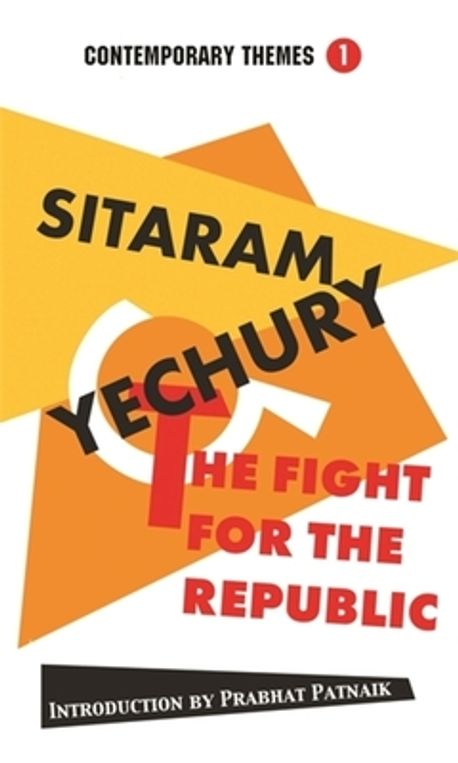
Having had the privilege of undertaking my undergraduate and postgraduate education in spaces that promised interdisciplinarity, I have experienced faculty members in these institutions wield the existing academic freedom effectively to expose us to texts beyond those that may be counted under disciplinary canons. Whether this was the inclusion – as core texts – of the Alisamma Women’s Collective Manifesto (2002) in a course on feminism or the film Seven Islands and a Metro (2006) directed by Madhushree Dutta in a course on culture and identity, these texts have only helped expand my imaginary on what sociology can be, what it can do, and how one may approach the social through routes other than the empirical. It was for this reason that I was excited to pick up Sitaram Yechury’s text, The Fight for the Republic, published by Tulika Books (2024). Extremely lucid while making sharp, informed observations, this text provides an important historical context to understand the situation that we as a country are in at the present moment.
The book, running for a pithy hundred-and-twenty pages, is a collection of essays that Yechury has written for publication elsewhere, with an introduction by Dr. Prabhat Patnaik, retired Professor of Economics, Jawaharlal Nehru University. Patnaik’s introduction serves to tie together Yechury’s essays that follow in two ways. First, by placing the central issue running through in the three essays – the consolidation, coming to power, and deadly impact of fascist forces in and on India – in a larger context of a global ascendancy of fascism backed by a nexus between neo-fascism, neoliberalism, and international finance capital. Second, by bringing to the fore the central theme running through in the essays (although only explicitly referenced in the final one) – the ongoing battle between unreason and reason, and how fascist forces thrive on unreason using the same to thwart reason, with Yechury calling for reason to be utilised as a means to fight against unreason. Additionally, Patnaik’s explication on the rise of ‘classical fascism’ as a response to economic depression in the Second World War (p. 18), the endless trap of incessant crises created by the neo-liberal order which neo-fascism is unable to find a solution for (p. 22), or his position, concurrent with Yechury’s, on the need for the tracing of alternative trajectories simultaneously on the social-political and the economic front (p. 27) helpfully gloss an undercurrent in the three essays that perhaps could not be engaged with in as much detail at the time of their writing.
As the beginning of the preceding paragraph indicated, the three essays that follow Patnaik’s introductory chapter were published elsewhere. The first one was originally a political pamphlet published in January 1993, written in the light of the destruction of the Babri Masjid the previous month, on December 6 1992. By posing contradictory statements issued by leaders (at times even the same leader) of the organisation culpable of this violent act, he attempts to show a feature that is characteristic of fascist organisations: “… that different leaders speak in different voices” (p. 50). The second article, published first in March 1993 in the magazine Frontline, is a close critical reading of M.S. Golwalkar’s (1939/1947) book We or Our Nationhood Defined, which according to a “sympathetic account” (p. 60) of the organisation he headed and which was responsible for the destruction of the Babri Masjid, is described as the organisation’s ‘Bible.’ Simply by bringing to light some incredible assertions made in this text, such as the primordial location of the ‘Arctic zone’ being adjacent to what is today Bihar and Orissa (p. 68), Yechury attempts to bring to light “the Goebbelsian technique of telling big-enough lies frequently to make them appear as the truth” (p. 66). The final and the most recent of the three essays was published in 2021 on the occasion of India’s seventy-fifth Independence Day. While the preceding essays highlighted the exclusionary “nationalism” of the fascist forces at large to critique their bigoted vision for the country, Yechury recalls another already existing vision – one that refuses to believe that “the character of independent India should be determined by the religious affiliations of its people” (p. 92). This ‘Idea of India’ forged during the many decades of the anti-colonial struggle, “represents the idea that India as a country moves towards transcending its immense diversities in favour of a substantially inclusive unity of its people” (p. 96). The text ends with Yechury calling for a vision that looks into the future as opposed to one which harks back to the glories of ideologically constructed pasts.
As a sociologist-in-training, I find it important to highlight one useful contribution of the text – Yechury’s treatment of neo-fascism. Writings on fascism in the contemporary period tend to focus on leaders of such movements, often characterising them as demagogues. However, the visibility that these figures gain carries with it the possibility of overshadowing the larger organisational workings which allow for their rise to ascendancy. Fascism, as helpfully presented in this next section, is not the doing of one charismatic leader or another, but is a collective effort. This text traces a situation of neo-fascism in India through the workings of organisations characterised by Yechury as neo-fascist. Specifically, the focus on how organisation/s have emulated the opinions of an individual, a former leader, is sociologically efficacious.
***
Sashwat S R is a PhD Scholar at the Department of Humanities and Social Sciences, Indian Institute of Technology (IIT) Madras. He is interested in the intersections of state, law, and intimacies in contemporary India.