
The modern state is often imagined through a fixed set of markers—territorial borders, citizenship regimes, models of democracy, and relations with neighbouring nations—all of which reinforce the idea of a population uniformly defined by nationality. But can identity truly be reduced to such singular, homogeneous constructs? Methodological nationalism operates on precisely this assumption, treating the nation-state and modern society as inseparable, even synonymous (Chernilo 2011). Yet this framework, while dominant, is only one of many lenses through which to analyse the tensions between state sovereignty and the fluid realities of belonging.
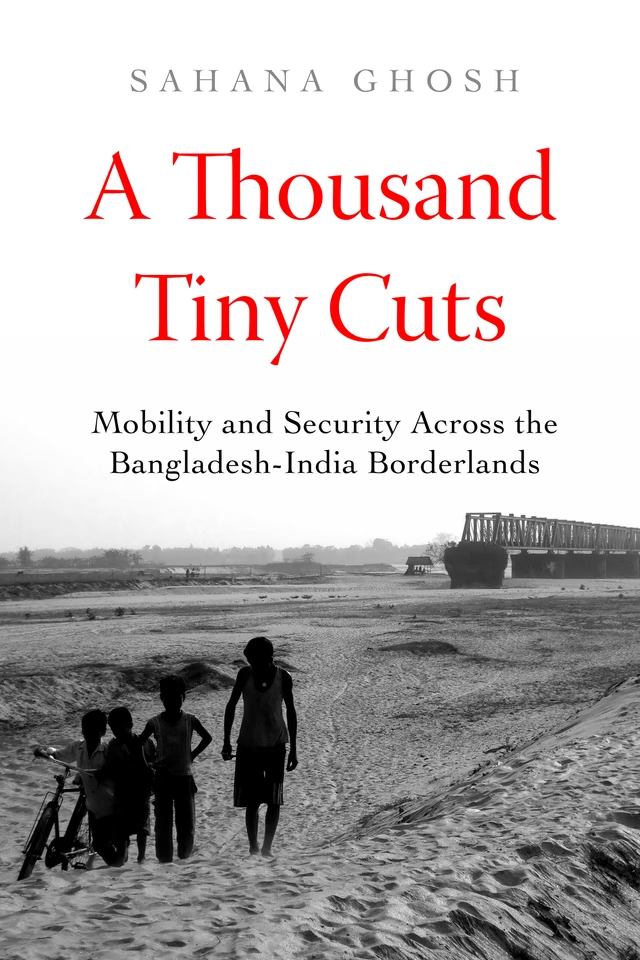
In her deeply insightful and rigorously researched ethnographic work, A Thousand Tiny Cuts: Mobility and Security Across the Bangladesh-India Border (published by University of California Press) in 2023, Sahana Ghosh employs a transnational feminist approach to transcend the limitations of methodological nationalism. Drawing on almost a decade of immersive fieldwork, Ghosh utilises mobile ethnography, traversing the borders between India and Bangladesh and conducting fieldwork in multiple villages on both sides of the imposed boundary in Northern Bengal. The borderline, as we commonly understand it, is a territorial demarcation between two nation-states, thus territorialising bodies, movement, experiences, relations, memories, and histories. Ghosh, through her methodology and findings, aims to challenge such notions. She demonstrates that the border is not merely a metaphoric line but also stands weak when seen through the everyday lives of the borderland people who move across this imagined line multiple times for multiple reasons, leading to symbolic “thousand cuts” on the borderline. Thus, the structural capacity and strength of borderlines can be held together only as long as we adhere to methodological nationalism; when transnationalism is used as a methodological tool, the deep cuts and fractures of the borderlines begin to become apparent. Therefore, through her work, Ghosh inverts the lens of gaze, arguing that it’s not only a “study of borderland” but also a “study from borderland” (p. 18).
Ghosh immediately plunges the reader into the nuanced complexities of borderland life, opening with the seemingly routine description of a marriage between a “Rajbangsi man” and a “Bangladeshi bride.” This seemingly ordinary event is subtly punctuated by the “normal” interruption of the Border Security Force (BSF), immediately establishing the pervasive presence of militarisation that shapes daily existence. Though their lives differ from those living deeper within national territories, they are nonetheless guided by similar societal norms. The pervasive forces of heteropatriarchy and a “nativist national vision” hover over their lives, shaping how they stigmatise those who deviate from set standards, including the interplay of Hindu-Muslim divides and the lived experiences of caste-based privileges and discriminations.
The book accounts for three interwoven ethnographic enterprises. Firstly, it illuminates the endemic nature of violence in the borderland, extending beyond explicit instances to the routinization of “violence-by-other-names,” in often paradoxically considered “friendly bordering” between India and Bangladesh. Secondly, Ghosh delves into the political economy of bordering, where clandestine trade relies on the relational value of the bordering nations. Her critical examination of the modern economy being tied to a national moral economy is evident in her investigation of tobacco and ganja production—one legal and open, the other illicit but equally traded across borders. Finally, the book explores the mobility of people and goods, and the attached sense of desire, pleasure, hope, and fear that accompanies these movements- how mobility across borders becomes gendered and how valorising manhood hovers over the men in the villages.
Ghosh masterfully illustrates how the “injustices of bordering are braided with the possibilities and gains of transnational living” (p. 5). For borderland residents, the border is a dual entity: both a risk and a resource. Ghosh’s ethnography of bordering is effectively an anthropology of value-making, revealing relational hierarchies of values. She vividly captures the visuality, textures, and untranslatable distinctiveness of these lives through her own photographs of borderlines, locals, and distressed agricultural fields. The author also critically locates her own position as a Hindu, upper-caste Bengali Indian woman, highlighting the implications for her investigative approach and access during fieldwork.
Beautifully juxtaposing the remoteness and alienization often associated with borders, the work highlights the vibrant transnational connections forged through material consumption, cross-border marriage ties, and intergenerational kin relations – connections that create “kinship geographies” that extend far beyond the current political maps of modern states, fundamentally challenging the very idea of a fixed morality in crossing the border.
In the second chapter, she uses various verbs that define the border landscape, thus making her writing not only enriched with ethnographic accounts but also a pleasure to read. “Waiting” symbolises both power assertion (who gets to wait, who has the power to make others wait) and the solidarity and resilience of people in their waiting. “Walking” questions the simplistic binary of violence and resistance. “Detouring” and “loitering” emerge as necessary actions for carrying out du-nombori material trade across borders. Finally, “stopping” through numerous checks and clearances profoundly impacts people’s mobility.
Acknowledging the pervasive impact of border policies, the analysis reveals how the logic of increased and homogenised security and militarisation across the Indian border, in its push for statist control, ultimately invisibilizes the “multiple temporalities” that lie beneath the “normative temporality” (p. 203). It belittles their existence to mere identification as borderland residents who fluidly shift between being citizens, refugees, foreigners, and even criminals.
For instance, the masculine pressures felt by young men in these villages, expected to embody mature, heterosexual, and productive roles despite limited employment opportunities and the stigma attached to their identity, further constrain their marriage prospects within national boundaries. The perpetuation and embodiment of national discourse of heteropatriarchal norms, the gendered regulation of mobility, the valorization of “matured manhood,” and the moral stigma attached to illegal trade all reveal how differentiated mobility is not only deeply gendered but also aligned with logics of national security, citizenship, and belonging (p. 22). Yet, a crucial tension arises in the last chapter when Ghosh delineates the distinctions between dwelling and domicile, resettlement and displacement, and refugee and citizen categories that expose the fractures in the state’s rigid classifications.
“A Thousand Tiny Cuts” stands as a rich and invaluable ethnographic work. Ghosh carefully treats the multiplicity of lived experiences in their respected uniqueness, avoiding the homogenizing label of border landers. Yet, she skilfully weaves together these diverse narratives, demonstrating how despite their differences, an overarching identity as residents of the borderlands profoundly influences their everyday lives. Ghosh’s work is essential reading for anyone seeking to understand the intricate human dimensions of international borders and the “thousand tiny cuts” that shape lives within them.
References:
Chernilo, D. (2011). The critique of methodological nationalism: Theory and history. Thesis Eleven, 106(1), 98–117.
Ghosh, S. (2023). A thousand tiny cuts: Mobility and security across the Bangladesh-India border. University of California Press.
***
Afsheen Rizvi is a Research Scholar in the Department of Sociology, Jamia Millia Islamia (JMI), New Delhi.