
Introduction
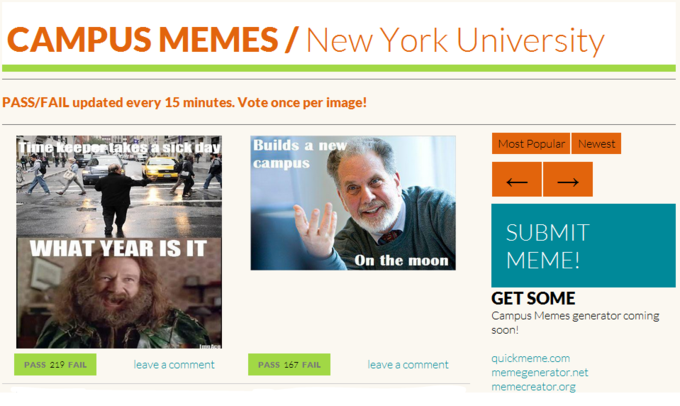
The term meme was introduced by Richard Dawkins in his pathbreaking 1976 book The Selfish Gene. He defined memes as “small cultural units of transmission, analogous to genes”, which spread from person to person via copying or imitation (Dawkins 1976). In contemporary times, however, the term is most often used to refer to images created and shared over the internet, spanning themes from everyday life to catastrophic events and everything in between. They serve as a means of expression – humour and dissent can succinctly be expressed through them. They serve as a site for people to bond over commonalities they share – be it a similar sense of humour or just sharing a laugh with a friend or even a random stranger. It is not much of a logical jump from this, then, that in spaces such as universities, memes are potential community builders, especially when they are about their university itself. Memes are increasingly becoming an appropriate resource for the creation of collective identities. As Gat et al. (2015) note, “Internet memes may be particularly relevant to such boundary work, as they are often public. Thus, choosing to post a particular meme version in a particular digital arena co-constructs individuals and collectives”. Furthermore, memes have descriptive and explanatory power with respect to cultural production (Lankshear and Knobel, 2007). Ryan Milner’s The World Made Meme (2018) is an investigation of the social functions of memes – he frames them as a key form of what he calls vernacular creativity. He calls attention to the tensions between humour and identity, arguing that memes are dual sites of empowerment and marginalisation. With the emergence of new participatory social media platforms and the resulting ease of access to public discourse, memes are quickly becoming drivers of collective identity formation.
What Scholars Say About Memes
Much of the existing literature on memes and digital ethnography focuses on understanding how the internet turned the spread of memes into a highly visible practice (Shifman 2013) or how the innate human tendency of humans to imitate makes memes spread themselves around indiscriminately (Blackmore 2000). Ntouvlis and Geenen (2023) look at memes as multimodal texts that facilitate identity exploration, particularly among younger people. Their core argument is that “ironic” memes are not simply humorous or nihilistic diversions but function as affective, reflective, and pedagogical tools for younger users navigating digital spaces. Their analysis connects meme literacy and postmodern notions of the self and performativity. However, there is not much literature that seeks to operationalise how memes operate in physically constrained social spaces, such as in universities, hospitals, or office spaces. The point underscored here is that in physically constrained social spaces, humour becomes a common ground for people to bond and self-express, and in today’s digital culture, that is achieved precisely through the creation and circulation of memes on social media platforms over the internet. An analysis of the texts used in reference for this study quickly reveals a trend: the conceptualisation of memes has shifted from a deterministic, gene-analogous model seen in Dawkins and Blackmore to a more culturally and socially situated participatory framework seen in Shifman and Milner. This brings me to discuss a few major ways in which memes are discussed in an academic environment.
What Students Said About Memes
A Google form was created for this article. In their responses to the Google form and interviews alike, students at the University of Hyderabad who frequently shared memes about the university with each other reported feeling closer to each other in their interpersonal relationships, implying the creation of a shared sense of community. In a transcribed interview, a first-year student from the university talked about his experience sharing university memes, saying, “I sent memes to a lot of my fellow students, particularly my batchmates, and we kept referring to them in further conversations. I would say that memes about the university helped me identify not only with my fellow students but also with the university itself”. When questioned about the Kancha Gachibowli land case in the context of memes, the student reported that he had shared memes made in connection with the case to at least five friends – they became the basis for further conversation upon the topic. The student felt that the sharing of memes and the underlying humour helped him strengthen bonds with friends and build a sense of community, especially when these memes were shared in groups comprising multiple students. While other interviewees were not quite as enthusiastic in their answers, a sense of agreement with this student’s views was palpable, although not quite as vehement as his. A common finding was that students often engaged with memes as a means of expressing their dissatisfaction. Memes provide a format – a shareable structure which acts as a means of dissent expression as they can be circulated quickly and are more engaging than long messages, pamphlets or flyers.
Thus, in conclusion, memes help students form relationships and feelings of community – in this case, memes are noted to perform social functions. Additionally, they serve as an effective means of expressing dissent, particularly within a university setting.
Notes:
- The Google form used for this study is linked here: https://forms.gle/teubth7ceLm9LhEP9.
- A copy of all responses received through the Google form is made available here: https://docs.google.com/spreadsheets/d/1GS0QIDDgbKQ9GPoWB9YMPasPxYoKTGHB81tO6JV-SFc/edit?usp=sharing.
Works Cited:
Blackmore, S. (2000). Chapter 1: Strange creatures. In The meme machine (pp. 1.1–1.7). Oxford University Press.
Dawkins, R. (1976). The selfish gene (30th anniversary ed.). Oxford University Press.
Gal, N., Shifman, L., & Kampf, Z. (2016). “It gets better”: Internet memes and the construction of collective identity. New Media & Society, 18(8), 1698–1714.
Knobel, M., & Lankshear, C. (2007). Online memes, affinities, and cultural production. In M. Knobel & C. Lankshear (Eds.), A new literacies sampler (pp. 199–227). Peter Lang.
Milner, R. M. (2018). The world made meme: Public conversations and participatory media. MIT Press.
Ntouvlis, V., & Geenen, J. (2023). “Ironic memes” and digital literacies: Exploring identity through multimodal texts. New Media & Society, 27(2), 1193–1211.
Shifman, L. (2013). Memes in a digital world: Reconciling with a conceptual troublemaker. Journal of Computer-Mediated Communication, 18(3), 362–377.
***
Abhijay Rambabu is currently pursuing his Master’s degree in the Department of Sociology, School of Social Sciences, University of Hyderabad.
Unique approach to things and super interesting to read through , good job!