
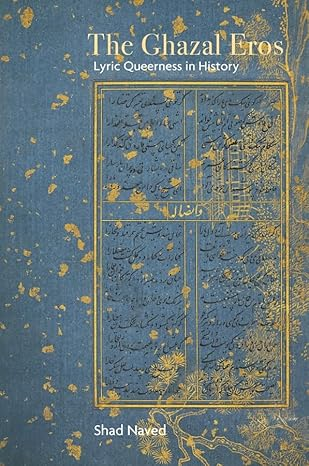
Shad Naved’s The Ghazal Eros: Lyric Queerness in History (published by Tulika Books in 2025) is a groundbreaking and genre-defining work that reshapes our understanding of the Urdu–Persian ghazal. It goes beyond just being a poetic form; it serves as a rich archive of lyric queerness. The author skillfully reclaims this concept from the confines of identity-focused queer politics, bringing it back to its historical, stylistic, and emotional origins. This isn’t just about taking something back; it’s a bold challenge to how queerness is told, remembered, and theorised – especially within the context of global Anglophone discussions.
Naved’s central argument is that for more than six centuries, the ghazal has been influenced by homoerotic male desire, even though dictionaries and mainstream literary histories have insisted it’s poetry “about women.” This disconnect, rather than being a mere oversight, becomes for Naved a realm of potential: a “lyric queerness” that defies simple definitions of identity or biology. He pushes back against the typical academic tendency to pinpoint queerness based on the sexual orientation of particular poets or characters. Instead, he zeroes in on the ghazal’s form itself – its conventions, voice, and emotional texture – as the genuine space for queer expression. The book kicks off with a thought-provoking Preface that intertwines philology, critical theory, and personal urgency. In this section, Naved acknowledges his intellectual influences from iconic poets like Abu Nuwas and Agha Shahid Ali while also critiquing the modern depoliticisation of the ghazal. He presents a compelling argument about how queer studies in the global North—often focused on ambiguity and destabilisation—tends to strip queerness of its historical context, disconnecting it from the very languages and cultures that have nurtured it for centuries. Part One, titled Orientation, lays out the theoretical groundwork. Naved introduces the concept that queerness in the ghazal isn’t just a theme but a structure of feeling—a way of composing and expressing emotions that challenges contemporary notions of fixed sexual orientation. Through his insightful analysis of 19th-century anthologies of women poets (especially Bahārīstān-i-Nāz and Gulshan-e-Nāz), he illustrates how the sudden literary “discovery” of women ghazal poets was less about inclusivity and more about reshaping a traditionally homoerotic genre to fit heteronormative standards. The rise of female lyric voices in Urdu was often filtered through gendered performances and male-edited anthologies, a dynamic that Ruth Vanita’s groundbreaking work on rekhti poetry highlights, and one that Naved thoughtfully revisits in his examination of 19th-century tazkirahs (Vanita, 2012).
Through careful textual analysis, he illustrates how anthologists like Fasihuddin ‘Ranj’ aimed to swap out the essence of lyric queerness for a façade of heterosexual realism. Moving into Part Two: Historicization, Naved dives into literary archaeology. Chapter Two focuses on Mir Taqi Mir’s ghazals, suggesting that their intricate dance between idealisation and de-idealisation reflects the diminishing significance of lyric queerness during a time teetering on the edge of colonial modernity. The following chapters explore how early Urdu poets such as Vali, Abru, and Hatim harnessed the vernacular to bring queerness into the public eye, effectively challenging the elite and classical boundaries of Persian poetics. Aamir Mufti’s (2007) examination of how nationalist and epistemological influences, especially in Urdu literary historiography, reshaped vernacular canons during colonial modernity aligns well with Naved’s endeavour (Mufti, 2007).
Chapter Four takes a bold stance against the common mystical interpretation of the ghazal’s eroticism, suggesting that mysticism has often been a cover for queerness in both colonial and postcolonial literary discussions. One of the most compelling aspects of The Ghazal Eros is how it refuses to idealise the past. Naved doesn’t yearn for a “lost queer world,” nor does he fall into the trap of oversimplifying history. Instead, he views queerness as a fluid and evolving concept—one that thrived within the ghazal because of its inherent ambiguity and resistance to straightforward meaning. As Joseph Massad points out in Desiring Arabs, the worldwide spread of Anglo-American queer language can sometimes create new forms of epistemic violence—an idea that Naved resonates with as he critiques the transliteration (rather than true translation) of queerness into South Asian cultural contexts (Massad, 2007). The author also critiques modern efforts—some even within South Asian LGBTQ activism—to apply global English categories to local traditions. He warns against a one-size-fits-all approach to sexual politics that overlooks the unique historical and regional contexts. The writing is sophisticated and rich with references, sometimes making it a bit challenging for casual readers. Yet, this complexity aligns perfectly with the book’s dedication to a multilingual, comparative literary history that respects Urdu, Persian, and Arabic traditions on their terms. The footnotes and choices in transliteration are carefully crafted, showcasing scholarly depth while still maintaining a smooth narrative flow. However, one aspect that could have used a bit more exploration is the role of the listener or reader in shaping the queerness of the ghazal. While the author does an excellent job of placing the voice and style of the ghazal in its historical context, the way audiences have interpreted, eroticized, or pushed back against these lyrical conventions doesn’t get as much attention. This isn’t a flaw per se, but rather an opportunity for future research. In conclusion, The Ghazal Eros is a groundbreaking work that paves the way in queer literary history, postcolonial theory, and vernacular philology. It’s bound to resonate with scholars interested in South Asian literature, sexuality studies, and comparative poetics. At a time when discussions about decolonising the literary canon often feel superficial, Naved provides a meaningful approach to rethinking literary form, historical desire, and the politics of interpretation. The book encourages us to view the ghazal in a new light—not as a relic of the past, but as a vibrant archive of love, loss, and lyrical rebellion.
References:
Massad, J. A. (2007). Desiring Arabs. Chicago: University of Chicago Press.
Mufti, A. R. (2007). Enlightenment in the Colony. USA: Princeton University Press.
Vanita, R. (2012). Gender, Sex and the City: Urdu Rekhti Poetry, 1780-1870. Delhi: Orient BlackSwan.
***
Yash Singh Sisodiya is a social researcher.