

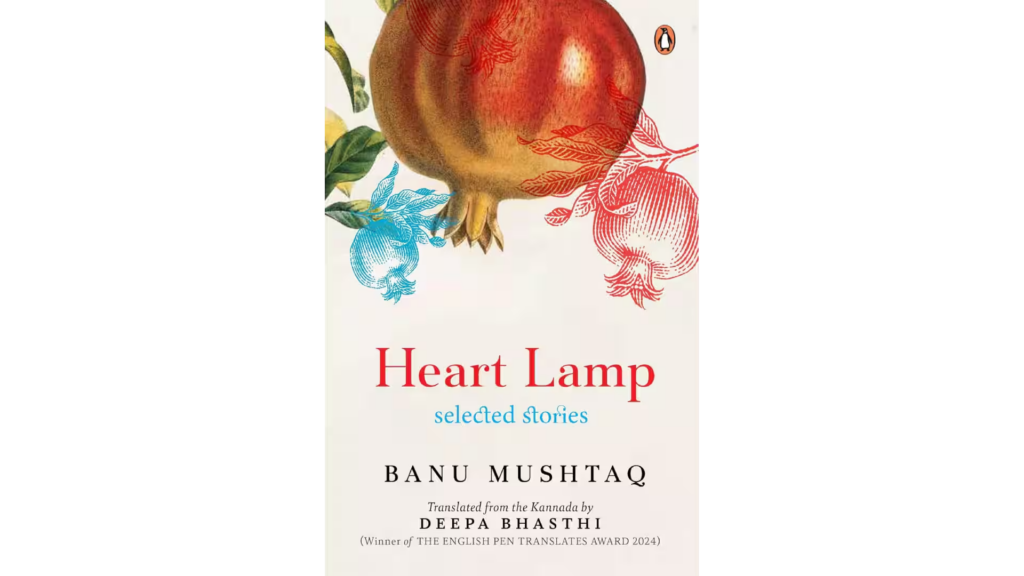
In an era where gender inequality remains deeply entrenched, Banu Mushtaq’s 2025 Booker Prize-winning novel Heart Lamp: Selected Stories (published by Penguin in 2025) emerges as a powerful literary intervention. It brings the lives and voices of marginalised women from the periphery to the centre of contemporary discourses of the humanities and social sciences across academia.
What makes this novel irresistibly interesting is its refusal to make reductive portrayals of women either as victims or romanticised ideals. Instead, it sets the reader’s heart ablaze, kindling a slow-burning flame of empathy and love for a shared humanity. Her characters navigate the intersecting oppressions of patriarchy, religion and society not with heroic defiance alone, but also with hesitation, contradiction, and vulnerability.
Heart Lamp is not merely about empathy, but it’s quiet insistence on complexity over clarity. Mushtaq does not offer idealised resilience; instead, she allows for failure, fatigue, and moral ambiguity. Yet, while the novel powerfully challenges social structures that oppress, it also risks aestheticising suffering, at times leaning on trauma as narrative propulsion. Still, Heart Lamp is an urgent contribution to Indian feminist literature, one that pushes readers to confront uncomfortable truths and rethink what dignity and resistance might mean when survival itself is a daily negotiation.
From the very first story, “Stone Slabs for Shaista Mahal,” Mushtaq sets the tone for what this book is about: not heroic resistance, but the ordinary cruelty of men and the quiet insistence of women to remain human despite it. Zeenat, the narrator, observes Shaista, a mother of six, about to deliver her seventh child, and the intricate emotional choreography of marriage, motherhood, and male entitlement. The story begins as domestic realism, becomes an elegy for a dead woman, and ends as a blistering critique of love mythologies that men cling to even as they replace their wives before the flowers on their graves wilt. It is a story about memory, mourning, and betrayal and about how women continue to mother even when the world refuses to remember them.
Banu Mushtaq does not offer us spectacle. There are no climactic breakdowns or revolutionary endings. What she offers instead is honest renderings of women’s lives caught in a web of duties to their husbands, children, in-laws, communities and their struggles to assert even a sliver of agency. The feminist sensibility in these stories is not marked by slogans or manifestos but by perception, a way of seeing the world from within the structures that oppress you, and still finding room to breathe.
In “Be a Woman Once, Oh Lord!,” the title itself is a provocation. The protagonist’s prayer is not to become a man, but to make God experience what it is to be a woman. The sarcasm cuts deep: what might divinity mean if it had to menstruate, bear children, face harassment, and be told to keep quiet while doing all of it? This is theology turned inside out. It asks not only what it means to be a woman in a patriarchal world, but what it means to live as one.
Mushtaq’s stories are also striking for how they deal with religion. As a Muslim woman writer in Kannada, she does not reduce Islam to either piety or politics. She renders it as lived — fractured, complex, contradictory. In “Fire Rain,” a mutawalli (mosque caretaker) embarks on a public campaign to re-bury a dead Muslim man whose body was mistakenly interred in a Hindu cemetery. The whole episode, full of masculine rhetoric and performative religiosity, is eventually exposed as hollow, especially when we learn that his son is dying, unattended. The story is devastating. It is about hypocrisy, the hollowness of patriarchal authority, and how religion becomes another terrain where women and the poor are denied justice.
Many of Mushtaq’s women are caught between obedience and quiet rebellion. They serve tea, manage children, wash clothes, attend to husbands, and still manage to nurture a spark of refusal. They are not saints. They gossip, snap, plot, and sometimes surrender. But what emerges through these portraits is a layered sociology of Muslim women’s lives, told from the inside. There is no exoticism here. No veiled mystery, no trapped silence waiting to be rescued. These women are already speaking, but you have to listen.
Stylistically, Mushtaq’s writing is plain but alive. She knows how to use sarcasm like a blade, sharp but not loud. Her narrators often speak with a matter-of-factness that makes the pain hit harder. The translation by Deepa Bhasthi carries this tonality well. The dialogues, full of everyday speech, retain their rhythm; the metaphors, often drawn from food, flowers, clothes, or weather, are deeply cultural without ever being explained away for the outsider.
What makes this collection stand apart is its attention to the emotional economy of women — how they manage, absorb, and sometimes return the emotional labour demanded of them. Whether it is a daughter negotiating dowry tensions, a sister confronting unequal inheritance, or a young girl resisting forced marriage, Mushtaq does not romanticise these acts. She portrays them bare for what they are: survival strategies in a world tilted heavily against them.
Sociologically, the stories expose the architecture of oppression that defines many working- and lower-middle-class Muslim homes: the burden of respectability, the control over female sexuality, the double bind of religious duty and gender expectation. Yet Mushtaq never flattens these spaces. Love exists here, too. So do joy, friendship, memory, cooking, music, and the small pleasures that make life bearable.
The most remarkable thing about Heart Lamp it trusts its women. Even when they make mistakes, they are not condemned. Even when they break, they are not shamed. This is rare in Indian literature, where Muslim women are too often reduced to symbols of backwardness, repression, or resistance. Banu Mushtaq does something far more radical: she writes them as people.
In an India increasingly hostile to both Muslims and women, Heart Lamp is a reminder of the quiet, relentless dignity of those who survive at the margins. It is also a call to readers, especially those who come from dominant castes and religions, to sit down, read carefully, and learn and unlearn.
These stories don’t shout. But they stay with you. They whisper in your ear. They haunt the oppressors’ conscience. And in doing so, they do what the literature must do; they kindle a small fire in your heart which refuses to flame off even when you are done with the novel.
***
Ismail Salahuddin is a writer and researcher based in Delhi, focusing on Muslim identity, communal politics, caste, and the politics of knowledge. Mohammad Asif is PhD scholar at the Department of History and Culture, Jamia Millia Islamia University, New-Delhi.