
Lata Singh’s book, Destabilising the Established Canon: Emergence of Feminist Theatre in India, published by Daanish Books in 2025, situates the emergence of feminist theatre in India. The book comprises four chapters and looks at the history of women performers in both colonial and post-independent India. The book focuses on stories of women performers who have been neglected in mainstream historical writings. Singh also explores the relationship between political resistance, cultural productions, and the feminist movement. Using gender as an analytical framework, she relies on historical material to construct the feminist narrative.
In the first chapter, the author looks at women’s contributions to performance in history using the example of the courtesans. It was not the elite women, but courtesans who were amongst the first generation of literate women in history (pp. 10). However, by the end of the 19th century, they were stigmatised and had to contend with severe social stigma. The nationalist imagination of a pure and sacred nation could not include the courtesans in the project of nation-building. The emergence of modern theatre coincided with the formation of the middle-class in colonial India. Unlike the courtesans, modern theatre was a respectable cultural domain for the middle-class. In this morality of the Indian middle-class, the woman’s question has remained central. Women performers were an unsettling group of people, primarily because it was tied to the question of morality. In the middle-class discourse, actresses and prostitutes became interchangeable (pp. 22). This was true for other kinds of acting, too. Aideu Handique, who played the titular role in the first Assamese feature film Joymoti, was socially ostracised. Her only crime was that she acted in a film with men. Handique – the first woman film actor from Assam – didn’t marry, but this was not her own choice. She was not seen as a ‘respectable’ woman. Ideas of gendered middle-class respectability became tied to acting.
Singh argues that there is a need to foreground actresses as subjects in history. While there exist biographies of women who became icons, the lives of most women performers remain in the dark. Although looked down upon, middle-class women became an integral part of theatre. They were also associated with political movements in the 1940s, like the Indian People’s Theatre Association (IPTA). For many women, their journeys were about both political and cultural activism. Many had to keep acting in IPTA a secret from their families. The author uses case studies of women performers in IPTA, like Rekha Jain, to talk about how they defied their families and society because of their political conviction and idealism, but even in IPTA, they were not in decision-making or leadership positions.
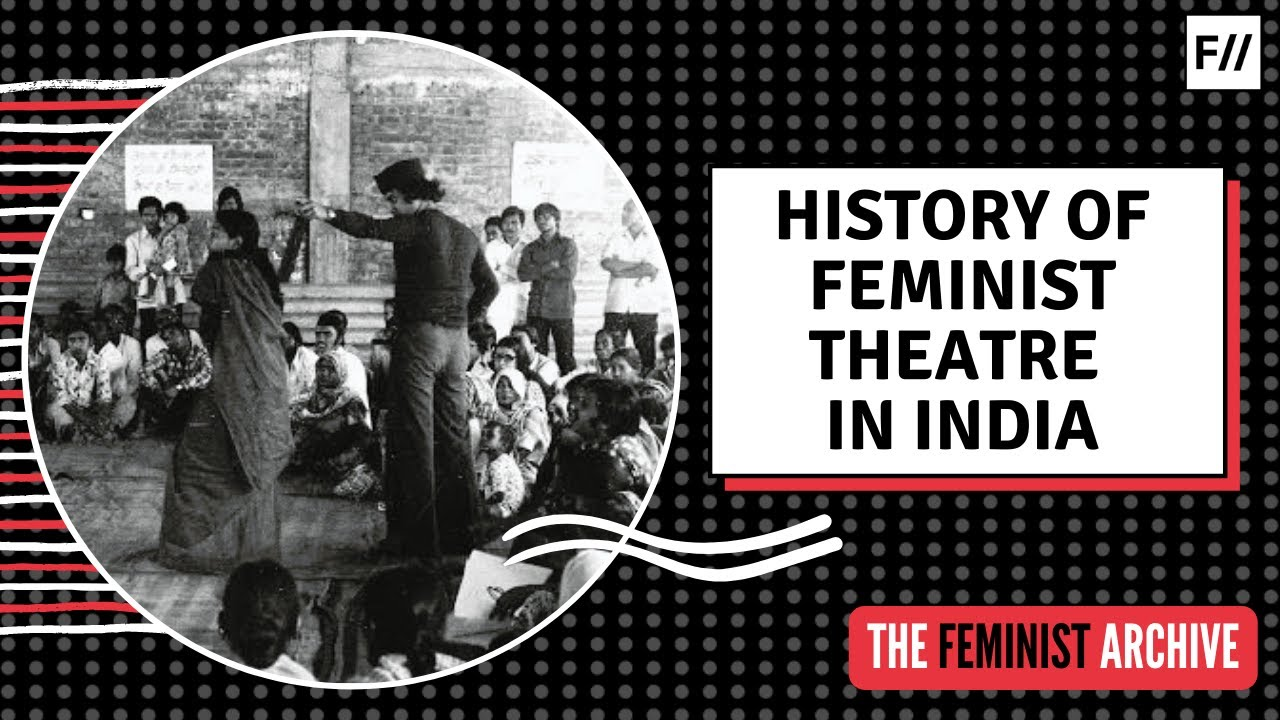
In the second chapter, Singh looks at women in directorial positions in elite theatre in the post-independent period. By throwing light on the works of Dina Gandhi, Sheila Bhatia, and Vijaya Mehta, who were women directors, she charts the role of women in theatre in the period after independence, that is, 50s, 60s, and 70s decades. This period also coincides with the growing women’s movement in India. With the rising centrality of the women’s question, the role of women in theatre becomes even more significant. For instance, street plays like Om Swaha, the play against dowry killing, became a big voice of the women’s movement. Feminist street theatre was based on shared experiences of women and a mode of feminist activism itself.
The third chapter explores how contemporary feminist theatre disrupts and unsettles the nationalist projects, hegemonic claim to respectability by reclaiming the voices of traditionally marginalised or loose women. The play, A Tale from the Year 1857: Azizun Nisa – San Sattavan Ka Qissa: Azizun Nisa by Tripurari Sharma, retrieves the marginalised voices of performing women, especially the courtesans. This play focuses on Azizul Nisa, a woman who is not seen as a respectable person. Sharma disrupts the dominant nationalist discourse. The character is granted agency and evokes the strong voice of a woman who asserts her concern (pp. 95). Sharma had strong links with women’s and democratic movements, and her work was a reflection of the larger social and political framework. By using the example of this play, Singh focuses on lost histories of marginalised women performers. The courtesans are brought to the centre of the political space, a space historically denied to women.
The last chapter is based on the play Teechya Aeechi Goshta (Her Mother’s Story), which highlights Tamasha, a popular form of Marathi theatre. Written by Sushma Deshpande, this play too unsettles the mainstream hegemonic discourse. Tamasha performers have been considered loose women who remain largely invisible in middle-class narratives. Like the courtesans, they are not respectable and often ignored in understandings of middle-class high culture. The formation of this middle-class high culture is rooted in the othering of popular culture with the rhetorics of obscenity and morality used to ostracise it. Similar to her attempt with the courtesans, Singh intends to bring the Tamasha performers to the forefront of theatre history in India.
Singh is able to bring out the way in which women performers have been neglected in historical writing. However, the book could be more regionally diverse in situating the historical role of women performers in feminist history. Nonetheless, written in an easy-to-read, jargon-free language, Singh’s book will appeal to people interested in theatre studies, performance studies, cultural studies, and feminist narratives.