

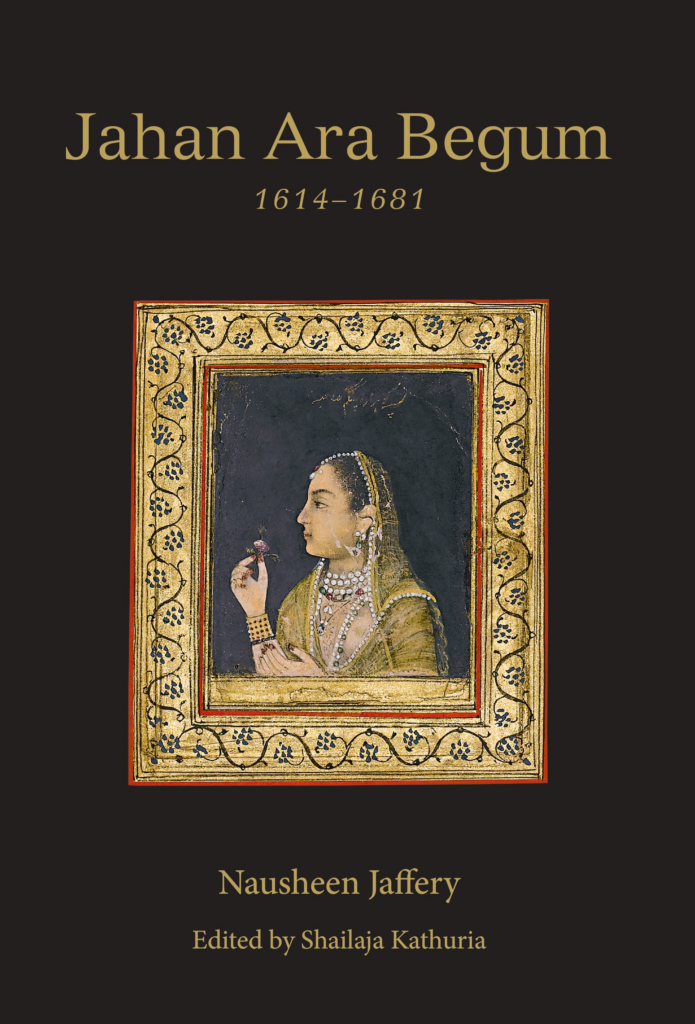
Jahan Ara Begum (1614-1681): A Biographical Study, authored by Nausheen Jaffery and edited by Shailaja Kathuria (published by Tulika Books in 2025), is a meticulously researched account of the life of the powerful Mughal princess. It is an in-depth study offering insights into Jahan Ara’s attributes, social and political standing and the intricacies of the Mughal court and society through her lifespan.
Many historians have either overlooked Mughal women or posited them as secluded in harems, aloof from public life. Jaffery’s intervention marks one of the few serious attempts to reimagine Mughal history beyond orientalist confines to recover the political and personal presence of women like Jahan Ara.
Jaffery’s work centres on Jahan Ara’s life during the reigns of three emperors while providing ample historical context from the reign of the first six Mughal emperors. She traces Jahan Ara’s early life, education, role in court politics, international trade, patronage in architecture, and the hagiographical works she undertook as a scholar—in essence, all the dimensions that determine power and position across cultures and history.
What makes the book most interesting are the two appendices at the end featuring her Nishans and Ruqats that momentarily transport readers back to the Mughal era. The chapters are also generously supported by references to her original letters and writings, weaving a narrative that feels both intimate and cohesive.
Jaffery begins with the world Jahan Ara was born into well-structured, intellectually vibrant Mughal court. Upper-class women, be it Muslim or non-Muslim, possessed wide knowledge, often accomplished as poetesses, reputed writers and were trained by private tutors. Jaffery writes about Jahan Ara’s education under the refined influence of her mother, Mumtaz Mahal, the widely sought-after Sufi Mullah Shah Badakhshi, and Sati un-Nisa Begum—the treatment and respect accorded to the teachers point to the importance of education in this period.
Later chapters reveal Jahan Ara as a prolific scholar, though not in the conventional sense of issuing legal edicts or fatwas. In an Islamic context, where scholarship is often equated with juristic or theological authority, Jahan Ara’s learning in Mughal society took a different but no less significant form. Featured in Akram Nadwi’s Al-Muhaddithat, she studied Quranic recitation and tajwid with Sitt Khanum, mastered calligraphy and Persian, and excelled in poetry and household management. Her intellectual pursuits placed her firmly within the elite scholarly class—women whose influence flowed not through the pulpit, but intellect, piety and cultural command.
This Padshah Begum was not cloistered; she set out to play an important role in the political and economic fields. Her role as mediator extended across fractious royal lines– between rival brothers, between rulers and the emperor, between foreign traders, chiefs and natives. She played the role of a delicate peacemaker whose influence outstripped even that of Dara Shukoh, the designated heir.
Jaffery discusses the financial abundance the princess enjoyed through revenue from ports, including the lucrative one at Surat, grants and the imperial allowances (a high amount, second only to her mother). She traded goods, amassed wealth and funded architectural marvels from the Jama Masjid in Agra, mosques in Kashmir, to caravanserai in Shahjahanabad, which seeded the bustling Chandini chowk. Jahan Ara possessed estates in several parts of the kingdom and used her port and ships in Surat to facilitate pilgrimage to Mecca, Najaf and Karbala.
Inside the royal household, she held sway over family matters and marital arrangements. Outside, she exercised authority through edicts— farman, sanad, Nishan, Parwana, hukum– on appointments, transfers and dismissals.
The book is rich in detail about ranks, revenues, and courtly expenditures. What I found most compelling were the excerpts from Jahan Ara’s hagiographies, poetry, and letters. The elegance of her prose, even during matters of war, offered insight and satiated my literary taste.
This work is a valuable intervention as it aims to show us the position of upper-class women in the Mughal society and how it functioned culturally and politically. It challenges prejudiced misconceptions about the treatment of Muslim women in Islamic societies and surprises many to learn that women living under an Islamic order could be scholars with authority in matters significant to legal commands and prohibitions.
Jaffery directly engages with the popular beliefs about Islamic injunctions on Muslim women’s participation in public life (p. 57). Thus, adding to the scarce literature on Mughal history, able to escape the orientalist gaze. Such accounts inspire women to look beyond possibilities and imagine power and agency in society. They also challenge the notions of disharmony between Mughal men and women by showing how Jahan Ara wielded influence across the reigns of Shah Jahan, Dara Shukoh and Aurangzeb.
A careful study of past societies impacts our understanding of the present, turning history into a potential tool for change. Still, some questions remain. There is almost no mention of Jahan Ara’s interaction with the common folk women. A figure so socially engaged would have certainly interacted with ordinary women – but such exchanges remain unexplored, perhaps, because of court-centred biases in historical records. Compared to Ira Mukhoty’s Daughters of the Sun, this narrative may lack lushness but offers a rare, detailed insight into one woman’s life. The writing is clear and academic, with a deliberate restraint that lets Jahan Ara’s own words and actions shape her legacy, rather than speculation or emotional embellishment. A book that is an admirable tribute honouring the one who penned it and whose life it revived.
***
Laiba Zahid is a PhD Scholar at the Department of Political Science, Jamia Millia Islamia (JMI), New Delhi.