
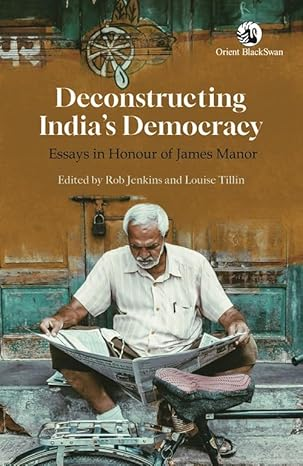
Deconstructing India’s Democracy: Essays in Honour of James Manor, edited by Rob Jenkins and Louise Tillin (published by Orient Blackswan in 2025),is a pertinent and insightful collection that explores anew the concept of Indian democracy at a time when its institutional foundations appear more precarious than ever. Bringing together some of the most prominent scholars in Indian politics, the volume pays tribute to James Manor not only as a political scientist who shaped our understanding of India’s democratic deepening, but also as a scholar attuned to the complex interplay between institutions, accountability, and the everyday workings of governance. The essays collectively trace a shifting democratic terrain, marked by both erosion and renewal, decline and reinvention, capturing a political landscape in constant flux.
The volume opens with an introduction that situates India’s contemporary democratic crisis within a longer trajectory of institutional change. Drawing on this framing, one might read the current moment through Antonio Gramsci’s notion of the “interregnum” (Gramsci, 1971) when the old is dying and the new cannot yet be born, and Hannah Arendt’s idea of crisis as a moment not only of rupture but of potential renewal (Arendt, 1963). The strength of this volume lies in its refusal to simply see the present as a break from the past. Instead, it explores what is being reconfigured and for whom, as the terms of democratic life are rewritten from both above and below. Rather than offering a linear story of decline, the book invites readers to reflect on the nuanced ways Indian democracy is simultaneously being dismantled and rebuilt.
Across its twelve essays, the volume is organised around four interlinked aspects of India’s political system. The first part, Leadership and Power, begins with Diego Maiorano’s exploration of how political leadership and its centralising tendencies have shaped India’s democratic trajectory. Referencing Machiavelli’s idea that it’s “safer to be feared than loved,” he examines how powerful leaders consolidate control over the system by bending institutions to their will. Maiorano revisits Manor’s concept of political decay (pp 32), pointing to a deeper, structural failure to check authoritarian drift. At the same time, he also acknowledges signs of democratic regeneration (ibid) through resistance at both the state and grassroots levels, although he is cautious about placing too much hope in these countercurrents.
John Harris takes a close look at the persistence of patronage in Indian politics, challenging the view that it has been displaced by newer forms of engagement. Through studies from Delhi and smaller towns, he shows how citizens’ access to the state is often mediated by a range of brokers and fixers. While such intervention by intermediaries occurs where the state fails, in doing so, they entrench elite control and weaken democratic accountability. Harris ultimately argues that India functions perhaps less as a patronage-based democracy and more as a ‘brokered’ one. Christophe Jaffrelot examines how populist politics, under the guise of electoral legitimacy, centralise power and narrow the space for dissent. He builds on Manor’s concept of competitive authoritarianism (pp 81), extending it to include electoral authoritarianism (pp 85) and elements of sultanism (pp 89). Though elections continue, institutional checks like the judiciary and the Election Commission have been systematically weakened. Still, Jaffrelot notes that this dominance may be fragile, shaped by growing inequality and the BJP’s heavy reliance on Modi’s personal appeal.
In the second part, Politics and Identity, Surinder Jodhka underlines the continued persistence of caste and how it shapes the making, positioning, and trajectories of India’s political elite. He traces three categories, each reflecting a different phase and constituency: upper-caste leaders like Gandhi and Nehru, shaped by urban privilege; dominant caste politicians like Lalu Prasad Yadav, rooted in rural power; and Dalit leaders such as Ambedkar and Kanshi Ram, whose politics emerged from lived experiences of caste violence. In a similar vein, Suhas Palshikar explores how caste has become a political resource for middle peasant communities facing a decline in dominance. Through cross-state comparisons of the Marathas, Jats, Lingayats, and Patidars, he traces how socio-political fragmentation and weak centrist politics have eroded their earlier hold on power. Their demand for backwards status reflects a deeper anxiety, caught between past influence and present insecurity. In his essay, Narendar Pani notes that neither he nor Manor foresaw how a district once leading in land reform would later become a hotbed of communal politics. Focusing on coastal Karnataka, he shows how reforms enabled former landlords to reinvest elsewhere, briefly aiding Congress but eventually helping the BJP, which merged the politics of discourse and delivery (pp 181) to gain ground.
In the third part, Democracy and Elections, Sanjay Kumar looks at evolving voter dynamics, highlighting a notable participatory upsurge in Indian elections, marked by a narrowing gender gap and strong rural involvement, despite the growing impact of media and digital platforms. While electoral processes remain active, Niraja Gopal Jayal raises a more pressing question: can elections alone sustain democracy once its liberal foundations are undermined? Even though liberalism has long been viewed as an elitist disposition, she argues that the BJP’s populist agenda has decisively delegitimised liberal values, leading to a steady hollowing out of democratic substance. Eswaran Sridharan examines the shift in balance between national and state-level issues in Indian elections over the decades. Although state issues remain imperative, non-economic concerns are increasingly shaping voter choices.
In the final part, Policymaking and Governance, Naresh Chandra Saxena evaluates the impact of Panchayati Raj, finding that while decentralisation has brought some benefits, empowerment is still hindered by elite control, patronage, lack of devolution, weaker accountability and so on. Zoya Hasan turns to the UPA era and attributes its downfall to governance failures, growing middle-class discontent, which the BJP skilfully turned to its advantage through a populist-nationalist narrative. In a timely intervention, Manisha Priyam shows how public universities like the University of Mysore remain shaped by local caste politics, an often-neglected factor in higher education reforms, especially as academic spaces face growing constraints on autonomy and critical inquiry.
In sum, the anthology offers a sharp and layered interrogation of India’s democratic present. It does not reduce democratic decline to institutional failure alone but instead explores the ideological, procedural, and participatory crises that underpin it. While the chapters vary in analytical depth and focus, the collection as a whole illustrates how India’s democracy is being actively reconfigured through erosion, contestation and reinvention. It is a valuable resource for scholars of Indian politics and democracy and a fitting tribute to James Manor’s enduring intellectual legacy.
Works Cited:
Arendt, Hannah. On Revolution. New York, Viking Press, 1963.
Gramsci, Antonio. Selections from the Prison Notebooks of Antonio Gramsci. New York, International Publishers, 1971.
***
Malavika Pradhan is a Research Scholar in Political Science at the University of North Bengal, Siliguri and a Guest Faculty in Political Science at Darjeeling Hills University.
Very compelling review.
It is absolute truth that citizens’ access to the state is often mediated by a range of brokers and fixers. Such intervention by intermediaries occurs where the state fails.
Also such brokers are many a time get formally approved and absorbed in the system. The office babus refer a citizen to come through an agent to get the work done on priority. Such agents are visible at Tehsils, RTOs, Land Record , Municipalities etc where the tasks are projected to be complicated. Many a public sector banks have formally accepted the brokers and have even impaneled private agents to source loans. That’s the bitter reality.