
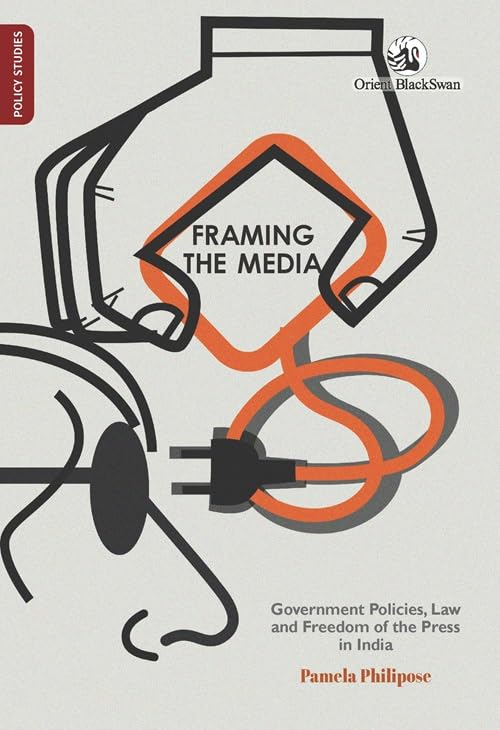
In Framing the Media: Government Policies, Law, and Freedom of the Press in India (Orient Blackswan, 2025), Pamela Philipose attempts the gargantuan task of mapping the fraught histories of the freedom of expression in India, from its colonial roots to postcolonial statecraft to the contemporary digital global village. The book revolves around how precarious freedom of the press in India has always been, teetering between democratic ideals of a young country and authoritarian control inherited from years of British colonial occupation. Freedom of expression in India remains compromised, where colonial habits of censorship and surveillance reappear in new guises, and the democratic promise of the media remains unachieved. Far from a story of steady progress, Philipose shows how each generation of rulers, colonial or postcolonial, has revived familiar instruments of control, even as technologies and political contexts shifted.
The opening chapters situate the press within the colonial encounter. British officials quickly grasped that regulating public opinion was key to governing a multiethnic and expansive colony. Although previous leaders had opposed printing due to concerns over turmoil, the British colonial system acknowledged its dual nature – both a method of control and a source of political instability. James Hicky’s Bengal Gazette revealed instances of corruption, and left Governor-General Warren Hastings perturbed, while also recognising the potential disruption caused by the press. The Censorship of Press Act of 1799, justified under fears of a French invasion, inaugurated India’s long tradition of curbing free expression in the name of security.
Over the nineteenth century, this control hardened into law. Sedition provisions, licensing requirements, and the 1878 Vernacular Press Act institutionalized censorship. The Revolt of 1857 intensified colonial mistrust of public sentiment, and Bal Gangadhar Tilak’s writings in Kesari in the late nineteenth century resulted in more severe sedition trials. By the early 1900s, laws like the 1910 Press Act and the Defence of India Act showed the colonial government’s view that public opinion was vital and threatening. The Jallianwala Bagh massacre is depicted as a crucial moment when colonial paranoia and censorship violently clashed with public opposition.
The book effectively links these colonial practices to a post-independent India, which was ushering in constitutional democracy. Freedom of expression was conceptualised as a constitutional right, yet the shadows of Partition, communal riots, and political murders loomed large over the stakeholders of the Constituent Assembly. The outcome was a constitutional agreement that ensured rights while permitting extensive limitations under Article 19(2). Consequently, independent India inherited a colonial legal framework for press regulation and a similar hostile attitude towards dissent.
The decades that followed bore out these anxieties. The Emergency of 1975-77 was the most explicit assault on press freedom, with censorship, arrests, and the replacement of the Press Council with a state-controlled agency, Samachar. Yet, the impulse to regulate persisted afterward. Rajiv Gandhi’s Defamation Bill of 1988, withdrawn after nationwide protests, revealed the government’s continuing mistrust of the media. With the sweep of liberalisation in the 1990s, the media ecosystem found itself closely tucked into the laps of the corporate conglomerates, while existing as a propaganda-driven state apparatus, too.
In the Hindi heartland, the commons experienced the press turning into a wrestling ground between ideologies of diametric temperaments – caste driven affirmative action and a parochial nationalism consolidated Hindu populist sensibilities. Philipose naturally contends that the press and media were not just reporting these events of national significance but remained pivotal in determining the course of events.
The neoliberal turn of the 1990s marked another shift. Under a feeble Press Council of India, editorial judgment lost its candour and remained enslaved to advertising, consumer metrics, and corporate benefits. The Editors’ Guild of India partly filled this vacuum, producing fact-finding reports such as those on the 2002 Gujarat riots and the 2023 Manipur violence. Nonetheless, its reach remained limited, and these frailties were exposed during the COVID-19 pandemic. The Supreme Court mandated that the Indian media houses and outlets only publish the government’s approved account of events, a move considered extremely steep in the media’s legislative history.
Philipose traces how successive governments extended control over new technologies as the book moves from print to broadcast and eventually to digital platforms. Broadcasting was once envisioned as a tool beneficial in achieving India’s developmentalist utopia. It has since been coiled under the fangs of regulative state machinery and, worse, the oligopolistic corporate hegemonies. This transition from watchdog to lapdog journalism is demonstrated through instances such as the Adani Group’s acquisition of NDTV and corporate power directly shaping news coverage.
The Information Technology Act (2000), revised in 2008, following the Mumbai terror attacks, gave unequivocal powers to the bureaucratic structures to achieve surveillance, monitor, collect digital footprints, and block online content. Digital media, once hailed as a great equaliser, was the latest subject of the government’s scrutiny. Section 66A, notorious for detentions related to Facebook messages and tweets, highlighted the vulnerability of online expression. Its eventual nullification in Shreya Singhal v. Union of India (2015) marked a significant moment for digital rights.
Schemes like Aadhaar-based welfare delivery and the Digital India programme (2015) were promoted as tools of digital inclusion, yet in practice, they produced new forms of exclusion through biometric failures while heightening concerns over privacy and surveillance. At the same time, platforms such as Facebook and WhatsApp have become vehicles for misinformation and political manipulation. Philipose cautions that these developments signal a drift toward digital authoritarianism, where technology serves control more than empowerment.
Framing the Media succeeds in asserting its central claim – censorship and regulation are not occasional deviations in Indian media history but enduring features of its political landscape. Philipose exhibits instead that crises – wars, communal riots, terrorist attacks, pandemics – have repeatedly been used to justify curbs on expression. The book’s success lies in offering an invaluable repository of India’s media policies over the last two hundred years. By investigating the institutional lineage of media governance in India, Philipose offers researchers, students, and policymakers a comprehensive reference by gathering laws, regulations, and judicial actions from colonial censorship legislation to the IT Rules and the proposed Digital India Bill. With a thumping heart, the book ends with an urgent concern for the future, raising questions about the trajectory of press freedom in a digitally driven media economy.
***
Sanskriti is a Doctoral Scholar at the School of Liberal Arts, Indian Institute of Technology Jodhpur.
[…] Framing the Media: Government Policies, Law, and Freedom of the Press in India by Pamela … […]