
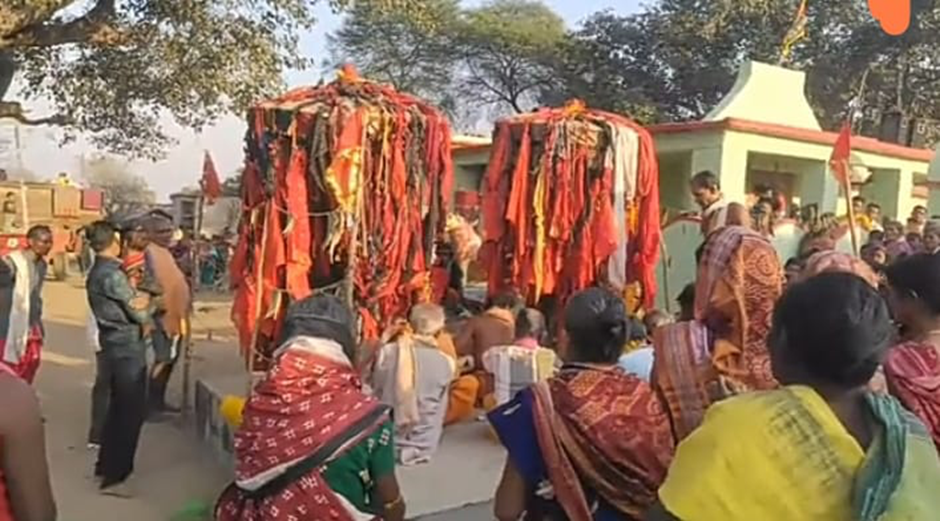
Growing up in a rural village in Odisha, I witnessed several rituals and traditions that puzzled and fascinated me every time. One of such rituals is Chudakhai Yatra or Dangar jatra, which is celebrated on the last Gurubar (Thursday) of Margasir masa at Rushibandha village every year. They worshipped the deity of Maa Maheswari. After completing puja on that day, holding the chhatar (Umbrella), the Maheswari thenga (wooden stick), and Tangia (axe) by Dehuri, chief of the village, dhulia, mahuria and some devotes, the journey begins from the gudhi (temple) of Rushibandha village, and travels through Shandhapali, Jamapali, Manupali, Khaliapali, Kumurukani, Talapadar and finally reachs Dangar, a hill situated in the middle of the Jatra dangar forest about seven kilometres from Rushibandha village, to perform puja (worship) of the deity. After completing the puja, they return to Rushibandha on Friday. On this day, a ritual procession takes place in the village. On the next Gururbar, the deity is brought to another village named Jamatangi, four kilometres away from Rushibandha, to worship the deity. The Athamangala puja marks this occasion. The fascinating thing about rituals is the use of Hulo sabda, or slang words, by men and women participating in the Yatra, with the rhythms of musical instruments. Since childhood, I have often stood at the edge of this ritual, watching silently, and sometimes pushing myself into the ocean of questions of (im) morality.
As per the ritualistic traditions of the region, the temple priest comes from the Suda caste (a lower OBC), rather than from the Brahmin. This non-Brahmin priest is locally known as the Dehuri or Deheri. The folks of this local believe that the ritual represents “the marriage ceremony between Maa Maheswari and Khambeswari (Shiba)” (2009, Pasayat). They also believe that singing hula gita (obscene songs) would eradicate the social evils from the village and promote the health and well-being of the community.
Mythological genesis of the ritual
For an in-depth understanding of the Yatra, I rely upon folklore and scholarly and experiential accounts of its origin. There are many folk narratives available that track the genesis of the ritual. However, I focus on the widely popular oral narrative in the region. This popular tradition believes that the Chudakhai Yatra was begun during the reign of a Kondh Zamindar, named Rudhu Mallik, in Rushibandha village. The story further tells us that the Kandha zamindar had once gone to a nearby Mahanadi riverside named Amurda Ghat (Dahya) with some of his fisherman friends for fishing. They spent the entire day fishing in the river, repeatedly throwing their net. They felt fish were in their net every time, but when they lifted it from the water, there was nothing. Despite their repeated efforts, they failed to catch even a single fish on the day. At the last attempt, however, surprisingly, the net yielded a thenga, a gadu (Jug) and an axe tangia. Then, they helplessly returned to the village with this equipment, without any fish.
That night, when the Zamindar slept, he dreamed of deity Maa Maheswari, who came in his dream and told him that she was there in the net every time they lifted the net, but their human eyes could not see or recognise her. If the zamindar would do puja to her, then he and his praja (mass) would be blessed and protected. Then, the zamindar woke up from sleep and recollected his dream. Thereafter, he decided to worship the deity. Initially, he installed the stone image of the deity in the village of Jamatangi and served that village for the daily puja services of the deity. The sevakaries like Dehuri or Deheri, Mali (gardener), Kumbhar (potter), Mahuria (Mahuri player), Dhulia (Drummer), were given lands for the sevas of the deity. Every day, the tribal zamindar came to the temple to have a darsanan (sight) of the deity. Once, the zamindar could not walk down four kilometres to Jamatangi villageto offer a ritual to the deity. The deity could understand his mind. She appeared in his dream and told him to arrange for the seva puja in his village, Rushibandha. Then, the zamindar established the deity there, and the sevakaries came from Jamatangi. It is believed that with the blessing of Maa Maheswari, this region will always be agriculturally prosperous. In every agricultural season, villagers first offer chuda (flattened rice)prepared from newly harvested paddy to the deity before using it themselves. Once a year, they gather to worship her with dance, song, and playful use of obscene words, believing it ensures a good harvest and reaffirms the deity’s protection. On this occasion, all villagers and devotees are served chuda.
Transgressing Gender Boundaries
From a gender perspective, the women in the festival Chudakhai Yatra can be interpreted as a symbolic act of walking out of perpetuated gender boundaries. The act of singing obscene songs and words during the procession is not merely an act of indulgence in vulgarity, but rather an act of subtle resistance against the oppressive patriarchal system. For instance, the songs like “san banda re san banda, tukel ra pudi ke paila nai” (Small dick, small dick, that could not fit with the young girls’ vagina), and “Tal gachha ku maili kanda, Kunha bandare, kunha banda” (I throw things to the palm tree by measuring, rusting penis, rusting penis). These utterances embody a collective release of sexual insults directed toward men, while also serving as an assertion of young girls’ suppressed desires, including expressions of sexuality that are otherwise silenced in everyday social life. The obscene language becomes a legitimate and powerful tool of expression. In doing so, the festival reflects “the normative function of a language which is said either to reveal or to distort what is assumed to be true about the category of women” (Butler, 1999, pp. 3-4). During the procession of the festival, Women satirically attack men’s sexual power and masculinity. The participants, especially women, articulate themselves through obscene songs and words, free from the constraints of everyday gendered expectations. The use of vulgar language by women during the ritual procession can be considered what Bakhtin (1984) called the “carnival”. It is the “temporary liberation from the prevailing truth and from the established order; it marked the suspension of all hierarchical rank, privileges, norms, and prohibition” (Bakhtin, 1984). This temporary suspension, whether ideal or real, of hierarchical rank during carnival creates a special form of communication impossible in mundane life. It gave rise to a distinct sort of marketplace speech and gestures, free and frank, allowing no distance between participants, and liberating from the norms of etiquette and decency otherwise imposed (pp.10). So, it helps us to see the Yatra as a moment of inversion, where social hierarchies diminish temporarily and the obscene becomes a language of freedom.
Conclusion
The ritual contents and performative aspects of Chudakhai Yatra are increasingly being subjected to processes of sanitisation, driven by the interventions, the imposition of Brahminical notions of (im) Morality, the idea of “good girls” and chastity women, and discourses that seek to build a homogeneous and respectful cultural identity. Historically, the Yatra was marked by the active participation of both men and women in performing songs and dances that were explicitly vulgar- a mode of expression that was not merely tolerated, but ritually sanctioned and emotionally potent. Vulgarity in this context was not seen as profane but as a legitimate and embodied form of devotion and community engagement, deeply tied to the worship of Maa Maheswari. However, the contemporary regulations of such expressions, where only male participants are allowed to utter vulgar words or perform obscene gestures, signify a gendered censorship and a loss of egalitarian space. As this sanitised version of the ritual gains dominance, the emotional and cultural intimacy with the deity gradually diminishes, distancing the ritual from the devotees’ everyday lives and emotional worlds.
References:
Bakhtin, M. (1984). Rabelais and His World (H. Iswolsky, Trans.). Bloomington, Indiana University Press.
Butler, J. (1999). Gender Trouble. New Delhi, Routledge.
Pasayat, C. (2009, October). Chudakhai Yatra. Orissa Review.
***
Sanatan Karna is currently pursuing a Ph.D. in Sociology at Sambalpur University, Odisha. His areas of interest are caste, gender, cultural labour, and folk culture of Odisha.
First of all, I would like to thank the author for providing a comprehensive and insightful account of the Chudakhai Jatra. The discussion is particularly valuable as it highlights the ritual’s elements of gender egalitarianism and caste inclusivity. The fact that women, as well as individuals across caste groups, exercise equal authority in the worship of the Goddess is both analytically significant and socially meaningful. It offers an important glimpse into cultural spaces where notions of equality are actively embodied in practice.
However, I am interested in further understanding the more specific socio-cultural and historical context underpinning the use of obscene language by women during this ritual. What symbolic functions does this practice serve, and how did it originate within the community’s ritual framework?
Congratulations, Dear Sanatan. It really represents the phenomenological perspective of Chudakhai Yatra, which is not as popular in the broader cultural context. After reading this piece, I recall Antonio Gramsci’s argument: “Folklore must not be considered an eccentricity, an oddity, or picturesque elements, but as something that is very serious and is taken seriously.’ Only in this way will the teaching of folklore be more efficient and really bring about the birth of a new culture among the broad popular masses.”