
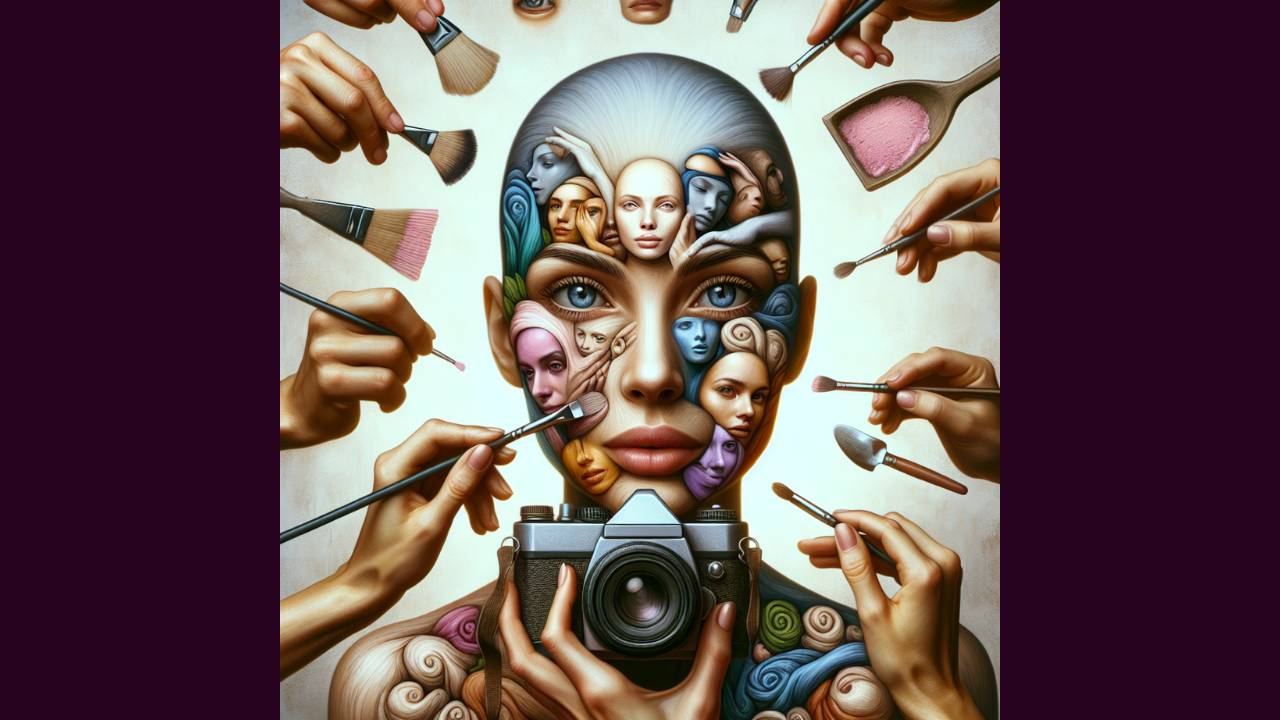
Jenny L. Davis broadly defined social media as the “set of interactive Internet applications that facilitate (collaborative or individual) creation, curation, and sharing of user-generated content” (Davis, 2016). In the age of social media and the digital world, everyone I know around me has different curated online personas. These online personas are created through different means, including posts, stories, highlights, bio, etc. According to Martinus Tejakusuma (2024), “one does not simply have an Instagram account, one becomesan ‘Instagram’ account; an idea, a concept, by following established norms, or by deliberately breaking free of the norm” (Tejakusuma, 2024).
Identity, Instagram and Authenticity
Identity, as a concept once understood as stable and internal, is now often seen as fluid, dynamic, and highly curated. The sociological lens offers powerful tools for understanding these transformations in presenting oneself on social media. American sociologist Erving Goffman’s dramaturgical model (1959)discussed how people present themselves in different ways in different contexts. Drawing from Goffman’s dramaturgical model (1959), we can view Instagram as a “front stage” where users perform front-stage versions or perfectly curated versions of the self, while concealing backstage realities. Here, the profile and bio of the account become a curated script, the caption a punchline, and the post a visual performance aimed towards a particular audience.
Instagram’s structure and its algorithmic logics ease the process of identity curation. Its wide popularity attracts others to create profiles on Instagram. Various practices include editing photos to make them “aesthetically pleasing”, application of different filters that are available on Instagram to meet the current trends, writing “cool” captions, putting trending background music and most importantly, trending hashtags. These are not just engagement tactics, but shape one’s identity online. Users often have the tendency to conceptualise an idea of who or what a person is like, exclusively based on what kind of posts he/she has on Instagram and his/her likes on different reels and reposting of reels and posts on Instagram. Martinus Tejakusuma (2024) writes this leads to the birthing of certain archetypes for example the, the skater boy, the nerdy, the skenaguy/girl, dark-academia bookworm, the liberal arts girlfriend/boyfriend, the punk guy, black cat girlfriend, golden retriever boyfriend, emo guy/girl and also some new archetypes such as diva, chill guy etc. These archetypes become problematic when they become a standard for judging people. This yardstick assesses people’s merit solely based on how well they conform to these stereotypes, trends, particularly in the social media space (Tejakusuma, 2024).
Identity curation is the term to describe the quiet, continuous process of choosing which parts of yourself to show to the world. It is like selecting certain pieces of furniture, art, and books in your room that you feel represent who you are, while other belongings might be stored away. To understand this concept of identity curation, I conducted structured interviews using an interview schedule (consisting of both open and closed-ended questions) among young users who use Instagram daily. Youngsters usually hesitate to admit that they curate a different identity on Instagram, but when asked different questions about the emotional impacts of Instagram, they somewhat accept that their posts and activities are also influenced, compared with other users’ posts. When I asked different kinds of questions, they confessed about how they really experience identity curation on Instagram. One of them said, “I feel my life is boring, my friends are going on vacations, treks, cafes every weekend, and I’m just lying in my bed liking their pictures…” Also, one interviewee said, “Nowadays people choose places to go based on how ‘instagrammable’ the place is…” This further shows, Instagram-worthy is a major reason to visit or travel to one place.
One might wonder what is problematic in curating an ideal, perfect online identity. The identity we curate on Instagram is often one-dimensional. But this one-dimensional identity contradicts human nature or the self. Our brains are constantly changing based on our day-to-day experiences; it is part of the richness of the human experience and allows us to learn and grow continually. However, platforms like Instagram convey us a different message (Cozolino, Drulis, & Samuelson, 2021).
A friend of mine who is an influencer with a considerable following confessed to me that she feels very tiring sometimes to maintain the self she has on Instagram. Behind her stylish outfits and confident smiles, there was a constant anxiety, an endless chase for what to post next, how to make every moment a picture-perfect moment. For the users who follow her, her life is their dream. In reality, it was becoming a carefully curated illusion that left her feeling empty and disconnected from her authentic self. She cannot show her real self, thinking, will my real self contradict my Instagram self? Will my followers accept my real self?
This disconnection, my friend fills resonates with our lives too. We find our lives compared with others who perfectly curate online selves. It becomes a source of unrealistic expectations and escalating insecurities affecting our relationships with others and even our true selves. We sacrifice parts of our lives to make ourselves appear less complicated. This eventually gives rise to an obsession with perfectionism and neglecting our true development as humans and self-acceptance. I have seen people saying, “My house doesn’t match the aesthetic of my profile. Thus, I avoid sharing photos captured in my house…” Similarly, my friends usually avoid visiting the same restaurant and café because they have already taken pictures in that restaurant and café, and the same goes for the outfits they wear on different occasions. These acts replace the joy of real-life spontaneity and make life more about finding a perfect place, ways to shoot a perfect picture, rather than enjoying the moment.
Our fear of missing out (FOMO) online is causing us to miss out on our real lives. We unknowingly make our lives small by creating an ideal self that means more to us than our real self. Our conversations become stale, our interests in things outside begin to fade, and our natural ability to trust our intuition is replaced with an obsessive need for external validation in forms of likes, shares, views and comments from others (Cozolino et al, 2021).
Honestly speaking, according to me, the only possible way to make one’s Instagram profile less curated is to stop making it the centre of everything, including our perception of someone’s personality. For me, it makes more sense to enjoy and experience things that actually matter to me. If I feel I can share it on my profile, I share. Experiencing moments should come before Instagramming them.
Sometimes, when I also feel like comparing, feeling sad over something, I remind myself that my Instagram profile cannot solely define who I am. My worth cannot be measured in likes, views. Also, when I find myself overthinking before posting something, I ask myself, “For whom is this performance intended or directed? For my own self? Or for other people who don’t even know I exist? ” These little reminders help me when I’m filtering myself too much online.
The reality is, no one, including me and that influencer you admire, fits perfectly into a grid. We change, we make mistakes, we learn, we grow, and that is what being human is. Life is not static; it is in continuous flux, and that is completely fine.
References:
Cozolino, L., Drulis, C., & Samuelson, C. (2021, November 18). Authenticity in the age of Instagram: Why social media will never be enough to capture who we are. Psychology Today. https://www.psychologytoday.com/us/blog/the-psychologists-eye/202111/authenticity-in-the-age-of-instagram
Davis, J. L. (2016). Social media. In G. Mazzoleni (Ed.), The International Encyclopedia of Political Communication. Wiley-Blackwell.
Marnenikk. (2024, January 27). The truth about Instagram reality: Authenticity issues & comparisons. Medium. https://marnenikk.medium.com/the-truth-about-instagram-reality-authenticity-issues-comparisons-6dd2a6e4a87e
Tejakusuma, M. (2024, May 21). Performative acts and the illusion of authenticity on Instagram: An attempt to deconstruct what it means to be a part of social media. Medium. https://martinustejakusuma.medium.com/performative-acts-and-the-illusion-of-authenticity-on-instagram-53fd5c356d0f
***
Gyandeep Bhattacharyya is an undergraduate student of Sociology at Cotton University, Assam, India.