
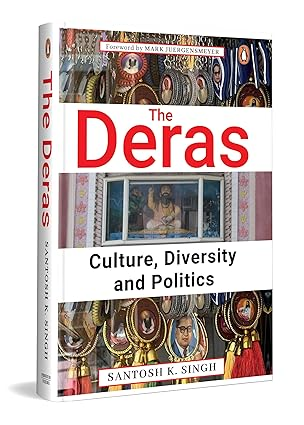
The popular imagery of deras remains mired in controversies helmed by dubious Godmen wearing garish outfits and selling their latest wares of pop religiosity. Santosh K. Singh’s The Deras: Culture, Diversity and Politics (published in 2025 by Penguin Viking) is an admirable attempt to rescue the phenomenon of the ‘dera’ from such a parochial imagination and place it within the sociological. Dedicated to the Ravidassia community and focusing on the dera Sachkhand Ballan in Punjab, this book is a result of Singh’s immersive engagement with the derasspanning more than a decade. Seeking to bring back curiosity, enchantment, and the spirit of a wanderer to knowledge production in the social sciences, Singh offers a compelling account of the deraculture in Punjab, placing it within the larger ambit of ‘lower caste’ identity articulation (particularly the Ravidassia community) and South Asian religious landscape. At the same time, the local embeddedness of each of the deras discussed in the book has also been studied in great detail, taking care not to reduce these deras to mere archetypes of a larger phenomenon. The derasare treated as complex institutions with rich histories, providing a people alienated by ‘upper caste’ hegemony in conventional religion, with a sense of belonging and connection with great philosophical traditions encompassing the likes of Ravidas, Kabir, and Ambedkar. This counter-perspective on the phenomenon of the derathat Singh vividly traces throughout the book adds a new layer to the scholarship on New Religious Movements in South Asia.
The book is divided into eight chapters, uncovering the world of the deras with all its complexity, conflicts, and diversity. The first chapter begins with the story of a village in Punjab, which reveals the multi-religious and syncretic nature of Punjab’s sacred geography, thus providing an important context for the emergence of deras in the region. The second chapter conceptualises the dera and its connection with caste in Punjab. The third chapter is a necessary detour from the core theme of the book, as it discusses the infamous dera Sacha Sauda of Gurmeet Ram Rahim, which is what most people think of when they first hear the word ‘dera’. The fourth and fifth chapters discuss at length the dera Ballan in Punjab and Varanasi, substantiating the core theme of the book by situating the deras within Dalit politics and identity articulation. The sixth chapter discusses the internal dynamics of the Ravidassia identity and how it is far from a monolith. This serves as an important reminder not to simplify dera Ballan or other derasto be the sole representatives of the Ravidassia identity. The chapter includes three accounts of people from the Ravidassia community, all with different ideologies and their own criticisms of the deras. The inclusion of this criticism is all the more important as it comes from within the community that the deras supposedly represent. The seventh chapter relates Ravidassia deras to the emergence of Dalit singers in Punjabi music who counter the hegemony of Jatt Sikhs through songs on Ravidas and Ambedkar. The final chapter discusses the other deras other than dera Ballan, highlighting the diversity in the dera culture. All these deras have their own genealogies, politics, religiosity and cultural expressions that, in popular perception, are seen as one deviant monolith.
The Dera as an Ideological Site
The dera is sociologically conceptualised by historicising the emergence of the deraculture in Punjab. The genealogy of contemporary Ravidassia deras is traced beginning from the Ad-Dharm movement, which can be considered as the first subaltern expression of caste and religion in Punjab, to the eventual emergence of the Ravidassia identity. Most Ad-Dharmis come from the same caste-occupation background of leather work as Saint Ravidas, thus leading to the formation of a new identity of ‘Ravidassia Dharm’ instead of Ad-Dharm (pp. 31,32). Singh argues that it is this label of Ad-Dharmi or Ravidassia that signifies the internal differences within the Ravidassia community in Punjab, and also between Ravidassias and other Dalit communities like the Valmikis. The myriad kinds of deras that have emerged all over Punjab are placed within this historical context of social movements calling for a separate religious identity for Dalits and other ‘lower caste’ groups. However, lately most derashave started disassociating from a particular identity or insisting on an alternative religious identity, in order to avoid conflicts with mainstream Sikh groups dominated by the ‘upper caste’ Sikhs (p.153). Placed within this historicity, the deras can be seen as a response to ‘upper caste’ hegemony in mainstream religions (particularly Sikhism) and a fluid religious space for ‘lower caste’ identity articulation. This conceptualisation of the dera as an ‘ideological site’ is the core theme and perhaps the biggest strength of the book.
Iconography and Identity
Central to the worldview of the Ravidassia derasisthe articulation of one’s identity as part of the anti-caste tradition of Saint Ravidas. This implies an awareness of one’s place in time and reveals an emancipatory goal behind the emergence of these deras, regardless of how far some of them might have strayed from their origins. The centrality of Ambedkar in the iconography of most of the deras discussed in the book can be seen as a continuation of this anti-caste tradition. As pronounced by one of the respondents in the book, Baba Saheb Ambedkar is seen as a political guru, while Saint Ravidas is a spiritual guru by the Ravidassia community. Ambedkar has been seamlessly incorporated into the Ravidassia religious iconography, which Singh argues is largely due to the rise in political awareness among Dalit youth (p.135). Ambedkar’s images, books, and other memorabilia can be seen in both Ravidassia and Valmiki deras. The pilgrimage to the Ravidas temple in Varanasi is an illustrative example discussed at length in the book. Similarly, the protest songs and popular culture examples discussed in chapter 7 also represent an ideological continuum between Ravidas and Ambedkar.
While disillusionment with and marginalisation from mainstream Sikhism are one of the primary reasons contributing to the mushrooming of deras, other factors have shaped dera culture in Punjab. Primary among these is the formation of a Dalit diaspora. This has led to Bob Marley and Che Guevara headscarves, toy aeroplanes, and Canadian flags being sold near the deras along with pictures of Ambedkar and Ravidas (pp. 144,158). The changing nature of the Indian State following the liberalisation policies of the 1990s could be another reason attributed to the emergence of deras. In the absence of State support for health and education, deras emerged as spaces providing basic amenities to all (p.42). Therefore, the deras as a phenomenon need to be looked at within this context of larger Dalit politics in the region and the formation of the Ravidassia identity, which, albeit not a monolith, is intimately connected to the political economy of the deras.
The absence of any engagement with ‘gender’ when discussing deras is a major blind spot in the book. Apart from a brief mention in the chapter on Dalit popular culture and protest songs, there is no discussion of how gender as a sociological category figures into our understanding of deras, caste, and religion. Furthermore, there are instances of certain established concepts like ‘communitas’ (p. 92) and ‘public sphere’ (p. 99) being used casually without any explanation or elaboration, leaving them open to interpretation by readers not familiar with these terms and a lack of critical exegesis for those who are familiar. In a similar vein, there is an uncritical homogenisation of ‘Indic’ religious traditions being ‘syncretic’, without qualifying such a broad generalisation and treating it almost as a truism. However, despite these minor criticisms, this book is an important addition to the scholarship on South Asian religiosity, particularly New Religious Movements. Western scholarship on New Religious Movements in India tends to focus more on the private and individualised aspects of these movements as opposed to the public and collective sense of community (Warrier, 2003). By conceptualising deras as ideological sites of identity articulation, Singh offers us a new vantage point to look at these movements.
There is an evocative discussion in the epilogue of the book with which I would like to conclude this review. Singh invokes the metaphor of a big banyan tree to imagine the South Asian religious landscape, illustrating the entanglement of faiths and religious traditions in the subcontinent. The deras are placed in one of the branches of this giant tree; a part of this fluid, porous, and, as the book insists, ‘fuzzy’ landscape. The writing is immersive and reflexive, and reads as a passionate and sincere engagement with the subject. The deras come to life in all their different hues, successfully overcoming—as Singh puts it early in the book—the methodological challenge of researching a localised tradition with a paucity of resources and no reasonable historical narrative. While acknowledging that there are deras oblivious to all ideological concerns, the book brings out the importance of looking at the dera phenomenon in conjunction with regional and caste histories. It achieves, what Pandian calls, a creative contamination of the religious and the secular, thereby offering a new perspective with which to look at the deras and their followers.
References:
Pandian, M. S. S. (2005). Dilemmas of public reason: Secularism and religious violence in contemporary India. Economic and political weekly, 2313-2320.
Warrier, M. (2003). Processes of secularisation in contemporary India: Guru faith in the Mata Amritanandamayi Mission. Modern Asian Studies, 37(1), 213-253.
***
Neha Sharma is a PhD research scholar at the Department of Humanities and Social Sciences (HSS), Indian Institute of Technology (IIT) Guwahati.