
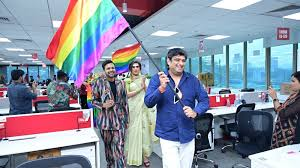
Indian society has had a complex and contradictory relationship with the LGBTQ+ community. On one hand, it is home to one of the world’s oldest transgender communities and carries a rich heritage of queer representation in ancient texts, art, and cultural practices. On the other hand, it has also been marked by colonial-era criminalisation, stigma, and marginalisation of queer identities. In recent decades, debates around sexuality and gender have increasingly moved into public discourse, shaped not only by law and politics but also by media and culture.
In this shifting landscape, social media has emerged as a crucial site of queer visibility. Platforms such as Instagram provide new avenues for self-expression, allowing individuals to curate belonging and participation. However, what becomes visible is not neutral and is shaped by algorithms and market logics. Queer influencers do more than showcase lifestyle: they build counterpublics, normalise forms of queerness, and at times engage in advocacy. Against this backdrop, a pressing question emerges: In what ways are queer Indian influencers using their digital platforms to negotiate identity, create visibility, and engage in advocacy?
To see how these questions play out beyond theory, I turned to Instagram, examining how a handful of queer Indian influencers make themselves visible online. Using a qualitative content analysis, I looked at thirty posts (ten from each account) made between June and August 2025. The posts were coded for themes of identity expression, visibility practices, and advocacy to trace how queer presence is shaped in the digital spheres of India. The influencers were purposefully selected for their diverse modes of self-presentation and significant online followings: @sushantdivgikr, also known as Rani KoHEnur, with 3.6 million followers; @trinetra with 404,000 followers; and Atulan Purohit and Divesh Tolani, who together run the couple account @honey.imm.home with 108,000 followers.
Performing Queerness ( Identity Work and Visibility)
Identity has long been recognised as central to queer life, both as a personal process of self-definition and as a public negotiation within heteronormative societies. For queer influencers, identity work is negotiated in public, making queerness legible and acceptable within digital publics. In the posts I studied, each influencer approached it in strikingly different ways.
For @sushantdivgikr, self-presentation was tied to spectacle and drag performance. Posts highlighted music collaborations, costumes, and artistry, while also inserting queer presence into cultural traditions. A Ganesh Chaturthi greeting, for example, positioned queerness within spaces often coded as heteronormative, challenging assumptions that queerness and religion must exist in tension.
Trinetra Haldar Gummaraju approached identity through professional and representational visibility. Her posts reflected on acting roles such as Meher in Made in Heaven, framing identity through both professional success and trans presence in mainstream culture. Unlike Rani’s drag, Trinetra’s identity work was quieter, but significant in expanding how trans lives could be imagined within Indian popular culture.
Atulan and Divesh of Honey I’m Home performed identity through intimacy and ordinariness. Their posts rarely centred on spectacle; instead, identity was visible in domestic gestures, travel, shopping, or shared routines. By making everyday intimacy the site of representation, their account suggested that queer belonging can be normalised through relational life.
Across these three cases, identity was not simply expressed but carefully performed. Drag artistry, trans professionalism, and domestic couplehood each represent ways of “doing” queerness that fit platform norms. As Butler (1990) reminds us, identity does not precede its expressions but is produced through them. The influencers in this study illustrate this dynamic, performing identity through repetition, aesthetic choices, and carefully curated digital practices.
Advocacy and the Politics of Silence
If identity and visibility reveal how influencers present themselves online, advocacy raises the question of what for. Social media is often imagined as a site of activism, where marginalised voices demand rights and amplify movements. Yet explicit political advocacy was rare in this dataset. Instead, advocacy appeared indirectly, folded into representation and everyday life.
For Rani KoHEnur, advocacy came not through rights-based demands but through the unapologetic visibility. By appearing in public spaces, festivals, and performances, Rani challenged that Drag was not just artistry but resistance. It was a way of saying, “We are here.” In this sense, visibility itself functioned as a form of advocacy, even if it was not framed in overtly political terms.
Trinetra approached advocacy more explicitly, but still through cultural rather than confrontational means. Posts about her role in Made in Heaven and Kankhajura were framed as milestones, not only for her personal journey but for trans representation in India. Yet it is important to note that this analysis covers only posts made in recent months. Much of Trinetra’s earlier content spoke directly to the struggles of transition, discrimination, and systemic exclusion. That dimension of her advocacy is less visible in this dataset, and the absence says more about the narrow temporal frame of analysis than about her overall body of work.
Atulan and Divesh enacted advocacy through normalising queer intimacy. Their posts rarely used activist slogans; instead, they modelled everyday couplehood. In a society where queer families are delegitimised, these depictions were quietly radical, advocating for belonging through ordinariness.
Yet these forms of advocacy also reveal the politics of silence. None of the accounts directly engaged with systemic inequalities around caste, class, or regional disparities. None posted about legal reforms, decriminalization struggles, or state violence. What appeared as advocacy was often the safer politics of representation, carefully curated to remain palatable to audiences, brands, and algorithms. This selective silence highlights the constraints of digital counterpublics: while influencers expand the understanding and imagination of queer life, they often do so within limits that protect visibility and avoid overt political risk.
Conclusion
The findings complicate Fraser’s (1990) conception of subaltern counterpublics. Fraser argued that marginalised groups create alternative spaces of discourse to contest dominant publics. While queer Indian influencers clearly build such digital counterpublics, they are not spaces of equal participation. Instead, they amplify certain privileged voices, illustrating that what circulates on Instagram is shaped not only by queer creativity but also by algorithms, sponsorships, and aesthetic economies that reward particular performances of queerness.
Rani’s drag spectacle, Trinetra’s professionalised trans representation, and Honey I’m Home’s domestic couplehood are not spontaneous expressions of self, but repeated performances that align with recognisable and socially legible scripts. These performances simultaneously enable visibility and limit it: drag must be glamorous, trans identity must be professionalised, and coupledom must be intimate but ordinary.
The influencers studied here disrupt aspects of India’s heteronormative order, but they do so from privileged positions. It is also important to acknowledge the limits of this study. The dataset was drawn only from a narrow three-month window (June–August 2025), making it difficult to capture shifts in tone, themes, or advocacy over time. For instance, Sushant has often engaged in advocacy on other platforms, such as television appearances, live performances, or through Instagram Stories rather than permanent posts. These forms of expression fall outside the scope of this dataset but are central to understanding their broader activist presence. This analysis, therefore, offers only a snapshot rather than a comprehensive account of advocacy. More broadly, the three influencers studied here are all urban, English-speaking, and upper- to middle-class, with access to platforms of privilege not shared by many queer Indians. Absent are caste-marginalized voices, rural and small-town experiences, non-English expressions and those whose online presence is less algorithmically rewarded.
These silences are visible, reminding us that digital counterpublics are stratified, privileging certain queer narratives while rendering others less legible.
References
Butler, J. (1990). Gender trouble: Feminism and the subversion of identity. Routledge.
Fraser, N. (1990). Rethinking the public sphere: A contribution to the critique of actually existing democracy. Social Text, 25/26, 56–80.
***
Manav Sharma is a recent graduate from the University of British Columbia, where he studied Psychology and Family Studies. His research interests lie at the intersection of media, culture, identity and kinship in South Asian communities.