
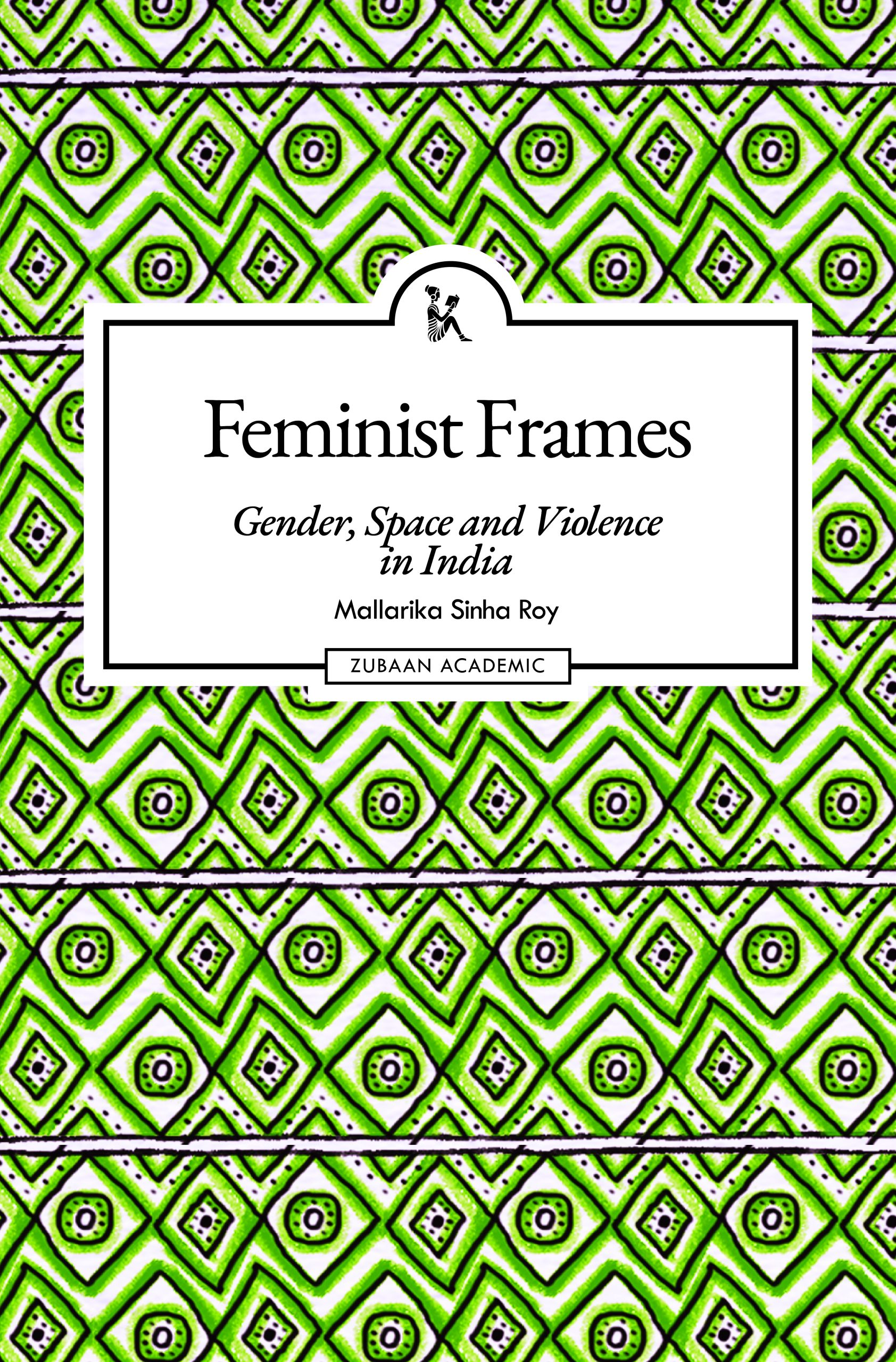
“The geopolitical entity of South Asia is constituted by the radical diversity and the tenacity as well as the fragility of South Asian nation-states. All three qualities—diversity, tenacity, fragility—with which Saloni Mathur has characterised South Asia also invite us to think about it as more than a conglomeration of border-sharing nation states” (Roy, p. xi).
Mallarika Sinha Roy begins the introduction of her book, Feminist Frames: Gender, Space and Violence in India (published by Zubaan in 2025), a crucial intervention in contemporary feminist historiography and postcolonial studies. The book situates South Asia as a historically fraught and culturally dynamic region beyond the neat enclosures of clearly defined borders. It is interesting to see how Roy uses framing, a conceptual device in social movement studies, to unsettle the received notions of region and foreground space as a living, mobile category of feminist analysis. In the South Asian context, she observes that feminist scholarship must resist both the temptation of adding women into pre-existing periodisation and the tendency to limit the analysis to exceptional figures who conform to dominant timelines. She also warns against “surrendering criticality”, a condition that arises when the ‘South Asian woman’ is defined solely in contrast to the European or North American ‘self.’ Instead, understanding how such a woman is continually reshaped due to shifting power dynamics, she advocates for the feminist knowledge to be situated in “overlapping boundaries, histories of transgressions, and unexpected similarities among disparate events.” For this, Roy locates Bengal as the primary site of her study due to its history of colonial conquest, socialist imagination, famine, revolutionary politics, and cultural rebirth. Also, the cross-border entanglements stretching from the Bay of Bengal to London, Moscow, and East Berlin make Bengal a fertile ground where one can think about feminist politics as transgressive, mobile, and relational.
In response to Jini Watson and Gary Wilder’s call to “deprovincialize the Global South,” the book challenges both Eurocentric frames of analysis and narrow nationalist paradigms, offering a regional feminism attentive to mobility, intimacy, and violence. She draws from Doreen Massey’s insight as a conceptual foundation that throws light on how some locations have far more influence over the mechanisms of globalisation.
The book is structured into six chapters that move across archives, theoretical insights from Raymond Williams, Doreen Massey, Walter Benjamin, Sudipta Kaviraj, and Rebecca Schneider, among others. What emerges is a layered, multi-sited narrative that situates “woman” not as a static identity but as a category at the intersection of commerce, race, sexuality, and politics. In the first chapter, Bengal is placed within global socialist currents. Even literary works by figures like Michael Madhusudan Dutt and Bankim Chandra Chatterjee are brought into the discussion to provide a conceptual ground for understanding women’s militancy and affective modern individuals. The second chapter shifts focus to the visual culture engaging with the Company paintings, the Bengal School, famine sketches, and socialist art of the 1930s and 1940s. Roy shows how Bengal’s landscapes were interpreted across artistic modes. The colonial works framed it as picturesque, nationalist art reimagined it as pastoral and famine imagery forced an unsettling confrontation with dispossessed, labouring bodies. The chapter also explores the history of Partition (1947). What emerges is the idea of “place-memories,” where the landscape holds traces of both idyll and rupture. The author’s use of Raymond Williams’ categories of archaic, residual, and emergent demonstrates how these images straddle both continuity and crisis. Drawing on interviews and memoirs along with other sources, the third chapter reconstructs women’s roles in the Naxalbari movement and the Bangladesh Liberation War. The passionate politics of Ekattorer Nari (women of the 1971 Liberation War) differed from Woolf’s ideas about women’s love for their nation, challenging her claim that women have no nation within the instrumentalised, political, rational framework of militarised conflict. The theatre dominates the fourth chapter, where play-texts and productions become important sites for understanding respectability, romance, and political desire. Roy deliberates on the travel culture among white actresses to the Calcutta (now Kolkata) stage, the formation of theatre districts, and actresses turned activists in the socialist revolutionary theatre. The play texts, such as Tagore’s Raktakarabi (Reed Oleander, 1925) and Dutt’s Teer (Arrow, 1967) and Agnishajya (Berth of Fire, 1988), are also discussed in detail. Thus, the performative becomes political. In the fifth chapter, the focus shifts to women’s cross-border movements, tracing a historical arc from servants and ayahs (maidservants) in colonial archives to elite and educated travellers such as Krishnabhabini Das and Sunity Devi. Roy reconstructs a genealogy of mobility shaped by both coercion and aspiration. Malobika Chattopadhyay’s memoir Biswaloker Ahvane also serves as a crucial element here, weaving together internationalist politics with deeply personal experiences of displacement, friendship, and belonging. In the last chapter, Roy examines news reports and audio-visual interviews to explore how visibility itself becomes a form of vulnerability in urban spaces marked by gendered violence. The case of Suzette Jordan, the mixed descent survivor of the Park Street gangrape, becomes a key link to understand the long history of global-local interface in this region. Jordan’s refusal to remain anonymous turned a personal violation into a public act of protest. Her insistence on being named and seen becomes, in Roy’s reading, an act of “response-ability”, a term borrowed from Rebecca Schneider to describe the capacity of gestures to both remember past violence and imagine future solidarities.
In my reading, Roy brings an interdisciplinary regional feminist approach that rejects linear time, presumed methods, and predefined geographical boundaries for understanding the figure of the ‘South Asian woman.’
***
Priyanka Tripathi teaches English at the Department of Humanities and Social Sciences, Indian Institute of Technology Patna (IIT) Patna.