
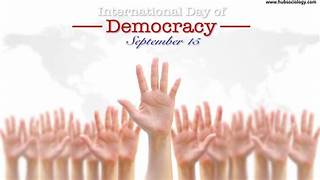
On the morning of the election, the city was unusually alive. Banners fluttered from electric poles, political slogans echoed from loudspeakers, and voters stood patiently in long queues, their fingers soon to bear the indelible ink that symbolised power. An elderly woman, after casting her vote, smiled and said, “Now we have done our duty.” Yet, as the day ended and life returned to its routine rhythms, nothing else seemed to change. Work remained precarious, prices continued to rise, and decisions affecting everyday life felt as distant as ever. The act of participation was complete, but the sense of control was fleeting. This quiet contradiction leads us to a persistent sociological question: Does democracy truly mean rule by the people, or is it something else altogether?
Democracy is conventionally defined as the “rule of the people.” Abraham Lincoln’s well-known phrase, ‘government of the people, by the people, for the people’, captures the normative promise that political power originates from and serves the citizenry. However, sociology urges us to move beyond ideals and examine democracy as a social institution embedded within power relations. Joseph Schumpeter offered a procedural definition that reframed democracy as a method by which elites compete for leadership through elections. In this formulation, citizens do not govern directly; instead, they periodically choose those who will govern them. This conceptual shift is crucial, as it reveals how democracy may function less as popular rule and more as a structured mechanism of elite circulation (Lincoln, 1863; Schumpeter, 1942).
Political democracy, as practised in most modern societies, rests on formal institutions such as elections, representative bodies, constitutional rights, and the rule of law. These mechanisms provide legitimacy and stability to political systems. However, sociological analysis highlights their limitations. C. Wright Mills, in his theory of the “power elite,” argued that real decision-making power in modern democracies is concentrated among a small group controlling political, economic, and military institutions. From this perspective, elections do not fundamentally redistribute power; they often legitimise existing structures of dominance. Political democracy thus ensures participation at the level of procedure, while substantive power remains unevenly distributed (Mills, 1956).
The limitations of political democracy become more apparent when examined alongside the idea of social democracy. T.H. Marshall’s theory of citizenship emphasised that political rights must be accompanied by social rights – such as access to education, healthcare, employment, and social security, if democracy is to be meaningful. Sociologically, political equality without social equality remains fragile. Individuals positioned differently by class, caste, gender, or race do not possess equal capacity to participate in democratic life. Democracy, under such conditions, risks becoming formally inclusive but socially exclusionary (Marshall, 1950).
India offers a compelling illustration of this contradiction. As the world’s largest democracy, India upholds universal adult franchise and constitutional guarantees. Yet deep-rooted social inequalities continue to shape political participation. Caste hierarchies, economic precarity, gendered divisions of labour, and regional disparities influence whose voices are heard and whose interests are prioritised. While electoral participation remains high, policy outcomes often reflect the priorities of dominant social and economic groups. From a sociological standpoint, this raises questions about whether democracy challenges existing power relations or reproduces them under a democratic framework.
To understand how democratic systems sustain legitimacy despite these inequalities, sociological theory turns to the notion of consent. Classical social contract theorists such as Hobbes, Locke, and Rousseau argued that political authority emerges from collective agreement. However, contemporary sociology problematises this assumption. Consent is rarely explicit or continuously negotiated; instead, it is produced through socialisation processes that normalise existing political arrangements. Citizens learn to associate democracy primarily with voting, internalising the belief that participation ends at the ballot box (Hobbes, 1651/1994; Rousseau, 1762/2002).
Antonio Gramsci’s concept of hegemony offers a powerful lens to analyse this process. Gramsci argued that ruling classes maintain dominance not only through coercion but through ideological leadership, shaping what society comes to accept as “common sense.” Institutions such as education, media, and political discourse play a central role in manufacturing consent. Viewed through this lens, democracy itself can function as a hegemonic institution. By offering limited forms of participation, it creates a sense of empowerment while leaving underlying power structures largely intact. People feel politically included, even when their capacity to influence structural decisions remains minimal (Gramsci, 1971).
This hegemonic functioning of democracy is also evident in global politics. The promotion of democracy by powerful states often reveals selective application. The United States frequently positions itself as a global defender of democratic values, yet its interventions in countries like Venezuela through sanctions, diplomatic pressure, and attempts to delegitimise elected governments raise questions about whether democracy is being promoted or strategically instrumentalised. From a sociological perspective, democracy here operates as an ideological justification for geopolitical power rather than as a commitment to popular sovereignty.
Similar contradictions can be observed within established democracies. The presidency of Donald Trump demonstrated how democratic institutions can be weakened from within. While democratic language was repeatedly invoked, executive power was centralised, institutional norms were challenged, and electoral outcomes were questioned when unfavourable. These developments illustrate a phenomenon sociologists describe as democratic erosion, where democratic forms persist, but democratic substance diminishes.
In the contemporary neoliberal context, democracy faces further challenges. Wendy Brown argues that neoliberal rationality transforms citizens into market actors and political decisions into technical or economic necessities. Public debate is replaced by managerial governance, and democratic choice is constrained by market imperatives. Democracy survives as a discourse, but its capacity to enable collective self-determination weakens significantly (Brown, 2015).
From a sociological standpoint, questioning democracy is not an act of rejection but of responsibility. Democracy must be understood as a dynamic social process rather than a completed political achievement. It requires continuous participation, social equality, and critical engagement. Without addressing structural inequalities and hegemonic control, democracy risks becoming a symbolic ritual celebrated in theory, yet constrained in practice.
Ultimately, the sociological question about democracy is not simply whether people vote, but whether they genuinely participate in shaping the conditions of their lives. Until democracy confronts its internal contradictions, it will remain suspended between promise and practice, normatively powerful, yet socially limited.
References:
Brown, W. (2015). Undoing the demos: Neoliberalism’s stealth revolution. Zone Books.
Gramsci, A. (1971). Selections from the prison notebooks (Q. Hoare & G. Nowell Smith, Eds. & Trans.). International Publishers.
Hobbes, T. (1994). Leviathan (E. Curley, Ed.). Hackett Publishing Company. (Original work published 1651)
Lincoln, A. (1863). The Gettysburg Address. National Archives and Records Administration.
Marshall, T. H. (1950). Citizenship and social class. Cambridge University Press.
Mills, C. W. (1956). The power elite. Oxford University Press.
Rousseau, J.-J. (2002). The social contract (G. D. H. Cole, Trans.). Dover Publications. (Original work published 1762)
Schumpeter, J. A. (1942). Capitalism, socialism and democracy. Harper & Brothers.
***
Abhijeet M. Vaidye is an Assistant Professor of Sociology at SHM Law College, Rajgurunagar, Pune.