
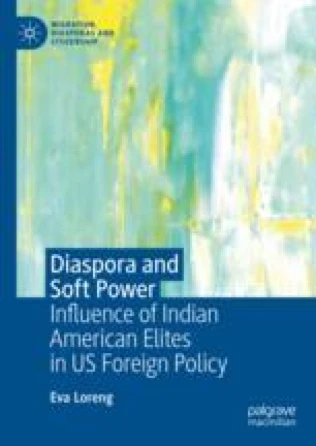
Eva Loreng’s Diaspora and Soft Power: Influence of Indian American Elites in US Foreign Policy, published by Palgrave Macmillan in 2025, is a timely and insightful intervention in the intersecting fields of diaspora studies, international relations, and political sociology. By meticulously interrogating the popular assumption that entire diaspora communities serve as sources of soft power, Loreng convincingly reframes the debate around a specific stratum she terms the “networking/strategic elite.” Her central thesis—that the capacity to influence foreign policy is concentrated within a resource-rich, well-connected segment of the Indian American community—challenges celebratory narratives and offers a powerful analytical lens for understanding the mechanics of transnational influence.
The book opens by anchoring its investigation in a contemporary moment: the 2020 election of Kamala Harris as US Vice President. Loreng uses this event to problematize the automatic link between diasporic ancestry and political influence, asking not ifthe diaspora wields power, but who within it does so, how, and under what conditions. This sets the stage for her core argument, which is developed through a sophisticated interdisciplinary framework blending the elite theory of C. Wright Mills with Joseph Nye’s models of soft power. The resulting concept of the “networking/strategic elite” becomes the book’s guiding principle, defining a group whose access to policymaking “trust networks” enables them to translate cultural and economic capital into political influence.
Organised both thematically and chronologically, the study is methodologically grounded in a “studying up” approach. Loreng’s primary data comes from life-history interviews with key Indian American figures, corporate leaders, think-tank scholars, and community organisers—supplemented by rich historical analysis of US immigration policy, Indian diaspora engagement, and demographic shifts. This dual methodology allows her to trace the evolution of the community from the colonial era to the present, demonstrating convincingly that the phenomenon of diasporic soft power is historically contingent, not innate.
One of the book’s most significant contributions is its detailed historical scaffolding. Loreng accurately shows that in the colonial and Cold War periods, despite the presence of Indian immigrants and even intellectual elites, the necessary conditions for soft power influence were absent. Factors such as discriminatory citizenship laws, India’s non-aligned foreign policy, and the community’s lack of socio-political assimilation precluded meaningful access to American foreign policymaking. The post-Cold War “conducive environment”—marked by US strategic interest in India, economic liberalisation, the rise of the IT sector, and proactive diaspora policies from Delhi—forms the critical backdrop against which the networking/strategic elite emerges. This historical argument powerfully supports her thesis that influence is a product of specific global and domestic alignments.
The heart of the empirical analysis lies in the case study of the US-India Civil Nuclear Agreement (2005-2008). Here, Loreng provides the crucial “methodological linkage” she finds missing in much soft power literature. She demonstrates how the networking/strategic elites, cultivated over the preceding decades, mobilised their financial resources, professional networks, personal connections, and political access to advocate, lobby, persuade, and shape the climate for the deal. This chapter moves the discussion from theoretical potential to documented agency, showing precisely how elite influence operates within the “close-knit” circles of foreign policy.
A further strength is the book’s nuanced attention to stratification within the diaspora. Loreng does not treat the Indian American community as monolithic. Her analysis incorporates the perspectives and differing realities of second-generation immigrants, women on dependent visas, and Dalit Americans. The discussion of caste discrimination, in particular, serves as a crucial internal critique, revealing how the very biases of Indian society are reproduced abroad and can undermine the community’s credibility and cohesive identity. This complexity enriches her argument, showing that the elite’s exercise of soft power exists alongside, and sometimes in tension with, deep internal fractures.
If a limitation is to be noted, it stems from the methodological design itself. As Loreng acknowledges, her “studying up” approach, while essential for tracing elite networks, inherently prioritises the perspectives of the influential. The reader gains a masterful view from the summit but a less complete understanding of how the elite’s advocacy is perceived by the broader diaspora or weighed by policymakers against other strategic interests (e.g., US corporate lobbying or geopolitical calculus). The research design, focused on proving the elite’s agency, makes it difficult to assess the relativeweight of their influence within the larger matrix of decision-making. This is not a failure of execution but a recognised boundary of the study’s scope.
Loreng’s prose is clear, scholarly, and accessible. She successfully navigates complex theoretical terrain without jargon, making the book valuable for both specialists and advanced students. The work engages critically with a wide range of scholarship, from classical diaspora studies to contemporary debates on transnationalism, while carving out its own distinct space.
In summary, Diaspora and Soft Power is a major contribution that successfully reorients a key debate. By shifting the focus from the diaspora-as-community to the diaspora’s strategic elites, Eva Loreng provides a more precise and politically realistic framework for analysing transnational influence. The book is essential reading for scholars of migration, international relations, Indian foreign policy, and US politics. It not only explains a critical case but also furnishes a model for investigating the paradoxical interplay of integration and influence, identity and interest, that defines the role of elite diasporas in the modern world.
Acknowledgment
I express my sincere gratitude to the academic mentors and peers whose discussions on methodology and diaspora politics helped shape the perspectives in this review. I also thank the editorial team for their guidance and patience.
***
Aqib Rashid Sheikh is a PhD research scholar at the Centre of Central Asian Studies, University of Kashmir.