
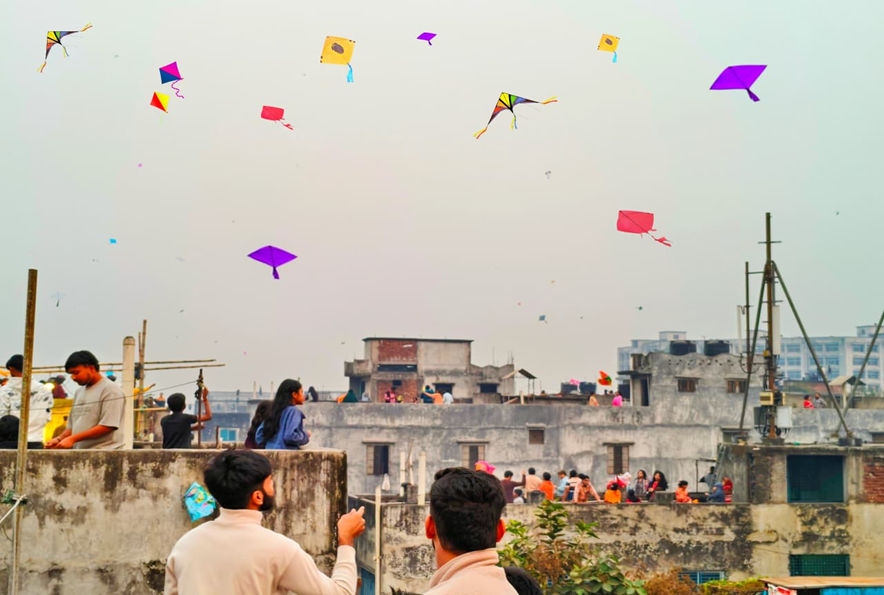
On a winter afternoon in Old Dhaka, the sky slowly changes its character. What begins as a quiet blue space above the city turns, within a few hours, into a moving canvas filled with colour. Red, blue, yellow, and green kites float, collide, and disappear. From almost every rooftop, voices rise shouting, laughing, and celebrating. For one day, the city looks up. This is Sakrain.
Sakrain is celebrated on the last day of the Bengali month of Poush, usually on 14 January. Today, it is widely known as the kite festival of Dhaka. But Sakrain is not only about flying kites. It is about rooftops becoming social spaces, about families and neighbours gathering, about food being shared, and about a city briefly stepping out of its ordinary rhythm.
Historical sources and early newspaper reports indicate that the practice of kite flying in Dhaka can be traced back to the Mughal period. At that time, it functioned primarily as a form of elite recreation and was actively patronised by the Nawabi households. Large-scale competitions, locally known as harifi, were organised in open grounds and on rooftops, often accompanied by social gatherings. Over time, however, this aristocratic leisure gradually moved beyond elite circles and became embedded in neighbourhood life, eventually turning into a shared urban tradition.
The festival is also deeply connected to the seasonal and religious calendar. Poush Sankranti marks an important moment of transition in the Bengali year. In Hindu cosmology, the day is associated with the victory of Lord Vishnu over the demon Ashur, symbolising the triumph of light over darkness and the renewal of life. Ritual bathing, temple visits, and the preparation of seasonal sweets continue to be important practices, particularly in the Hindu localities of Old Dhaka. At the same time, kite flying itself developed into a more public and inclusive activity, gradually crossing religious and social boundaries.
Oral histories further enrich this narrative. Local accounts frequently mention that after 1757, Mir Jafar sent his son, Miron, to Dhaka for administrative responsibilities. Miron, remembered for his enthusiasm for kite flying, is often credited with popularising the custom of flying kites on the last day of Poush in specific neighbourhoods. These stories are also intertwined with domestic traditions: when a son-in-law visited during the winter holidays, families would present him with kites and natai (the bamboo frame), along with homemade pitha and puli. The following morning, family members and guests would gather on rooftops not only to fly kites but also to spend time together and reaffirm social ties.
By the late nineteenth and early twentieth centuries, Sakrain had grown into a major urban event. Large competitions were organised in areas such as Ramna, Paltan, and Gendaria. Kite flying had by then become a skilled practice rather than a casual pastime. The objective was not merely to keep one’s kite aloft, but to cut the opponent’s string using manja, a sharp coating made from glue and powdered glass. The making of kites and the preparation of strings required specialised craft knowledge, patience, and collective labour. In this sense, Sakrain also functioned as a celebration of urban craftsmanship and artisanal skill (Rahman 2018).
Over time, the festival became deeply embedded in the social life of Old Dhaka. Neighbourhoods such as Shankhari Bazar and Lakshmi Bazar grew famous for their crowded and colourful rooftops. The day was never only about competition. It was also about visiting relatives, hosting guests, exchanging sweets, and watching children and young men celebrate their victories in the sky. In this sense, Sakrain functioned as an annual moment of reconnection between families, between neighbours, and sometimes even between strangers.
In recent decades, however, Sakrain has undergone visible transformations. Open fields have gradually disappeared, the city has become more densely built, and celebrations have shifted almost entirely to rooftops. New elements such as loud music systems and DJ parties have also been added. At the same time, there has been growing opposition to the festival in many areas, often expressed in the language of religion, morality, or public order. Significantly, much of this opposition does not come from long-term residents of Old Dhaka, but from newer inhabitants or outside groups. This suggests that Sakrain today is not only a festival; it has also become a site of cultural contestation over what kind of city Dhaka should be.
These changes also make social inequalities more visible. Although Sakrain is often described as a festival of unity, access to celebratory spaces is not the same for everyone. Some rooftops remain open only to family members and close social networks. In certain areas, participation has become “ticket-based” or dependent on financial capacity. Those who can afford to host large and elaborate events gain greater visibility and symbolic presence. Thus, even in a festival centred on togetherness, class distinctions and social boundaries do not fully disappear.
And yet, Sakrain still creates moments that feel different from everyday life. During field observation, one scene was especially striking. A man was moving from rooftop to rooftop. Local people said that he did not belong to the area and that he was mentally unstable. But everyone seemed to know him. Nobody stopped him. He was smiling, watching the kites, and enjoying the noise like everyone else. For that day, at least, he was simply part of the crowd. This suggested that Sakrain can sometimes open space for unusual and unexpected forms of inclusion.
From an anthropological point of view, Sakrain can be understood as a ritual in the sense described by Victor Turner (1969). Turner argues that rituals create moments of liminality, times when ordinary social routines are suspended, and people experience a sense of communitas, or togetherness. Sakrain does exactly this. For one day, work stops, rooftops become shared spaces, and people interact beyond their usual social boundaries. Hierarchies do not disappear, but the city’s social life temporarily takes on a different rhythm, more playful, more open, and more collective. In the dense and urban landscape of Old Dhaka, rooftops temporarily turn into shared public spaces during Sakrain, blurring the boundary between private homes and collective life.
Sakrain can also be seen as a generator of social capital. Through repeated participation, shared memories, hospitality, and seasonal gatherings, people build and maintain social networks. Even if some relationships are seasonal or temporary, the festival still works as a mechanism for renewing social ties and reinforcing a sense of belonging to place.
As Fortes’ (2016 ) classic argument about ritual and social cohesion, Sakrain shows how rituals do not simply express unity but actively produce it, even while containing tensions and exclusions. As Frost suggests, festivals exist within complex “festival ecologies,” shaped by politics, economy, religion, and urban change. Sakrain today is not only a celebration of tradition but also a site of negotiation over culture, morality, space, and authority in the city. Sakrain, then, is not just about kites. It is about how a city remembers itself. It is about how people negotiate space, tradition, and togetherness in a crowded urban life. Forms change, rules change, even meanings change. But every year, when the winter sky fills with colour, Dhaka briefly becomes a city that looks upward together.
References:
Fortes, M. (1936). Ritual festivals and social cohesion in the hinterland of the Gold Coast. American Anthropologist, 38(4), 590–604.
Frost, N. (2016). Anthropology and festivals: Festival ecologies. Ethnos, 81(4), 569–583.
Turner, V. (1969). The ritual process: Structure and anti-structure. Aldine Publishing.
Rahman, S. U. (2018). Utsober Dhaka. Oitijhya.
***
Anjuman Ara holds an MA in Sociology from South Asian University (SAU), New Delhi. Her research interests include culture, ritual festivals, and urban life in South Asia, with a focus on how public celebrations produce both social solidarity and cultural tensions.