
In the Malayalam movie ‘Rani Padmini’, Padmini, who has always defined herself as someone with ‘adakam and othukam’ (modesty and restraint), experiences this particular thought – “[Modesty and restraint] is a trap… if you keep your wings tucked, how will you fly?”- mid-movie. She then paraglides and ‘flies’ over the Himalayan valley.
There is something distinctive about a woman driving, especially a geared motorbike, through the roads of India/Keralam that greatly unsettles the patriarchy. General misogynistic commentary/ ‘humour’ along the lines of women’s financial and physical competence alongside their intent behind riding – which, according to certain men, is only about one-upmanship and, most commonly, women being ‘immodest and unrestrained’ through the sheer act of driving are rife in both online and offline spaces. Underlying these hostile sentiments are particular gendered notions of ‘ideal femininity’ that rely on ideas of demarcated ‘private/public’ spaces as exclusive domains for women and men. The said norms, which were conceptualised in twentieth century India/Keralam, I posit, have not disappeared and have been modified across time and space. The riders’ socio-cultural markers such as caste and class also influence societal reactions. Furthermore, it is the specific idea of adakam and othukam or ‘modesty and restraint’ in English, that I explore as dictating much of the conversations around gender in Keralam, including women’s relationship with motor vehicles. How, then, do women themselves frame/re-frame their experiences even when fielding external judgement of their actions?
Gender Studies scholar J.Devika explains that in the late nineteenth and early twentieth centuries the state relied on the educated, middle-class women as agents to re-order the society along the lines of gender as opposed to caste. According to the logic of this transformative endeavour, educated middle-class women were encouraged to enter public spaces through institutions like schools and hospitals precisely because these institutions were ‘domestic’ and allowed women to simultaneously be public-facing and traditional. It was this scenario that Kalathiparambil Raman Narayani, or K.R. Narayani, rode her Royal Enfield into in the late 1920-s/early 1930-s Keralam. Narayani’s act of motorbiking in early twentieth-century Keralam was a disruptive one that did not align with the ‘ambiguous liberation’ that J.Devika identified. Women, even in public-facing situations, were expected to complement men but never be their equal or superior (Devika, 2006).
Narayani’s deft handling of the bike – a ‘manly machine ’- posed a direct threat to male authority over public spaces, which in turn was reframed as a threat to society itself at large, resulting in the control of the woman herself. Comments related to the arrival of Kaliyugam, the stage of decline from Hindu mythology’s four stage world prophecy- and the public harassment Narayani received in the form of cat-calling testify to this fact (Anooj, 2020). I frame modesty as a morality concept that limits bodily movements as per external gendered standards. Even though Narayani maintained a sense of modesty by restraining herself from switching to male garments or retorting to the hostility she was subjected to with similar hostility, she was still persuaded by her father to stop her act of gendered deviance. Narayani’s act of “whole-body engagement with unfamiliar machinery” through driving (Clarsen, 2008) didn’t simply challenge gender roles broadly but specific ideas of physical and psychological competence. Drawing on ideas of the female body as a “site of struggle (Clarsen, 2008)”, I point out how the nickname ‘Bullet Narayani’ wherein Narayani’s identity was enmeshed with the machine she drove around reformulates a woman’s societal perception the way it wouldn’t for a man. Narayani’s father didn’t ask her to discontinue because she was incompetent but precisely because she was too competent and, possibly, for her time. Narayani’s particularly privileged class position, which operated in spite of her Bahujan caste position, may have played a role in limiting the public repercussions. Although K.R.Narayani’s story reads as a scandalous ‘one-woman-show’ that did not last long, despite the rigid standards of her time and the spectacle that was a woman on a Bullet, there is no record that Narayani herself wanted to quit, and she did initiate something in Keralam that still has a contentious history.
Now, in the mid-2020s, in Keralam, almost a century after K.R.Narayani’s sole act of defiance, more women than ever manoeuvre motorised vehicles. However, the gearless scooters make things particularly curious. The switch-based starter system and the lack of a gear and clutch mechanism of scooters ensure they don’t demand the physical or continued mental and physical coordination from women the way motorbikes would. Furthermore, the presence of a step-through area ensures that women can comfortably ride the vehicle wearing ‘womanly’ attire such as a saree or a skirt without tucking it up. Their smaller size, lower cost and lower performance parameters created a modest position compared to the dominant geared motorbikes, resulting in the scooter’s higher acceptance for women.
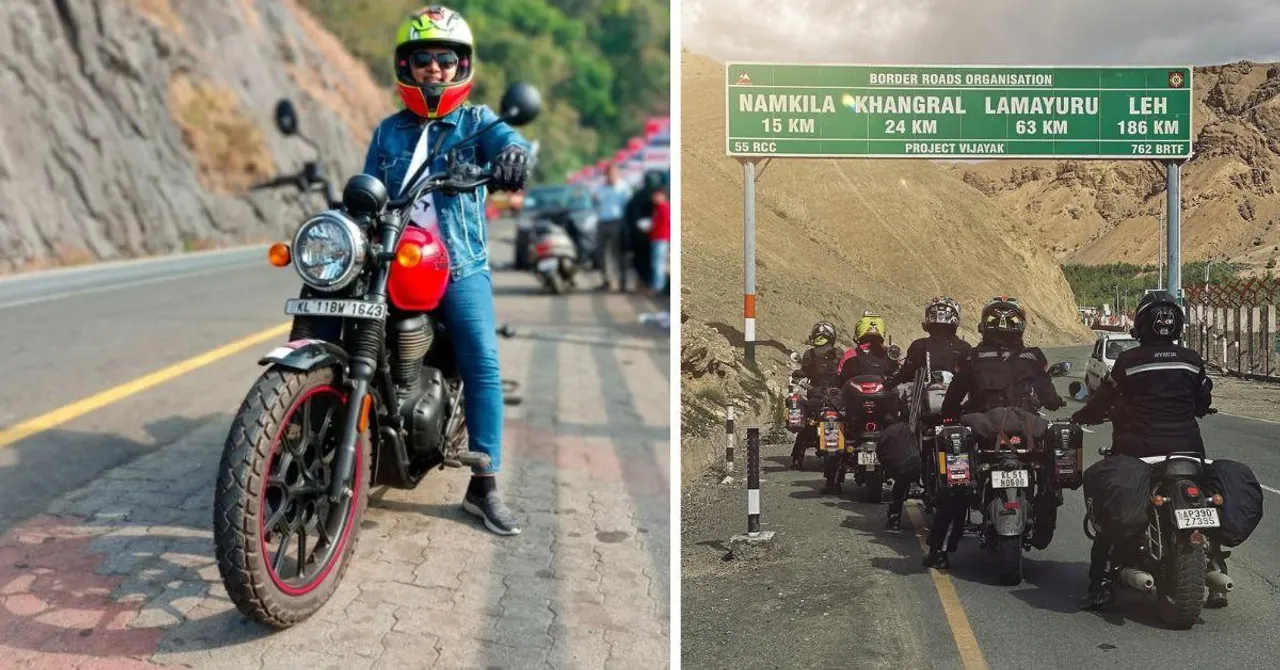
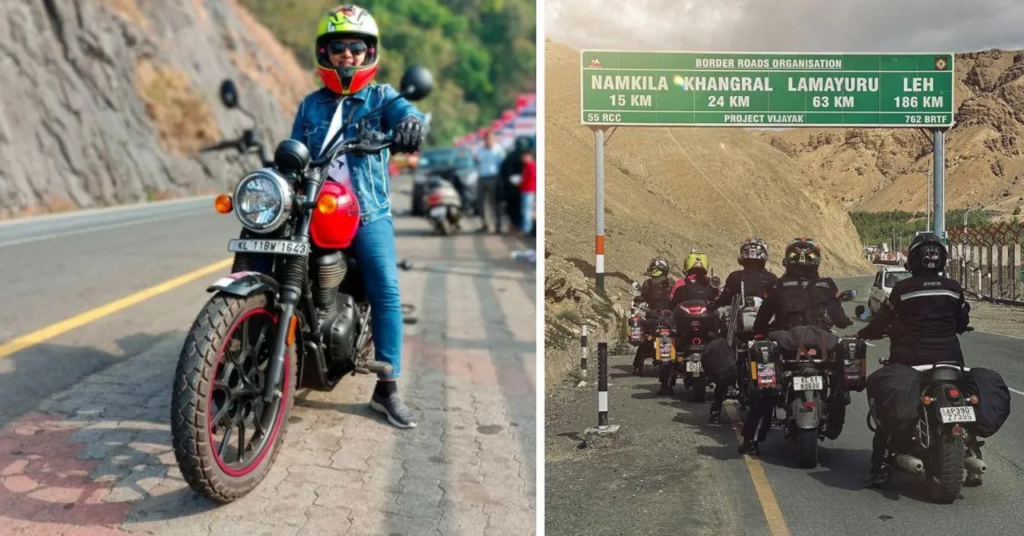
Even though things have changed considerably for women bikers in Kerala since K.R. Narayani, women motorbike riders are still the exception rather than the norm. The presence of scooters has served to complicate matters further by inviting questions along the lines of ‘comfort and need’, which is only a cover for the age-old question of modesty and restraint. Nevertheless, the presence and increasing popularity of women-only riding groups like Calicut Riders Family (CRF): Women on Wheels, based out of Kerala, testify to women’s resilience. Members of CRF point out that the collective nature of riding pacifies their family’s safety concerns. More than a hobby, for most of these women, riding is an attempt at redefining womanhood by building a sense of accomplishment and being an inspiration for others (CRF: Women on Wheels, n.d.). Nevertheless, the urban, middle-class and educated background of the riders still maintains the luxury/luxury-adjacent nature of motorbikes, as some of them received the bikes as gifts from their presumably well-salaried husbands (Preethi, 2025).
However, it is not without gendered backlash that these women engage in these activities. Comments like “…go home do kitchen work first…” on the Instagram posts of the group show that patriarchal notions of women as primarily domestic beings still permeate discussions surrounding their mobility(@kmahesh2372, 2026). It is the symbolism of women driving a ‘man’s machine’ that triggers these reactions rather than the act itself. The extant presence of ideologies from Narayani’s time, especially the ones related to the ‘private/public’ gendered binary, renders the visibility of these women as contentious. The ongoing gendered discourse around the recent case in Gurugram involving biker ‘Siya’ Chauhan and Kalyan Bainsla, where he allegedly rammed his car into Siya’s bike when she didn’t stop after he gestured at her, lays bare the hostile and vicious environments that women drivers still face in India. It shows how women are ‘Othered’ and treated as outsiders in their own public spaces (Beauvoir, 1953). From Narayani to Siya, women who supposedly transgress public spaces are policed, and the mechanisms range from ‘humour’ to physical violence. While the women remain resilient and unflinching in their defiance, they occupy what theorist Anzaldúa calls a borderland – a space of overlapping ideas that never fully resolve- where they are forced to continuously negotiate and re-negotiate their identities, despite having never created these conditions (Anzaldúa, 1987).
References:
Anooj, M. A. (2020, December 11). Probably Kerala’s first woman rider, definitely a social pioneer. OnManorama. https://www.onmanorama.com/lifestyle/women/2020/10/10/probably-kerala-first-woman-rider.html
Anzaldúa, Gloria. (1987). Borderlands/La Frontera: The new mestiza. Aunt Lute Books
de Beauvoir, S. (1953). The second sex (H. M. Parshley, Trans.). Jonathan Cape. (Original work published 1949)
CRF: Women on Wheels [@crf_women_on_wheels]. (n.d.). Global women riders community. Instagram. Retrieved 17 September, 2026, from https://www.instagram.com/crf_women_on_wheels/
Clarsen, G. (2008). Eat my dust: Early women motorists. Johns Hopkins University Press.
Devika, J. 2006. Negotiating women’s social space: public debates on gender in early modern Kerala, India. Inter-Asia Cultural Studies 7(1), 43-61
mahi [@kmahesh2372]. (2026, September 15). … go home do kitchen work first … [Comment on the video “🏍️ CRF WOMEN ON WHEELS — BANGALORE 🏍️… “].Instagram. https://www.instagram.com/reel/DdTl8F9Ts4l/
Preethi, M. (2025, April 11). ‘Women ride too’: Meet the 1000+ bikers from Kerala taking Indian roads by storm. The Better India. https://thebetterindia.com/419349/crf-women-riders-kerala-motorcycle-ladakh-stereotypes/
***
Soumithra M S graduated with an Integrated MA in English Studies from the Indian Institute of Technology (IIT) Madras.