

Films can be a powerful tool to confront unequal social relations by offering alternate worldviews. Here, I discuss two films released on Netflix on 26 July 2024, Mr & Mrs Mahi and Savi, which are not what we may expect from a commentary on women’s empowerment. Yet they offer liberatory vignettes and a refreshing break from some gender stereotypes. I focus on the assertion of agency by the two married women protagonists and the complementarity in their respective conjugal relationships. I argue that the film’s heteronormative framework – the marital setup is the background against which events occur – should not be seen as its weakness because it challenges certain ideas about heteronormative gender relations in society, albeit fragmentarily and not radically.
In Mr & Mrs Mahi, Mrs Mahi, played by Jahnavi Kapoor, is passionate about cricket but decides to pursue medicine (and becomes a doctor) following her father’s advice. Cricket as a career option for women is unpalatable to respectable families! Women in the 21st century, we are told in the film, can (at least) pursue education and work after marriage, but must be disciplined enough not to hang out with boys on the cricket field. Her spouse, Mr. Mahi, enacted by Rajkummar Rao, who, as an average cricketer, unable to rise in fame, recognises his wife’s talent. Post-marriage, they bond over cricket, and he becomes her coach. She performs well and gets selected for the state-level cricket competition. Mrs Mahi’s eventual rise in fame generates insecurity in him, and she realises that all the while he was trying only to manipulate her and secure a part of the glory himself through her success. Mrs Mahi, up to this point, had been leading a life envisioned by her male kin (first her father, then her spouse), but finally defends her dignity and refuses to take her spouse’s help, almost boycotting him before the final match that would decide her selection into the Indian team. Mr Mahi, after a conversation with his mother, begins to value the joy of simply playing for the love of the game over fame and apologises to Mrs Mahi on the day of a crucial match. At a critical juncture in the match, he tells her to only listen to her judgment about the kind of batting she should do in the last over and not heed the coach who was instructing her to bat a certain way. She relied on her instinct and calculation and batted quite differently from what she was told to and won the match for her team.
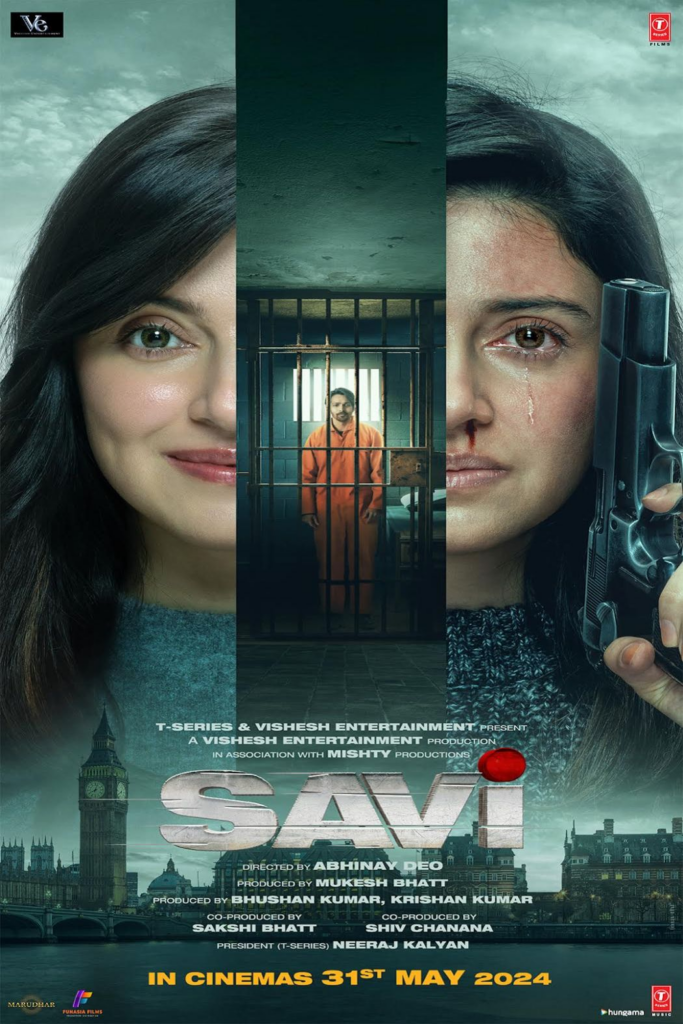
In Savi, Savi, played by Divya Khossla, is depicted as a homemaker living with her spouse, Nakul, played by Harshvardhan Rane, and their son in Liverpool. Her spouse gets arrested based on circumstantial evidence for murder and is sentenced to life imprisonment. They are both utterly helpless. Nakul spends a miserable time in prison, where he is beaten up by hardened criminals. The film is about her plotting and enabling his escape. In both the original 2008 French film ‘Pour Elle’ (Anything for Her) and the subsequent 2010 American adaptation The Next Three Days, the woman is shown to be arrested while it is her spouse who executes the plan for a prison escape. It was quite refreshing to see the reverse in Savi, where it is the woman who engineers the prison escape for her spouse. By doing so, the film challenges the stereotypical notion that only men are capable of intelligent, risky, bold acts like plotting prison breaks while women are emotional beings, best suited for household work and caring duties. The woman investigating officer in Liverpool remarked that Savi was merely a housewife and, therefore, did not believe that she could be capable of such scheming. The utter fallacy of such a belief system has been called out by feminists across eras.
Mrs Mahi and Savi both emerge as ‘willful girls,’ borrowing the phrase from the book Living a Feminist Life by the British feminist thinker, Sara Ahmed. Willful girls are not always appreciated by society as they break the norms by exerting their will. In a heteronormative world, to pursue cricket as a married woman means sacrificing the family’s well-being by not being available on beck and call. Mrs Mahi disappoints her father, though not quite her in-laws, for the fame she brings to the family. The film does not dwell much on the marital household of Mrs Mahi but we learn that her in-laws do not interfere much with her and their son’s decisions.
Savi, an ‘ordinary housewife,’ is shown to fight the state and the British legal system. She is helped by an ex-convict Mr. Paul, played by Anil Kapoor, but he has been cleverly portrayed as a guide helping from the siderather than being an active plotter for the prison escape. Mrs Mahi’s refusal to be coached by her husband and be on her own and Savi’s firm decision to plan the prison escape, despite battling her fears and her spouse’s dismissal of her plan, highlight their determination and clarity. The two men who helped the women achieve what they did, Mr Mahi & Mr Paul, merely played supporting roles. Such a withdrawal by the men could be seen as a sign of the collapse of the disciplinary apparatus that governs women’s bodies and regulates their behaviour. It provides space for women to just exist at ease. Women do not need men to lead them, as more commercially successful films (say, Jawan, Chak de) continue to portray. Empathetic, caring partners in the lives of women have the potential to create meaningful conjugal bonds.
Willfulness implies “do not adjust to an unjust world,” in Ahmed’s words. Mrs Mahi and Savi both refused to “adjust to an unjust world” in their distinct ways. As opposed to Indian films, which glorify toxic masculinity, both these films are interlaced with liberating messages, albeit not in a revolutionary tone. Nakul and Mr Mahi repose faith in their spouse’s actions and decisions. The films depict the tenderness of the masculine, while the counterpart feminine, is not portrayed as an aggressive figure either. However, after portraying women as independent thinkers, Savi falls short of the choice of the name itself, Savi, a short form of Savitri, the Hindu goddess from Brahmanical mythological texts. Not only does it highlight the continuous circulation of subtle caste references that perpetuate caste inequalities, but also the mythological figure of Savitri as the virtuous married woman who is devoted to her husband does not permit Savi to emerge entirely as a story about love and comradeship in marriage. Likewise, the use of the prefix ‘Mrs.’ in ‘Mr. & Mrs Mahi’ is also questionable. The films create an egalitarian projection of marital relationships without fundamentally challenging the patriarchal instincts of the heteronormative conjugal space. There is room for more creative and radical re-imagination of intimate partnerships.
***
Deblina Dey is a Fulbright-Nehru Visiting Scholar at the Women’s & Gender Studies Department, DePaul University, Chicago, United States of America (USA).