
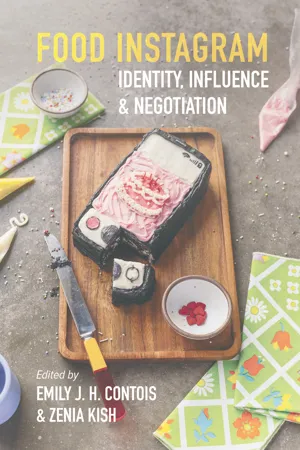
In a world where “camera eats first” has become an instinct, Food Instagram: Identity, Influence, and Negotiation edited by Emily J. H. Contois and Zenia Kish (and published by University of Illinois Press in 2022) arrives as a timely and much-needed investigation into how social media specifically Instagram reshapes our experiences of food, self, and society. As a postgraduate student trying to navigate the interlinkages between media, identity, and everyday life, this book felt both relatable and intellectually stimulating. It doesn’t just tell you what’s happening on your Instagram feed it gives you the tools to think more deeply about what it all means. The book is a collection of seventeen chapters grouped into three overarching themes: Identity, Influence, and Negotiation. It brings together a diverse mix of academics, artists, journalists, and even influencers to explore how Instagram isn’t just about food photography it’s a complex digital ecosystem that connects aesthetics, politics, labour, and representation. What makes this volume especially engaging is its interdisciplinary tone, which speaks to readers from cultural studies, food studies, media studies, gender studies, and even political science.
The introduction by the editors is quite expansive it acts like both a primer on Instagram’s visual culture and a reflective commentary on its role in constructing food narratives. They even draw parallels between Instagram’s food images and older forms of food representation like Renaissance still-life paintings and cookbook photography. As someone who grew up seeing both Dal-Chawal and Dalgona coffee on my feed, I found this historical tracing insightful. It helps us understand that what looks new is often rooted in older cultural practices but digital platforms intensify them in new, powerful ways. While every chapter adds a unique flavour to the volume, a few stood out for their clarity and thematic depth. Michael Z. Newman’s chapter on the Instagram account @hotdudesandhummus uses humour and masculinity to unpack how food gets politicized and depoliticized at the same time. The account turns hummus into a cool, sexy, ‘neutral’ food, detaching it from its geopolitical contexts. I found this argument especially relevant in today’s world where food trends are often globalized without acknowledging their roots.
Another compelling chapter is Tsugumi Okabe’s analysis of Japanese diet food culture and how cuteness (or kawaii) gets merged with food restriction. Using the lens of girlhood and aesthetic performance, Okabe brings out the troubling intersections of body image, patriarchy, and consumption. As an Indian reader, I couldn’t help but think of similar trends in our own influencer culture where women are often expected to post ‘aesthetic’ meals that are both appetizing and calorie-conscious. The chapters under “Influence” look at how Instagram creates micro-celebrities, blurs the line between advertisement and authenticity, and influences even traditional industries like meat production. The essay by Emily Truman on the #UnicornLatte war between a Brooklyn café and Starbucks felt like a Netflix miniseries it’s a real story of how hashtags, aesthetic value, and corporate muscle collide in the digital age.
What I appreciated most about this book is that it doesn’t present Instagram as purely a tool of neoliberal capitalism or purely a site of resistance it shows how it can be both. Chapters like Robin Caldwell’s reflection on how Black women built community through food during the COVID-19 lockdown highlight the platform’s potential for care, solidarity, and cultural pride. At the same time, the book doesn’t shy away from pointing out Instagram’s darker side its role in perpetuating unrealistic body standards, erasing labour behind food, and even endangering farmers through geotagging. That said, as a student reader, I did feel that some chapters assumed a bit too much theoretical background. A few essays dipped heavily into academic jargon, which might make them slightly less accessible to general readers or undergraduates. It might have helped if each section had a short introduction to thread the chapters together thematically.
Overall, Food Instagram is a book I would recommend not just to scholars, but also to foodies, creators, and everyday Instagram users who want to think more critically about what they scroll past every day. It offers a fresh perspective on something seemingly mundane snapping a food photo and reveals the layered meanings and politics behind it. For me, the biggest takeaway is that food on Instagram isn’t just about appetite it’s about identity, labour, memory, politics, and power. In the end, the book lives up to its title: it’s not just about what we eat, but about how we negotiate ourselves through what we post.
***
Subham Kumar has pursued an MA in Development Studies at the Department of Humanities and Social Sciences (HSS), Indian Institute of Technology (IIT) Guwahati.