
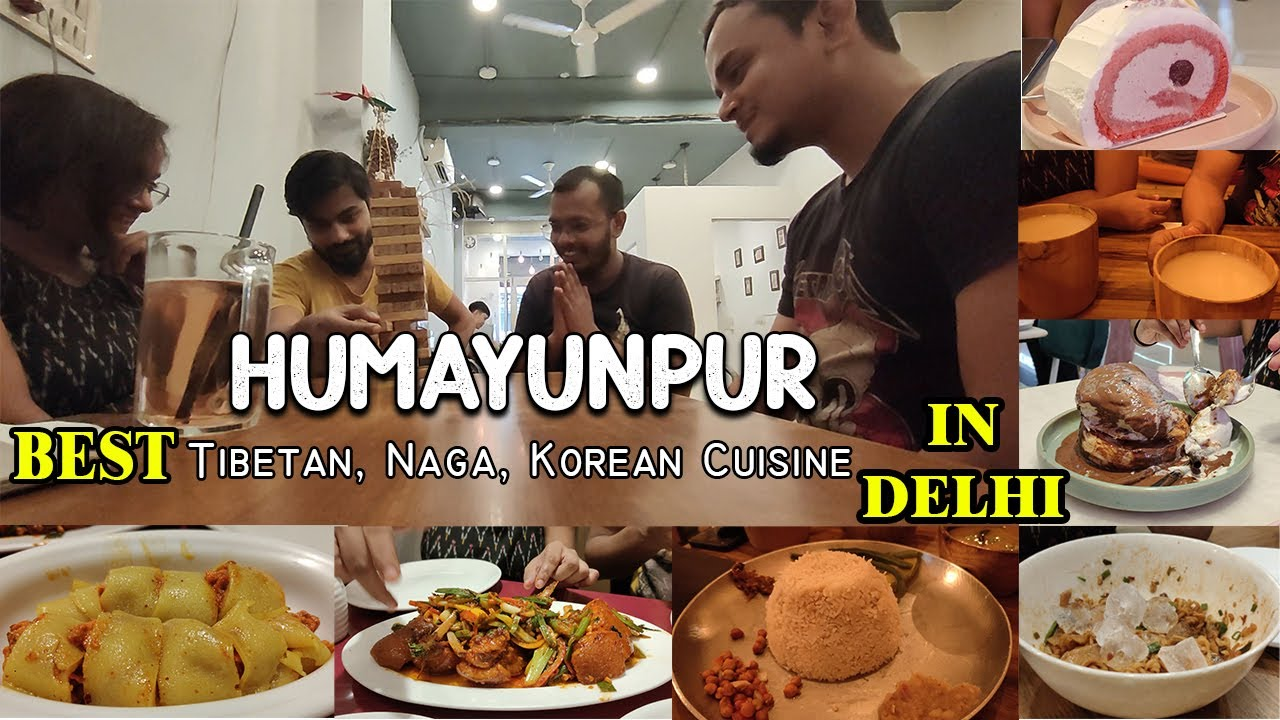
‘Humayunpur feels like home.’
‘I feel safe when I am there.’
‘The food there reminds me of home.’
– Residents of Humayunpur
Located in south Delhi, Humayunpur is an area with one of the highest migrant populations hailing from the Northeastern region of India, including Sikkim, West Bengal (mostly Darjeeling), as well as Nepal and Tibet (McDuie-Ra, 2012). These ethnic groups live in rented houses, mostly owned by Haryanvi families for decades. The area has emerged as a popular attraction for migrant youths in Delhi owing to the presence of a variety of businesses like restaurants, clothing shops and grocery stores with shelves filled with food from back home. The restaurants specialise in a huge variety of Northeastern as well as Tibetan, Bhutanese, Nepali as well as Korean and Indo-Chinese cuisines. The grocery stores sell spices/condiments used in cooking Northeastern food. This article looks at how food plays a role in creating a ‘home’ and sense of belongingness for migrants in a metropolitan city like Delhi and how individuals negotiate with these ideas to create a pan-identity. It deals with understanding the characteristics of this space that make it ‘safe” and ‘close to home’. It also aims to look at the way food plays a major role in bringing people close to each other, with constant negotiation with the aromas of fermented food that are considered smelly by the locals and how it helps in shaping the feeling of belongingness among migrant communities.
Interviews of 11 individuals were done through a semi-structured interview guide that explored themes around food, identity and belongingness. 3 were students from Northeast studying in Delhi, who did not reside in Humayunpur, 2 were youths residing in Humayunpur, one was a real estate businessperson in the area, and 5 were restaurant owners who have lived for over 20 years in the area. The narratives of these individuals were collected.
Food and Belongingness
‘Going to Safdurjung feels like I have come back home. Seeing people like you makes me feel included. One thing that I like is that you can easily ask for any food there without any fear of judgement,’ – Student from the University of Delhi.
Food is interlinked to culture, and the way it manifests community identity becomes crucial. The ethnic group created through similar identities and food habits has, over time, become a part of the larger economy of the city. Kikon and Karlsson (2019) wrote about food and identity of Northeast migrants to the new city, which is attached to it, ‘Food gives the comfort of connecting the migrants to their home back in the northeast. The eating places cater to the migrants as they serve as a marker of community. Food becomes important to negotiate their places in a new city’.
Humayunpur provides the space for this migrant community to indulge in food that is rarely found in other parts of Delhi. Many have noted how even if people live away from Safdarjung, they come back at least on weekends to spend time in Humayunpur and explore northeast food. It is more than a hub of restaurants and cafes.
‘After moving out of home, I truly understood why food is often called an emotion – how deeply it connects us to places, people, and memories. Amidst the rich and often overwhelming North Indian spices, the first thing my heart longed for after moving out was the gentle, familiar flavours of Northeastern food, something as simple as ‘aloo pitika bhaat,’ – A student in Delhi.
Ruby, owner of Oh Axom, an Assamese food restaurant, mentioned, ‘Humayunpur has become like a mini northeast’. She talked of an instance where in Bihu, many Assamese students come to her restaurant to eat Assamese food that they miss here being far from their home.
Food plays a role in creating a ‘home’ and a sense of belongingness for migrant groups in a metropolitan city like Delhi. Individuals often negotiate with these ideas to create a pan-identity by indulging in food that brings back the tastes of their native place while being in a distant place.
Politics of Smell
Fermented food, which is widely used by the migrant community in this area, has a strong aroma. Fermented food creates an identity of its own in that it represents the indigenous cuisine from the region (Kikon, 2021). For instance, the Naga ‘Axone’, Sikkimese ‘Kinema’ and the Nepali ‘Gundruk’ – all of these fermented foods from the northeast Indian region are distinct markers of their respective regions and cultures. Fermented food in northeast India stands in contrast to Michael Pollan’s view on fermented foods as a means of homogenising food experiences (Kikon, 2021). In places outside northeast India, such foods are termed as exotic and marginal to dominant food cultures in India. Although fermented foods like milk, rice, cereals and so on are consumed in other parts of India in forms of curd, cheese, buttermilk, and ingredient mixes, the fermented foods from northeast India are often looked at as being inferior and revolting. This notion, Kikon (2021) argues, is founded on class and caste hierarchies.
One of our respondents, who is a landowner in Humayunpur, said:
‘Ye log ke khane se itna smell aata hai ki aapko vomit aa jayega.’ (Their food smells so much that you’ll feel like vomiting.)
Smell finds its place beyond the walls of rented apartments, often seeping into the lanes of Humayunpur and neighbours’ houses. Those without exposure to fermented food would find the smell to be pungent rather than aromatic. The association of food with smell then becomes an important marker of identity and food habits.
While the smells for the participants of the northeast were associated with the feeling of ‘belongingness’. Smells are intimate. They are like whispers, hence the emphasis on subtlety. To let a smell go wild is to shout out a secret in public’ (Dey and Sayeed, 2019).
One participant shared that while making fermented foods with a strong smell, she put them in a plastic packet so that the smell would not spread too much. This can be seen as a way of creating one’s space and preserving culture through negotiations in an alien place. Negotiation and assimilation thus become important aspects of finding a place of their own for the migrant community, be it through food or identity.
Reimagining spaces
‘Home’ is a place that can neither be restricted to a geographical area nor a particular feeling. It changes and constantly gets modified. The experience of Humayunpur has been similar, where the migrants from Northeast India, as well as Nepal and Tibet, have created a space that they call their ‘home’. The ethnic migrant groups have been able to create an identity of their own through decades of coexistence, which has further redefined this urban space.
McDui-Ra (2012) notes that it is extremely rare for Northeasterners to own property in Delhi, and most of them are rentiers. Landlords often extend existing buildings by constructing additional floors and renting these out to Northeasterners at high prices. The rentiers are mostly working professionals, small business owners and students. McDui-Ra further highlights that most Northeasterners prefer to live in neighbourhoods where other Northeast migrants are found in large numbers. One of the participants, who is a student, emphasised the importance of ‘safety’ and how they can move around freely in the area as compared to other localities in Delhi. She stated:
‘You can wear whatever you want while visiting Humayunpur, and no one will make you feel uncomfortable. They don’t stare at you or comment on anything, and no one will even look at you with an uncomfortable gaze. Coming to a place like this is comforting in Delhi.’
‘Apna ghar yahi basa liya hein’– Real estate business person in Humayunpur
The quote translates to ‘They have made their own home here’. One of the real estate business personnel, who help people look for properties, mentioned how almost all of the rentiers have started to settle here in early 2000s from northeast India, and the migrants have made home in the new space.
Migration has always existed, and it is a collective experience (Kikon, 2019). As the oral history goes, the area of Humayunpur used to be ‘underdeveloped’ before the migrant communities came and settled here. It all started with Asha, who first opened a grocery shop where Northeast food was available.
Earlier, there were kutcha houses and rent was less, but now with new businesses coming up, rent has increased. Tolerance has increased due to the increasing businesses by northeastern people. Earlier, there were restrictions, and now there are not many as we have our association, and in case of any trouble, everyone comes together’- Asha, Business owner.
A unique idea of home is prevalent when we look at Humayunpur. When respondents from the Northeast were asked to describe this place, most of them said that Humayunpur feels like home. One student from Delhi University said, ‘Humayunpur feels like home to me as we don’t stand out there. All the people look, dress and eat like us.’ Another respondent also shared that the fashion culture of the people in Humayunpur was similar to that back home, as compared to other areas in Delhi. She felt that she was not in focus when she went there and could easily ‘blend in’.
Conclusion
Northeastern cuisine in eateries, canteens and restaurants was not easy to find in Delhi. It is only in certain areas like Humayunpur where northeastern migrants are a sizeable presence . These areas have acquired an identity of their own with northeastern, Nepali and Tibetan ethnic groups settled in large numbers and close to each other. There is thus an emergence of pan identity as ‘Northeasterns’ among the people who live in these spaces as well as those visiting them. Food becomes the anchor that brings people together to form a collective identity amidst all the differences that they call ‘home.’
References:
Kikon, Dolly and Karlsson, G. Bengt. (2019). Leaving the Land: Indigenous Migration and Affective Labour in India. United Kingdom: Cambridge University Press
McDuie-Ra, D. (2012). Northeast Migrants in Delhi: Race, Refuge and Retail. Amsterdam University Press.
***
Madhusmita Devi has completed a Master’s in Social Work (Public Health) from Tata Institute of Social Sciences (TISS), Mumbai. Prerona Barman has completed her Master’s in Sociology from the Delhi School of Economics (DSE), New Delhi.