
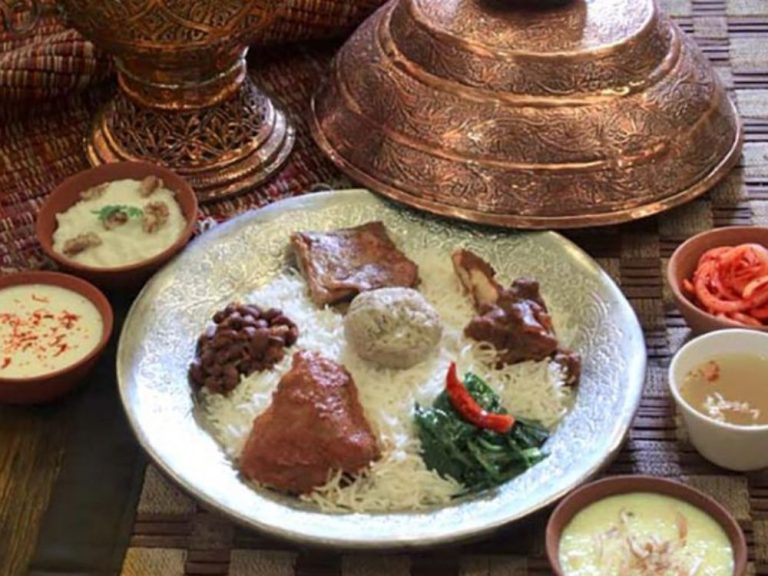
Introduction: Wazwan as a Cultural and Social Institution
Food has often been considered a representation of culture, identity, and heritage. However, from a sociological perspective, food practices often represent sites within which power relations, social structures, and gender relations are negotiated and institutionalised (Glucksmann, 2014). In this light, the Kashmiri Wazwan, a multi-course ceremonial feast, offers a useful site for examining the gendered division of labour. While women are usually associated with cooking in normal life, the prestigious and public preparation of Wazwan is carried out by male cooks, called Wazas. This construction underscores that foodways serve not only as an expression of culture but also as a means of gender stratification (Das & Mishra, 2021).
Wazwan is more than a meal; it is an exquisitely prepared social institution. In the traditional service, it is a delectable multi-course meal of finely cooked and fragrant meat dishes served one after another in order of ceremonial significance, with each course bound by honour, hospitality, and the communal reputation of Kashmiri culture. The scale of a tremendous meal, capable of handling hundreds of guests, requires technical mastery, coordination, and leadership. These aspects are exemplified in the Waza, who assumes a hereditary and highly revered position. The Waza’s power extends to a range of responsibilities beyond meal preparation, including directing assistance, utilising resources, and representing the host’s standing.
Gendered Culinary Labour and the Production of Masculinity
At the root of Wazwan is a significant gender-based division of labour in the kitchen. Women are responsible for household cooking to ensure that the members of their family are fed. This is a continuous process of free labour that is not recognised (Das & Mishra, 2021; Kemmer, 2000). Men, on the other hand, are responsible for cooking for special occasions, from which they earn money. The fact that women are not allowed in the preparation of Wazwan is not because of a lack of skill or knowledge, as Kashmiri women possess a great deal of culinary skills which have been imparted to them over the years. The reason for this is due to the role of space, size, and legitimacy. While cooking at home is considered suitable for women, cooking for 100 or 200 people is considered the domain of men, demarcating a clear line between public and private power (Glucksmann, 2014).
That is the point that marks a broader trend in feminist theory: the work that is associated with the domestic sphere is feminine and regarded as of little value (Glucksmann, 2014; Kemmer, 2000). The work that moves to the public sphere is elevated. Looking at the situation of Wazwan, the important thing is not the cooking itself but the space where the activity happens. In the domestic space, the women’s role of preparing a meal is regarded as a natural act. However, in the case of men cooking in official ceremonies, cooking is viewed as skilful, controlled and authoritative. Therefore, Wazwan reframes cooking as performative masculine work, dismissing the idea that cooking is women’s domain by default.
The significance of the role played by the Waza cannot be overemphasised in defining kitchen masculinity. In any kitchen, it is mandatory that a Waza shows masculine qualities in relation to stamina and skills because cooking a lot of meat requires strength. Learning from senior Wazas encourages brotherhood and passing of power through masculine strata. In this way, the exclusion of women is compounded with the masculinization of cuisine, finding its realisation in the preparation of Wazwan cuisine as a specialised skill that is removed from the domestic domain, thereby inscribing the exclusion of women as a cultural and not a political phenomenon.
Tradition, Power, and the Reproduction of Gender Stratification
Tradition significantly contributes to justifying the exclusion of women based on gender. Those who oppose women preparing Wazwan often raise issues related to ritual cleanliness, physical strength, or societal norms. These reasons serve as cultural justifications that uphold male dominance in public culinary roles. By portraying exclusion as a way to honour tradition, the system deflects criticism and resists change. From a sociological perspective, this demonstrates that tradition is not unchanging but is actively employed to sustain current power structures (Kemmer, 2000; Das & Mishra, 2021). What is claimed to be continuity is, in fact, the ongoing reinforcement of gender inequality.
These traditions have stood the test of time, even against the modernising and commercialising forces in society. Although women have gradually made their way into the business side of cooking in restaurants, hotels, and catering, which are outside the traditional Wazwan cooking, their involvement in ceremonial cooking remains minimal. Selective participation in this industry seems to suggest that the problem is not women’s place in public life but access to symbolic and ritual power. This also suggests that there is a second dimension to Wazwan as an institution that regulates acceptable and unacceptable forms of women’s work.
Sociologically, the Wazwan points to the fact that gender inequality does not stem from the exclusion of women from the labour force, but rather, from their exclusion from recognised, prestigious and socially sanctioned work. Cooking itself is an act charged with the power struggle over who cooks for whom, and under what circumstances. Viewing Wazwan via a gendered lens exposes how cultural practices are invoked to justify social stratification while creating an apparent harmony and festivity (Glucksmann, 2014; Kemmer, 2000).
Conclusion
In summary, the Kashmiri Wazwan does not exist simply as a cuisine but as a gendered institution that labours, empowers, and provides prestige in a masculine fashion. Women produce everyday food for the family, which preserves both culture and community. Their role exists in the private, domestic domain, while men who cook for Wazwan satisfy public masculinity and increase honour and status. A sociological perspective of Wazwan shows how food practices become a mechanism to reproduce gender relations. Culture is neither transmitted nor naturalised. It is structured, contested, and constitutes a labour of reproduction and struggle for domination.
References:
Das, S., & Mishra, A. J. (2021). Dietary practices and gender dynamics: Understanding the role of women. Journal of Ethnic Foods, 8(4), Article 31.
Glucksmann, M. A. (2014). Bake or buy? Comparative and theoretical perspectives on divisions of labour in food preparation work. Anthropology of Food, (10).
Kemmer, D. (2000). Tradition and change in domestic roles and food preparation. Sociology, 34(2), 323–333.
***
Arwa Rafie is a master’s student in Sociology at Jamia Millia Islamia, New Delhi.