
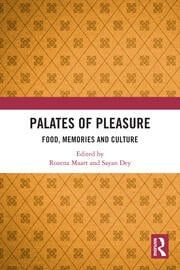
Food narrativises and personifies itself as a cultural artefact and memory of the community. It dispossesses and holds the bodies into account, especially the tongue, to narrate how culture depicted through the notions of cooking and consumption, end up forging the concept of ‘palate’. A palate, then becomes a container for the resistance, conflict and sacrifices endured. Palates of Pleasure: Food, Memories and Culture (published by Routledge in 2025), edited by Rozena Mart and Sayan Dey, traces the journey of the palates, to speak and allow the tongues to finally claim the taste, rightfully, for their shared history.
The book starts with a focus on the politics of ‘borrowed dishes’ and gratification that the coloniser has always appropriated and sought out. The first chapter looks at the way the community of District Six (a residential neighbourhood in Cape Town, Africa) have a rich culinary history. It also looks at the many ways enslavement occurred over the mind, body and soul, the hands and the palate of the enslaved, and how these food habits, which were borne out of struggles and conflicts, were used as pleasure points by the colonisers. For them, it was a dish which contained gratification, bereft of the pain and struggle of the oppressed. They lived on the music and the rhythm the community generated. The author goes on to write that despite the laws and the lashes that were imposed on the community, the difficulties of overcrowding, and lack of basic human facilities, the love of food remained central to the District Six community, bringing families together.
The body of the subaltern, who has internalised deprivation and subjugation, and on whose body the politics of food and power plays out, is forced to demand ‘less’ for their palate. This happens in a similar wavelength of ‘censoring of pleasures’ through religious stratification. Chapter four Exercising Power over Subaltern Bodies: Forbidden Foods and the Hindu Widow by Sukla Chatterjee underlines the Hindu widow’s body being a site where purity, restraint and celibacy must be upheld. She must withhold herself from engaging in non-vegetarian dishes, as they represent the symbolic ‘depravity’ and ‘indulgence’ of the culinary space. In the section, Eating with the ‘Others’: Caste and Religious Battles Inside the Kitchen Spaces of India, the Hindu kitchen space functions as a symbol of caste and religious hierarchies through the usage of separate utensils for the maidservants, and deeming them to be ‘unhygienic’. It also goes into how social media spaces such as Instagram and Facebook, culinary groups are created by high-caste Hindus to promote vegetarian and vegan culinary cultures across India. These groups celebrate and idealise vegetarianism in relation to a Brahminical patriarchal identity. For these identities, the creation of a majoritarian Hindu ethnostate is simultaneous with the propagation of vegetarianism.
In the chapter titled Food, Colonialism, and Enslavement across the Ocean (India and South Africa) by Rozena Maart and V. Ratnamala, they talk about how “food is a marker of caste culture”. They detail their experiences as an anti-caste, anti-Brahmanical Bahujan woman, the caste impositions that have been prevalent in their mother’s cooking, starting from how the rice must be boiled to whether the pot should be drained of the water or not. They also talk about how temple food and funeral food are regarded as colonial-free Indigenous foods, since they do not incorporate foreign vegetables such as chillies, tomatoes, and potatoes, which are not native to the country. They also speak about how in Brahminical families, the cooking must be according to traditional ritual modes, whereas in Dalit Bahujan families, cooking is a mundane task, with the intention to nourish and sustain the family, and it destabilises the position of religion on having a hold over one’s palate and eating rituals, subsequently their gastronomic desires.
Much of the Mizo cuisine and culture has been appropriated and stereotypically portrayed through media and other depictions. The chapter Mizo Ethnic Food Culture by Karen Donoghue, V. Ratnamala and Christina L. Varte goes into the formation and beginning of Mizo culture, entwined with cuisine. The authors speak about how colonialism affected, starting from the way the old Mizo worldview essentially governed around chieftainship, to one centred around the church and a Mizo understanding and expression of Christianity. This specifically made certain food habits and choices prohibitive, such as zu (rice beer), in pre-Christian Mizo society was an important part of the traditional way of life. Drinking zu was an act of community and celebration. The influence of Christianity, imposed on drinking, has continued to be a legal clause, till now, as the sale and consumption of alcohol are legally prohibited. There are other dishes which are mentioned, such as ‘sanpiau’, which is made of rice porridge, papor and meat with fish sauce, moon cakes (a type of milk cake with a sweet filling that originated in China), prawn paste, etc, which were welcomed from the neighbouring states. These dishes are proof of the influences which continued to be a part of everyday life, and portray a much more fluid transaction of culinary systems.
There are appropriations and quite deeply embedded stereotypes that have been prominent in the scholarly work of various cultures, which do not go into detail regarding the community and the food it creates as a means of resistance and adaptation. They skip over the part where even the usage or the swapping of certain ingredients has been deliberate and entrenched in the cultural identity of the community. The book, I believe, through an engaging narrative mode, with interviews and personal experiences, allows the readers to be informed of said prejudices and learn about the history of the dishes, the ingredients and the cooking methods.
***
Rayana Roy is a final-year student in English Literature at English and Foreign Languages University (EFLU), who has an interest in food anthropology.