
Objects surely don’t talk. Or do they? The person in that living room gives an account of themselves by responding to questions. But every object in that room is equally a form by which they have chosen to express themselves. They put up ornaments; they laid down carpets.
They selected the furnishings and got dressed that morning. Some things may be gifts or objects retained from the past, but they have decided to live with them, to place them in lines or higgledy-piggledy; they made the room minimalist or crammed to the gills. These things are not a random collection. They have been gradually accumulated as an expression of that person or household. Surely, if we can learn to listen to these things, we have access to an authentic other voice.
– Daniel Miller, The Comfort of Things (2008)
This piece is a result of a small exploration into the imagined futures of young women. Although futures have remained prominent in our understanding and explanations of present social action, over the previous decade, there has been a growing interest in futurity and imagined futures (Ravn, 2022). “Imagined futures” can be understood as perceptions and representations about the future held by the actors (Abbott, 2016, cited in Suckert, 2022). Researching imagined futures remains challenging; these futures are fleeting and indistinct, verbal responses might be brief and stereotypical, while artistic and creative responses might be difficult to interpret (Ravn, 2022). This piece is a result of a material elicitation exercise, which inserts an object into the interview process. The object, material and concrete, evokes deeper responses than words simply might, especially when the interview focus is abstract (such as imagined futures).
For this project, five university students, within the age of 21-22, were given a prompt and asked to bring one to three objects that represented their future, or those they related to their futures. Each of them was then asked about their reasons for the selection of the particular object. Each of the participants brought different objects to represent a different aspect of the future: professional life, personal life, or continued passions or resolved confusions. At times, the objects represented multiplicity of possible futures in terms of “if not this, then this…” sentences, where the imagined futures shifted but still managed to contain the object within them.
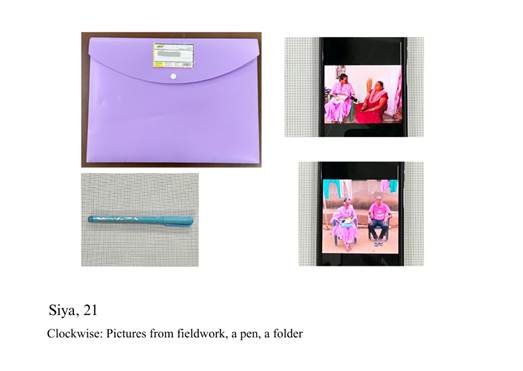
For Siya, the future was a balancing act between professional ambition and personal life. She looks forward to having a job that utilises her professional training towards public interests (represented by the folder and the pictures from her dissertation fieldwork). For Siya, the job is a means to an end (financial independence and social commitment) and not an end in itself. The pen was purchased from a person selling them at a traffic signal, a reminder that people find ways to improve their situation, and Siya wants to be able to contribute to that.
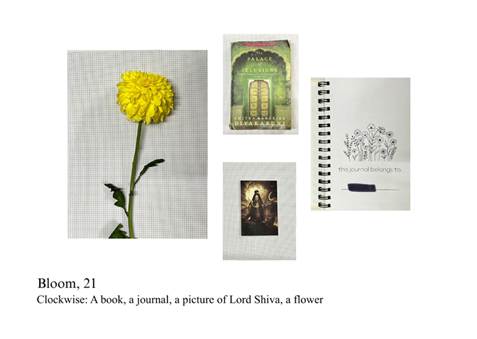
For Bloom, the future is a balanced emotional state. The book (a retelling of the Mahabharata from the point of view of Panchaali) represents her professional ambition of taking a ‘view from below’. The journal represents the personal ambition of being in tune with her feelings. The picture of Shiva, a Mahayogi, represents the ability to combine the spiritual and mundane – Shiva attains the highest state of detachment while having a family. The flower is the symbolic result of this harmony, of being in touch with one’s sensitive side.
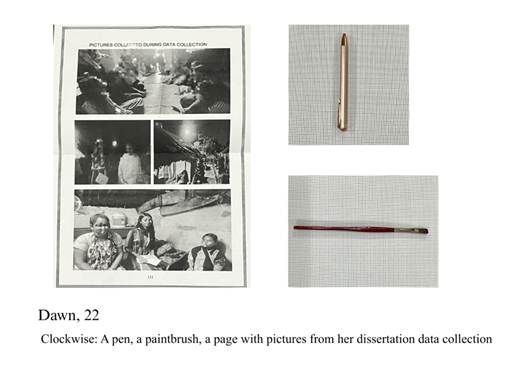
For Dawn, the pen and paintbrush represent her professional and creative ambitions. She wants to have a job where she has authority and her signature holds power, but not lose connection to her creative child-like side. The pictures from the fieldwork represent her ability to connect and contribute to people’s concerns.
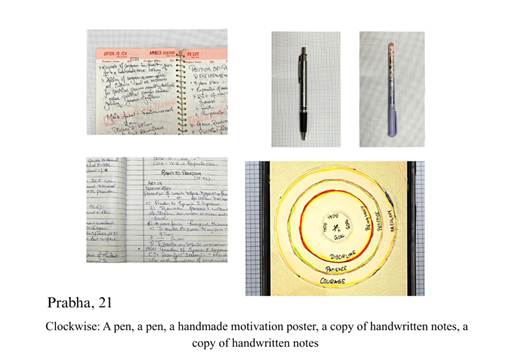
For Prabha, both the pens represent two futures: one a nearer academic future and the other a farther professional future. The pens also symbolise her father’s faith in her capabilities. The notes represent a merger of interest and curiosity with direction and ambition. The motivation poster is a reminder of her discipline and ability to stay focused.
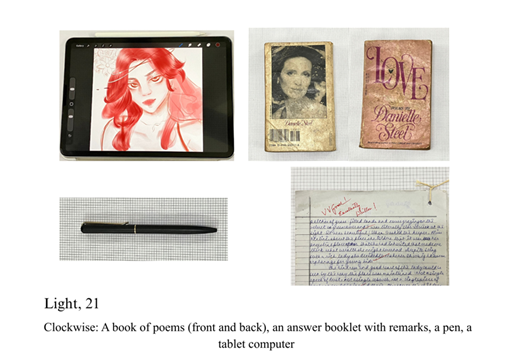
For Light, the pen and the answer booklet with a remark (that reads: V.V. Good! Excellently Written!) are evidence of her ability to write well, an ability which she wants to base her future on. The book is a thoughtful gift shared between her parents, which is a reminder of personal bonds that involve knowing the other person well enough to give a perfect gift – a kind of bond she hopes to have in the future. The tablet computer represents many things: technological proficiency, a form of expression, a digital archive of self.
A few common themes emerged in the five interviews: the primary role of education in making these imagined futures possible; the apprehension of balancing the personal and the professional; and a desire for continuity of self by protecting their creativity and emotions from anticipated external pressures. However, this could be explained by the similar social backgrounds of the participants; therefore, more diversified interviews would be required to definitively attribute these specific themes to gender.
As the reader would have noticed, a lot of the description of the object involved references to past events or feelings. The future, as an imagined reference point, serves to construct a narrative of continuity between the past, the present and the possible future. Objects often serve as reminders or evidence that the preferable future is indeed probable, also serving as a relief for any doubts or hesitations they hold. Objects, often mundane and mass-produced, are changed in their symbolic values by the emotional association prescribed to them by their owners. These objects are then able to act as probes that go deeper into their consciousness than words simply might, encouraging more detailed and vivid descriptions.
References:
Ravn, S. (2022). Exploring Future Narratives and the Materialities of Futures. Material Methods in Qualitative Interviews with Young Women. International Journal of Social Research Methodology, 25(5), 611–623.
Suckert, L. (2022). Back to the Future. Sociological Perspectives on Expectations, Aspirations and Imagined Futures. European Journal of Sociology, 63(3), 393–428.
Further Reading: Harper, D. (2002). Talking about pictures: A case for photo elicitation. Visual Studies, 17(1), 13–26.
***
Anwesha Panigrahi holds a master’s from Delhi School of Economics (DSE), and is currently a guest faculty at Utkal University, Bhubaneswar.
It’s lovely to realise how imagined futures are rooted in the past, and that they act as a bridge between the past, present and the future… never thought about it like that.