
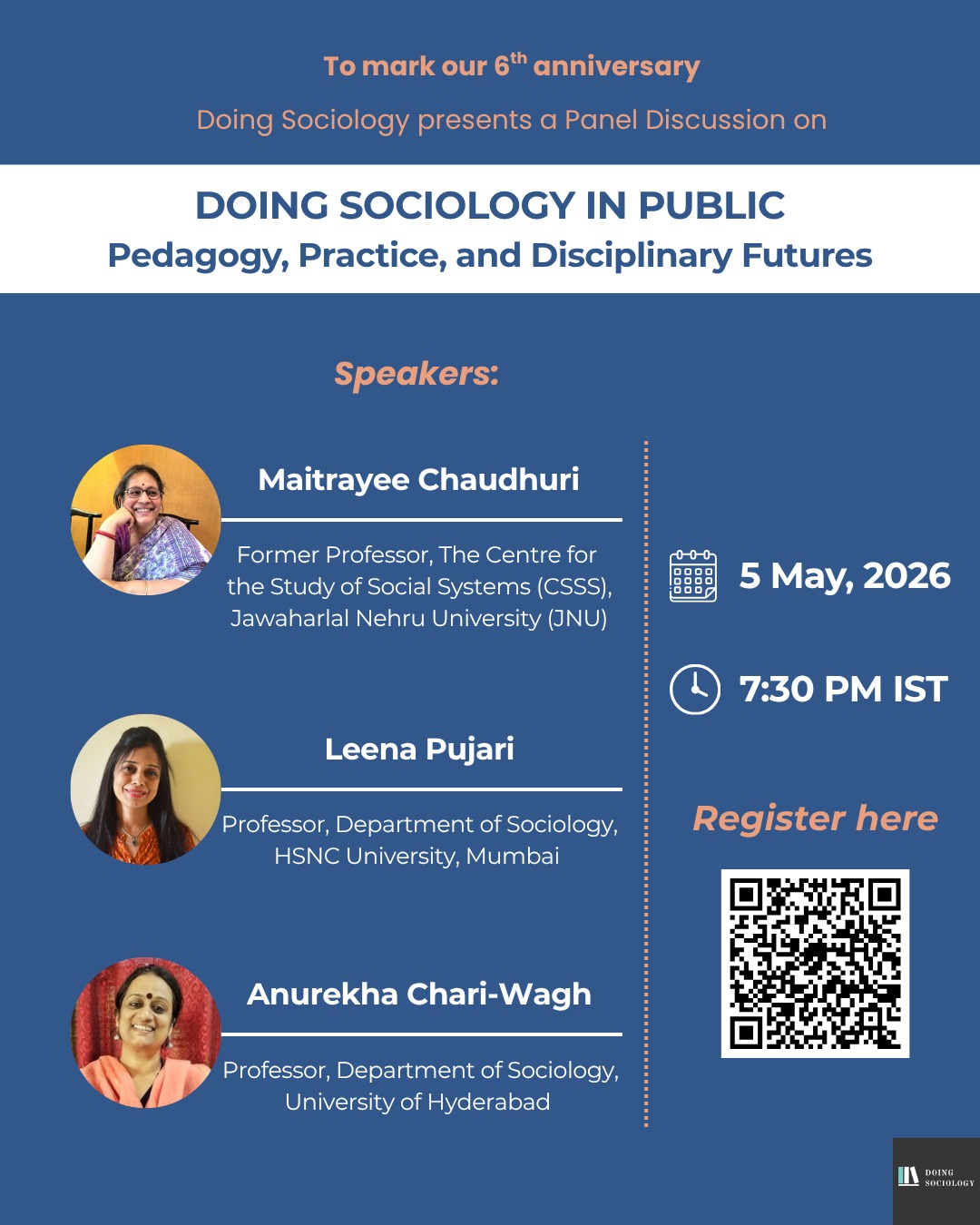
Maitrayee Chaudhuri is a retired Professor of Sociology from Jawaharlal Nehru University (JNU), New Delhi. Her research interests have been on the making of the public discourse in modern India with a focus on nationalism, colonialism, neoliberalism, populism and feminism in India. She was a DAAD Visiting Professor at Albert Ludwig University, Freiburg in Germany (2003), a Visiting Fellow at Harvard University (1995-1996) as well as at the University of Massachusetts (1995-1996) and ICCR Visiting India Chair, McGill University and ISID (2015). Her published works include The Practice of Sociology (2003), Feminism in India (2005), Sociology in India: Intellectual and Institutional Practices (2010), Refashioning India: Gender, Media and a Transformed Public Discourse (2017) and Doing Theory: Locations, Hierarchies and Disjunctions (2018). She is one of the co-founders of Doing Sociology – a digital resource dedicated to the cause of public Sociology. She has been the President of the Indian Sociological Society (2024-2025).
Anurekha Chari-Wagh is a Professor at the Department of Sociology, University of Hyderabad. Anurekha was awarded the UGC C.V Raman fellowship for her postdoctoral research at the University of Connecticut, US. Anurekha is also the editor of the book ‘Introduction to Gender Studies’ (Learning Material for PG Diploma Programme, Gender Studies, Dr B. R. Ambedkar Open University, Hyderabad). Anurekha is also a member of Decolonising Education and Research on Migration, International Thematic Network (DERM), based at the University of Ghent, Belgium. She specialises in the areas of gender, development and citizenship rights, particularly in agrarian and microfinance for women. Anurekha’s research in recent times has focused on classroom ethnography addressing issues of teaching and learning, feminist pedagogy, and mentoring. She has been writing, amongst others, on issues such as ‘interrogating privilege as a pedagogical exercise’, ‘the classroom as a site for feminist civic literacy’, and the reframing of masculinities within higher educational institutions inspired by the political interventions of radical social reformer Mahatma Jotirao Phule. Her recent publication focuses on ‘Doing Autoethnography: Towards the Self as Epistemologically Significant’ (forthcoming 2026).
Leena Pujari is a passionate pedagogue and researcher who believes in teaching for praxis and nurturing critical and analytical minds. Currently, she serves as Professor and Head, Department of Sociology, and Dean, Faculty of Interdisciplinary Studies, at HSNC University, Mumbai. Her research interests lie at the intersection of gender, law, and development with a particular focus on feminist pedagogy, feminist resistance, and feminist jurisprudence. She is a member of the Advisory Group of a transnational research project at the University of Westminster, UK, on ‘Decolonising Sexual and Gender-Based Violence in Higher Education: Innovations in Theory, Policy, and Practice’. She also serves as the Convener of the Research Committee 32 on Pedagogy, Teaching and Learning of the Indian Sociological Society. Much of her research and writing has focused on re-imagining classrooms and campuses as transformative spaces. Her current work engages with questions of pedagogical interventions for interdisciplinary classrooms and the possibilities they open for transformative learning. Her recent publications include ‘Fostering Gender Just and Emancipatory Campuses in HEIs: Interrogating the role of Gender Cells and ICs’, published in Sociological Bulletin and a chapter titled ‘The conundrum of being a feminist pedagogue in the Gender Studies Classroom’ in an edited volume on Hundred Years of Sociology in India. She is currently editing a book volume tentatively titled ‘Counter Narratives: Mental Health of Marginalised Communities in India’ to be published by Zubaan.