
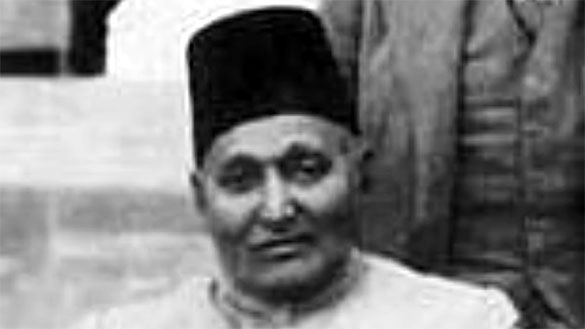
In an era where India’s legislative bodies are frequently scrutinised for their functionality, the founding principles of their design demand re-examination. While the architecture of the Indian Constitution is rightly dominated by the towering figures of Jawaharlal Nehru, Sardar Vallabhbhai Patel, and B.R. Ambedkar, its operational integrity was often secured by lesser-known leaders who prioritised governability. One such figure was Sir Syed Muhammad Saadulla, Premier of Assam, whose decisive intervention in the summer of 1947 inserted a crucial note of restraint into the design of India’s democracy.
On 17 July 1947, as the Constituent Assembly debated the Provincial Constitution, Saadulla moved an amendment that would impose a hard ceiling of 300 members for any provincial legislature. This was not merely a technical fix. It was a crystallisation of a political philosophy, born from the administrative realities of a frontier province, that democracy must be functional to be truly inclusive. His success offers a critical lesson for today: that nation-building is as much about institutional craftsmanship as it is about grand ideals.
Clause 19 and the Peril of Pure Proportionality
The draft of Clause 19 promised a straightforward egalitarian principle: one legislative representative for every 75,000 citizens. On paper, this guaranteed proportional representation. In practice, as Granville Austin notes, it risked creating overcrowded, unwieldy assemblies, particularly in populous provinces like Uttar Pradesh and Bihar, while straining the financial and administrative capacity of smaller ones (Austin, 1966).
For Assam, the stakes were unique. Saadulla, drawing on his experience governing a vast, sparsely connected territory with delicate demographics, understood that legislative mechanics could not be divorced from geography and fiscal prudence (Guha, 1977). A massive assembly was not just expensive; it was impractical in a region where infrastructure magnified every procedural inefficiency. His awareness of Assam’s logistical realities framed his broader argument for a republic-wide safeguard.
From Regional Pragmatism to National Principle
Saadulla’s strategy was a masterclass in persuasive framing. His first amendment, to alter the ratio to 1:90,000, was rejected by an Assembly still enamoured with the romanticism of universal franchise. Undeterred, he pivoted to a more subtle proposal: the 300-member cap. This did not alter the proportional formula for most provinces but acted as a brake on extreme expansion in the most populous ones.
In doing so, he transformed a regional concern into a principle of national efficiency. He argued, drawing on a Madisonian fear of overly large deliberative bodies, that an assembly beyond a certain size would see debate degenerate into noise rather than reasoned discourse (Madison, 1788). This was not abstract theory for Saadulla; it was a lesson from the ground. A smaller, disciplined assembly, he contended, would preserve the quality of legislation and remain accessible to its members.
This reframing was his masterstroke. By appealing to the pragmatic need for a workable state, he made the amendment palatable to the centralist-minded Sardar Patel. Patel’s swift acceptance of the proposal is a telling, rare instance where a leader from a peripheral province shaped the constitutional core with minimal resistance. The clause was adopted, ensuring that India’s largest states would not have legislatures so large as to become dysfunctional.
A Philosophy of Governance for a Functional Republic
Saadulla’s intervention on Clause 19 reflects the broader philosophy he practised as Premier: a steadfast belief in pragmatism over pure idealism. It was a vision where inclusivity was balanced with governability, and minority representation was embedded within a functionalist framework rather than pursued through unworkable exceptionalism.
This stands in stark contrast to leaders who viewed the Constituent Assembly primarily as a theatre for ideological declaration. Saadulla used it as an engineering workshop, understanding that the day-to-day health of Indian democracy would be determined by these granular design choices. He forced a crucial compromise in the classic democratic trade-off between size and efficiency, ensuring that the representative house would also be a deliberative one.
Legacy and Contemporary Relevance
The 300-member cap remains a feature of India’s constitutional architecture. While state bifurcations and delimitation have adjusted assembly sizes, the principle of a legislated ceiling endures. Its relevance, however, extends far beyond the number itself.
In today’s political climate, where legislative sessions are often marked by disruption and polarisation, the quality of deliberation is again a central concern. Saadulla’s reasoning—that the structure and size of a legislative body directly condition its ability to function—is profoundly prescient. The ongoing debates about the productivity of Parliament and the financial burden of expanding legislature find a direct echo in his 1947 arguments.
His legacy is a testament to the power of measured, well-argued persuasion. It is a case study in how a leader from the geographical and political margins could successfully influence the constitutional centre by appealing to a shared interest in a stable, efficient, and functional republic.
Conclusion
The story of Sir Syed Saadulla and Clause 19 moves us beyond the cult of the nationalist titan and into the engine room of Indian democracy. It reveals a constitution forged not only by grand vision but also by pragmatic adjustments insisted upon by seasoned administrators. Representation without functionality risks becoming empty symbolism; functionality without representation slides into oligarchy. In Saadulla’s successful amendment, we find one of those rare instances where the Constituent Assembly masterfully reconciled the two, giving India a durable framework for governance whose wisdom we are only now, in an age of legislative tumult, coming to fully appreciate.
References:
Austin, G. (1966). The Indian constitution: Cornerstone of a nation. Oxford University Press.
Constituent Assembly of India. (1947, July 17). Constituent Assembly Debates (Vol. IV).
Guha, A. (1977). Planter-raj to swaraj: Freedom struggle and electoral politics in Assam, 1826–1947. Indian Council of Historical Research.
Madison, J. (1788). Federalist No. 55. In A. Hamilton, J. Madison, & J. Jay, The federalist papers.
***
Jeherul Bhuyan is a graduate student in the Department of Civilizational Studies at Darul Huda Islamic University, Kerala, India. He holds a bachelor’s degree from Swahid Sowarani College, Gauhati University.