
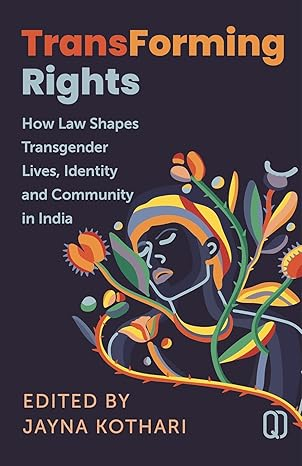
The foundation of the recently published Transforming Rights: How Law Shapes Transgender Lives, Identity and Community in India, edited by Jayna Kothari and published by Westland Books in 2026, rests on a compelling dichotomy. It contrasts celebrated progress in the legal arena with the lived realities of trans communities, which remain marred by systemic exclusion and violence. Tying together the social, legal, and political aspects of belonging as a gender non-binary person in India, the essays’ trajectory mirrors the trans rights movement itself, resembling a complex tango of translating constitutional promises into concrete realities. The curated emotional arc begins with hope sparked by landmark judgments but turns increasingly bleak as material realities set in, culminating in a sobering examination of state militarism.
Writing recently in the Times of India about the 2026 Trans Amendment Act, Jayna Kothari described the move toward medical certification as a knife twisting into the community’s heart. This present-day crisis is exactly what the essayists in Trans Forming Rights warn against as they unpack India’s foundational transgender jurisprudence. While landmark cases like NALSA (2014) and the Transgender Persons Protection of Rights Act 2019 anchor the book, the contributors expose their deeply flawed reliance on medicalisation. In analysing higher education, Sayantan Datta critiques NALSA for reinforcing biological essentialism, arguing that the mandate for medical boards is a literal manifestation of Michel Foucault’s “medical gaze.” Building on this, Mihir Rajamane and Vibha Swaminathan explicitly frame the Trans Act as treating transgender bodies as sites of biopolitics. Through pathology and surveillance, the State forces bodies to become legally legible before granting welfare, ultimately turning the doctor into a gatekeeper of citizenship.
Moving into the social sphere, essays bring attention to the glaring absence of emerging and alternate kinship systems in Indian law. Chayanika Shah explores how the state recognises the traditional family as the sole legitimate representative of a person, equating marriage with reproduction. This framework leaves alternative structures like the guru and chela custom legally vulnerable. The law’s failure to account for affinal and filial bonds outside heteronormativity leaves marginalised individuals facing disinheritance and familial violence. Contextualising this, Siddharth Swaminathan maps broad public attitudes, revealing a society where a significant portion remains resistant to queer relationships, despite education offering slight shifts. As our traditionally patriarchal society inches towards ‘one nation, one law,’ the complexities of these alternate kinship structures demand a sustained public discourse.
The struggle for rights extends into livelihood and education, where several essayists effectively call on Susan Mettler’s “policyscape” to analyse conditional state welfare. S.V.D. Chandrasekhar and Avinaba Dutta highlight community-driven models like the PLEQSUS India Foundation while dissecting cascading flaws in state policies. They note how the SMILE scheme forces a Scheduled Caste trans student to choose between a caste-based or gender-based scholarship, ignoring the intersectional reality of facing violence on both fronts. Extending this lens to higher education, Datta notes that policies like the National Education Policy 2020 are discourses constructing subjectivities, exposing the irony of integrating trans persons into educational spaces with largely unaccommodating curricula.
Perhaps the collection’s most compelling interventions occur when it forces the reader to confront the blind spots within the mainstream transgender movement itself. The discourse frequently defaults to a homogenised, mainland trans identity, an erasure that Santa Khurai powerfully disrupts by detailing the exclusion of the indigenous Manipuri Nupi Maanbi or Nupi Maanba. This is a poignant reflection of the broader political marginalisation of the Northeast, proving that legal recognition often fails to translate across regional realities. This demand for a deeply intersectional approach is further cemented by Vyjayanti Vasanta Mogli and Grace Banu, who argue that without cross-movement solidarity and horizontal reservations, marginalised bodies will continue to face bureaucratic erasure. Amidst these heavy and compounding vulnerabilities, Arvind Narrain’s essay on Chelsea Manning offers a crucial, necessary breather for the reader. By envisioning a queer politics rooted in radical empathy, Narrain provides a much-needed theoretical respite. Yet the collection refuses to let the reader rest in that comfort for long. It abruptly pulls the narrative back into the bleak reality of state surveillance with Diti and Vihaan’s examination of police violence, ensuring the book concludes on a note of vigilance rather than a note of peace.
Born out of the conferences hosted by CLPR, Trans Forming Rights is a significant contribution to gender and legal studies in India. Its primary strength lies in refusing to view legal victories in isolation from the material, historical, and social structures enforcing heteronormativity. By gathering voices spanning legal practice, academia, and grassroots activism, Kothari provides a comprehensive critique of how the Indian state grants rights with one hand while policing bodies with the other. Nonetheless, the current discourse risks ghettoising the community if it remains trapped in the ivory tower. This book holds enough merit to venture out of academic circles, perhaps in mutated, accessible forms across social media, making its way into everyday discourse to truly transform the community’s place in society.
***
Ruchi Nanwani has graduated with an MA in Sociology and Social Anthropology from the Tata Institute of Social Sciences (TISS), Guwahati.