
Introduction
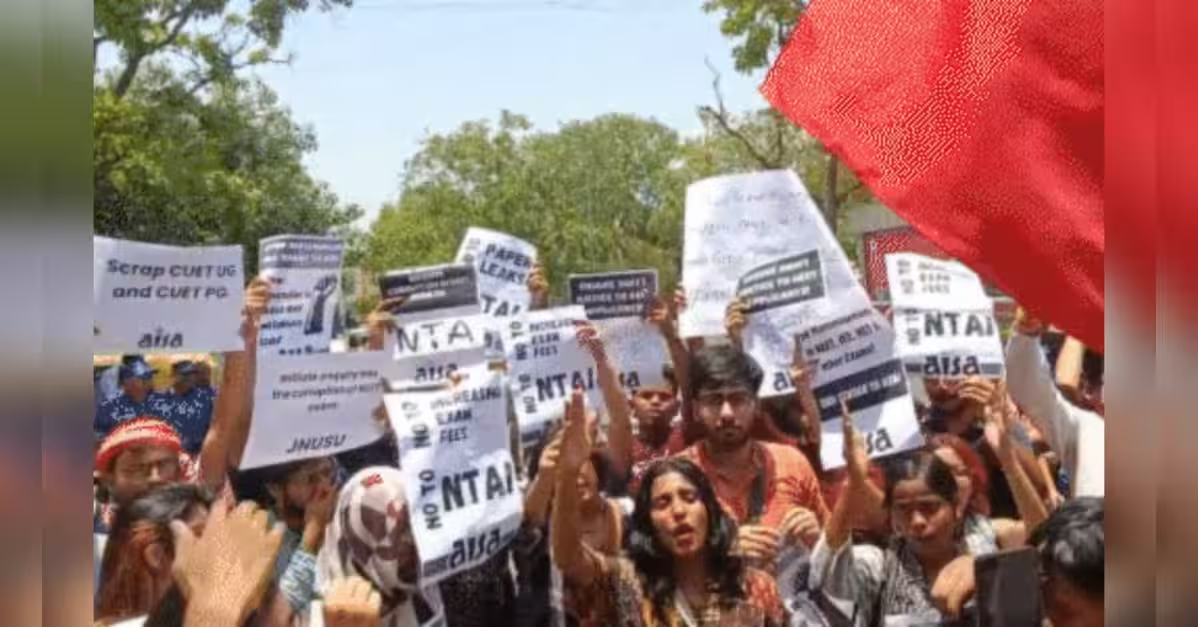
Thousands of young Indians took to the streets in June and July 2026 over a leaked medical entrance examination, rallying behind a satirical social media account (Maniyeri, 2026; Parth MN, 2026). The National Eligibility cum Entrance Test (NEET-UG) was held on May 3, but nine days later, on May 12, the government declared it invalid amid allegations of paper leaks. More than two million aspirants competing for fewer than 130,000 medical seats were forced to take a re-examination on June 21 (Parth MN, 2026; The Wire Staff, 2026). Within weeks, the Cockroach Janta Party (CJP) was organising rallies around the country, and commentators began to call it a youth movement. The label is sociologically loaded, implying longevity, organisation and a collective identity that a surge of online rage may lack. This paper asks whether it is deserved.
A demonstration is not always a social movement. Charles Tilly (2006) describes social movements as sustained campaigns of collective claim-making that combine a repertoire of public actions with displays of worthiness, unity, numbers and commitment (WUNC). But even the biggest rally is a moment of contestation. A movement requires sustained collective action, organisation or networks, shared claims and identity, continuity over time and an orientation toward social or institutional change (see Tilly, 2006). The study therefore does not assume that the NEET-UG demonstrations amount to a social movement. The critical question is when a demonstration becomes one. For this case, the research question is: How did the 2026 NEET-UG paper leak protests evolve from an examination-related grievance into continuous collective activism, and to what extent can this mobilisation be conceptualised as a social movement? The analysis follows the CJP, the focal organisation, although opposition parties and the activist Sonam Wangchuk also backed the protests (Reuters, 2026a; Al Jazeera Staff, 2026).
A theoretically informed case study
This is a theoretically informed case study based on secondary sources: reporting by Al Jazeera, Khaleej Times, The Wire and The Sentinel (Maniyeri, 2026; Parth MN, 2026; The Wire Staff, 2026). It is not an empirical field study, as there are no interviews, surveys or participant observation. The reports are read as documentary evidence of the mobilisation’s sequence, organisation, claims and institutional interactions, not of individual intentions (see Harutyunyan, 2022, for a discussion of case study and document analysis as methods of studying social movements). Three theories are employed as analytical tools rather than as separate sections: Relative Deprivation Theory (Gurr, 1970) accounts for the emergence of grievance, Resource Mobilisation Theory (McCarthy & Zald, 1977) explains how that grievance became organised action, and Political Process Theory (McAdam, 1982) explains how the mobilisation interacted with institutions and political opportunities. I treat the statements of spokespeople and participants as public claims, not as verifiable facts about motives. The conclusions are therefore tentative, since news reporting is selective. The account runs to mid-October 2026, and events are still unfolding.
Relative Deprivation Theory attributes collective discontent to the gap between what people believe they deserve and what they actually receive (Gurr, 1970). NEET-UG is the gateway to medical colleges, and its integrity significantly affects the life chances of young people (Parth MN, 2026). One student had taken a two-year break from formal study to prepare; the cancellation, nine days after he wrote the paper, turned relief into uncertainty. The leak thus produced a shared sense of procedural unfairness rather than scattered, individual disappointment. Public outrage at the government’s failure to prevent recurrent paper leaks extended far beyond the examinees (Parth MN, 2026). Student suicides linked to the cancellation added to the anger, and compensation for the families became a formal demand (Reuters, 2026a; Al Jazeera Staff, 2026). But resentment alone tells us little about action, for aggrieved candidates do not inevitably protest.
Organisation: from satire to structure
Resource Mobilisation Theory points to the organisations, networks and communication channels that turn grievances into action (McCarthy & Zald, 1977). The decisive resource here was digital. The CJP began as a satirical account after the Chief Justice of India compared some unemployed youth to cockroaches (Parth MN, 2026). The leak coincided with the party’s launch on May 16, and the movement also drew on wider concerns such as youth unemployment (Reuters, 2026a), so the exam was its main target rather than its only grievance. Within a month, it reportedly gained over 22 million Instagram followers and more than 800,000 signatures on an online petition demanding the education minister’s removal. It then expanded its ground capacity by bringing in local civil-society groups and student bodies in each place where it mobilised. Its spokesperson admitted that it was not a registered organisation or union. The group also kept its distance from much of the mainstream media, using social media to reach young audiences directly, and its protest reels are said to have crossed 400 million views (Parth MN, 2026).
Institutions: demands on the state
Political Process Theory emphasises the importance of political institutions and opportunities in collective action (McAdam, 1982). The CJP’s demands were institutional from the start of its street activity: its first rally at Jantar Mantar on June 6 demanded the resignation of Education Minister Dharmendra Pradhan (Parth MN, 2026). Rallies followed in Pune, Jaipur, Amritsar, Bengaluru and Hyderabad. An ‘exam manifesto’ sought compensation for candidates when papers leak, transparent testing, physical evaluation of answer sheets and an independent audit of private testing contracts. The group also planned to lobby members of parliament.
The state’s response was mixed. Police used tear gas and batons on July 20 against tens of thousands of people trying to march on Parliament (Reuters, 2026a), and mobile internet around Jantar Mantar was restricted (Al Jazeera Staff, 2026). The Prime Minister did not address the protesters directly, but on July 23 he pledged fast-track courts to prosecute those responsible for the leak (Reuters, 2026b). Opposition parties, who disrupted Parliament (Reuters, 2026b), and the activist Sonam Wangchuk, who went on a 26-day hunger strike (Al Jazeera Staff, 2026), backed the demands: the kind of allies McAdam (1982) emphasises.
Resignation and settlement
Pradhan’s resignation was accepted by the President on July 25 (Maniyeri, 2026). Ministers then met CJP representatives, agreed to examine a five-point charter of reforms and accepted three key demands: Pradhan’s resignation, the withdrawal of First Information Reports (FIRs) against protesters, and compensation for the families of students who died by suicide after the cancellation (Al Jazeera Staff, 2026; Maniyeri, 2026). The CJP then declared the end of its agitation. The resignation came amid ongoing rallies and was the demonstrators’ primary demand. Pradhan’s own public resignation statement cited the situation at Jantar Mantar (Al Jazeera Staff, 2026). That does not mean the mobilisation caused it, however; establishing that would require evidence of the government’s decision-making, which the reports do not provide.
Protest or movement? Applying the criteria
The case is mixed when measured against the distinguishing features of a social movement.
Continuity
The agitation spanned several cities and lasted around ten weeks, seven of them on the streets, but its continuity was partial (Maniyeri, 2026; Parth MN, 2026). It was more than a one-off demonstration but short for a movement. Later activity complicates this. The CJP ran a school-audit campaign in August (Sharma, 2026), called a September 5 march over what it described as unmet commitments (Sentinel Digital Desk, 2026) and joined near-daily protests against the chief election commissioner in October (Al Jazeera Staff & Reuters, 2026).
Organisation
Its organisation is informal but real, with an identifiable brand, spokespeople, a petition and local partners, but no formal membership structure. By late August it also had a National Working Committee, which reviewed the government’s compliance with its commitments (Sentinel Digital Desk, 2026).
Common claims
Its claims were shared and consistent: the resignation demand and the exam manifesto (Maniyeri, 2026; Parth MN, 2026). By October, however, they had widened to voter-list revisions and the chief election commissioner (Al Jazeera Staff & Reuters, 2026).
Collective identity
Collective identity, the sense of belonging to a larger group (Polletta & Jasper, 2001), is the least clear criterion. The self-applied label ‘cockroach’, adopted by many young people as a badge of resilience, suggests a developing identity, but the reports draw on only a small number of participants and cannot show whether it lasted (Parth MN, 2026).
Repertoire and turnout
The repertoire was wide, comprising online advocacy, street rallies, a petition and lobbying. Turnout complicates the picture: the first Delhi rally drew fewer than 2,000 people, but later gatherings reportedly drew thousands, and the July 20 march on Parliament drew tens of thousands (Parth MN, 2026; Reuters, 2026a). Observers also differed on the significance of the mobilisation: one senior journalist was sceptical that it could shake the government, while others saw it as an expression of widespread generational angst (Parth MN, 2026).
Conclusion
Looking at the three theoretical ideas together, the NEET-UG mobilisation shows a clear evolution from a procedural grievance, to digital and local organisation, to persistent claims on the state. No single theory distinguishes a movement from a protest: grievance accounts for emergence, organisation accounts for persistence, and institutional engagement accounts for direction toward change. The mobilisation has many characteristics of a social movement and illustrates how a satirical internet identity can act as an organisational resource for a generation suspicious of traditional politics.
Continuity beyond the July concessions (Maniyeri, 2026) is now partly evident in the school audits, the September march call and the October protests, although a solid collective identity and organisational endurance are not yet established. The widening of its claims also means the NEET campaign may be only the first phase of the mobilisation. The government’s side of the July settlement also looks unfinished: the CJP says commitments were not honoured (Sentinel Digital Desk, 2026), and the Central Bureau of Investigation’s (CBI) supplementary chargesheet has so far named no government or National Testing Agency (NTA) official as an accused (The Wire Staff, 2026).
As of mid-October 2026, then, this is a protest campaign with strong movement traits rather than an established movement: a movement in formation. The findings could be tested in future research through a systematic content or discourse analysis of a defined corpus of CJP posts and videos, protest speeches, slogans, placards and media statements over a specified period, examining grievance, framing (Snow et al., 1986), collective identity (Polletta & Jasper, 2001), mobilisation and political claims.
Even though these theories were written in different eras, they give us the perfect lens to understand what’s happening right now. Like Resource Mobilisation highlights how today’s activities utilise material assets, digital media, networks, people’s support, etc to organise modern movements. At the same time, the Political Opportunity Structure model explains how local political shifts can trigger widespread resistance. Looking through these lenses is how we decode the complex network of 21st-century movements and analyse the unique nature of it.
References:
Al Jazeera Staff. (2026, July 25). India’s ‘Cockroach’ youth call off protests after education minister quits. Al Jazeera. https://www.aljazeera.com/news/2026/7/25/indias-education-minister-resigns-after-weeks-of-cockroach-protests
Al Jazeera Staff & Reuters. (2026, October 13). Police detain leaders of India’s ‘cockroach’ movement at New Delhi protest. Al Jazeera. https://www.aljazeera.com/news/2026/10/13/police-detain-leaders-of-indias-cockroach-movement-at-new-delhi-protest
Gurr, T. R. (1970). Why men rebel. Princeton University Press.
Harutyunyan, G. (2022). Researching social movements: Methodological choice. Journal of Sociology: Bulletin of Yerevan University, 13(1), 55–65. https://doi.org/10.46991/bysu:f/2022.13.1.055
Maniyeri, P. (2026, July 25). India appoints new education minister as Dharmendra Pradhan resigns after NEET protests. Khaleej Times. https://www.khaleejtimes.com/world/asia/india-new-education-minister-pralhad-joshi-neet-protests
McAdam, D. (1982). Political process and the development of Black insurgency, 1930–1970. University of Chicago Press.
McCarthy, J. D., & Zald, M. N. (1977). Resource mobilisation and social movements: A partial theory. American Journal of Sociology, 82(6), 1212–1241. https://www.jstor.org/stable/2777934
Parth MN. (2026, June 16). ‘My voice is being heard’: A month of India’s Cockroach Janta Party. Al Jazeera. https://www.aljazeera.com/news/2026/6/16/my-voice-is-being-heard-a-month-of-indias-cockroach-janta-party
Polletta, F., & Jasper, J. M. (2001). Collective identity and social movements. Annual Review of Sociology, 27(1), 283–305. https://doi.org/10.1146/annurev.soc.27.1.283
Reuters. (2026a, July 22). Explainer: What’s behind India’s ‘cockroach’ youth protests? Khaleej Times. https://www.khaleejtimes.com/world/asia/explainer-whats-behind-indias-cockroach-youth-protests
Reuters. (2026b, July 23). India’s Modi announces fast-track courts to probe NEET paper leaks amid youth protests. Khaleej Times. https://www.khaleejtimes.com/world/asia/indian-pm-modi-announces-fast-track-courts-to-probe-paper-leaks-amid-youth-protests
Sentinel Digital Desk. (2026, August 25). Cockroach Janta Party announces peaceful march in Delhi on September 5. The Sentinel. https://www.sentinelassam.com/more-news/national-news/cockroach-janta-party-announces-peaceful-march-in-delhi-on-september-5
Sharma, Y. (2026, August 18). India’s ‘Cockroach’ movement makes schools next battleground against Modi. Al Jazeera. https://www.aljazeera.com/features/2026/8/18/indias-cockroach-movement-makes-schools-next-battleground-against-modi
Snow, D. A., Rochford, E. B., Jr., Worden, S. K., & Benford, R. D. (1986). Frame alignment processes, micromobilization, and movement participation. American Sociological Review, 51(4), 464–481. https://doi.org/10.2307/2095581
Tilly, C. (2006). Regimes and repertoires. University of Chicago Press.
The Wire Staff. (2026, October 15). NEET question paper leak: CBI files supplementary chargesheet, no govt, NTA officials named as accused so far. The Wire. https://thewire.in/government/neet-question-paper-leak-cbi-files-supplementary-chargesheet
***
Mayurakshi Baishya has completed her MA in Sociology from Cotton University.