
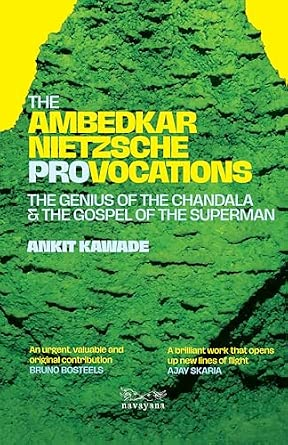
The centenary of the Mahad Satyagraha makes this an appropriate occasion to reminisce about B. R. Ambedkar’s public repudiation of the Manusmriti, the text he and his followers consigned to flames on 25 December 1927. The burning at Mahad remains a defining moment in the history of the anti-caste movement. The text’s association with December, however, is rather unexpected. Friedrich Nietzsche, that brilliant and controversial German philosopher, had found in the Manusmriti a model of social organisation worthy of admiration, particularly its ordering of ranks and exaltation of the Brahmin. Their unlikely philosophical encounter acquires a third interlocutor in Manu, whose Manusmriti becomes the subject of Ankit Kawade’s The Ambedkar–Nietzsche Provocations: The Genius of the Chandala and the Gospel of the Superman (published by Navayana in 2026).
Having encountered the Manusmriti through Louis Jacolliot’s French translation, Nietzsche admired its hierarchy, particularly the Brahmin’s freedom from political rule and social obligations, which supposedly enabled intellectual and spiritual cultivation. The Chandala, meanwhile, signified the disorder threatening this arrangement, becoming Nietzsche’s figure for a modern European society that had become a sick conglomerate of Chandalas, incapable of maintaining distinctions. Ambedkar’s encounter with Manu was equally uncompromising: his examination of the text exposed contradictions within its supposedly complete fourfold order, culminating in its public burning at Mahad. (Incidentally, Nietzsche’s Chandala is not quite the figure inhabiting the social and historical world of the Manusmriti; it is precisely this difference that Kawade investigates.)
The Chandala continued to unsettle Nietzsche’s philosophical imagination, often exceeding the historical figure he had borrowed from the Manusmriti. But it would be naïve, nay, intellectually convenient, to dismiss his fascination with Manu as mere Orientalist admiration, or his invocation of the Chandala as an unfortunate metaphor for social degeneration. His engagement, mediated by Jacolliot’s rather unreliable translation, deserves closer examination.
The European intellectual engagement with the Manusmriti was heavily mediated by emerging scholarship on Indian religion and law. Nietzsche found in the Brahmin an exemplary figure of cultivation, while the Shudra occupied a recognisable place within the fourfold hierarchy. The Chandala, however, was another matter altogether. In Twilight of the Idols, The Antichrist and his unpublished notebooks, Nietzsche employed the figure to signify the disorder threatening social rank. An 1888 notebook entry distinguishes the Shudra from the Chandala, who represents the “degeneration of all castes” and becomes a metaphor for modern Europe’s inability to preserve distinctions. Kawade brings this appropriation into conversation with Ambedkar’s examination of the contradictions concealed within Manu’s supposedly exhaustive order.
But three would also be considered company by those attempting to understand the unlikely encounter between Ambedkar and Nietzsche. Manu, notwithstanding his considerable historical baggage, is integral to Kawade’s intellectual arrangement. Nietzsche’s engagement with the Manusmriti brings the Brahmin and Chandala into his critique of modern Europe; Ambedkar’s examination of the same text places Manu at the centre of his struggle against caste. The Chandala travels between these intellectual worlds, acquiring a rather different significance in each. The Nietzsche–Ambedkar–Manu triad would, arguably, qualify as philosophical company.
What becomes apparent to a discerning and possibly sceptical, even historically minded? – reader is the asymmetry between their engagements with caste. Nietzsche approaches Manu in search of an exemplary Rangordnung, an order of rank countering the egalitarian impulses he associated with Christianity and modernity. Ambedkar, conversely, approaches the Manusmriti as an authority to be interrogated and dismantled. Shared preoccupations with hierarchy and social organisation hardly make them philosophical companions. Philosophical fraternity? Never. Kawade must therefore negotiate their considerable differences without turning the encounter into a contest of intellectual victories. His reading of Nietzsche’s master and slave moralities alongside Ambedkar’s critique of Brahminism is particularly suggestive: the Brahminical order, admired by Nietzsche as aristocratic mastery, appears rather different through Ambedkar’s account of its regulation of marriage, occupation, knowledge and social boundaries. What presents itself as mastery may depend upon prohibitions and continuous subordination. The apparent master, in other words, may resemble the reactive morality Nietzsche associates with the slave.
This is not to suggest that their encounter is without its uses. The Chandala, in particular, has risen to the occasion. Nietzsche distinguishes the Shudra, who occupies a determinate place within the fourfold order, from the Chandala, whose existence unsettles the Manusmriti’s insistence that there are four varnas and no fifth. The text must nevertheless account for those outside its arrangement through varnasamkara, or the mixing of social orders. Nietzsche appropriates the figure to diagnose modern European degeneration; Ambedkar’s historical and political concerns return attention to the social arrangements producing those excluded from the hierarchy. Kawade makes the Chandala an intellectual hinge through which Manu’s contradictions, Nietzsche’s admiration and Ambedkar’s repudiation can be examined together.
But the most enduring contribution of Manu to Kawade’s argument is to make Nietzsche and Ambedkar appear less like self-contained philosophical figures than thinkers whose projects become intelligible through their uneasy encounter. Conventionally, Nietzsche, critic of Christian morality and modern egalitarianism, occupies one end of a moral spectrum, while Ambedkar, advocate of liberty, equality and fraternity, occupies the other. Yet the Manusmriti complicates this convenient opposition. Nietzsche discovers in an imagined Brahminical order an alternative to modern Europe’s levelling tendencies; Ambedkar exposes the prescriptions and mechanisms through which caste reproduces itself. The Chandala, whose significance changes depending on who reads it, becomes something of an intellectual hinge. Kawade rescues their encounter from a predictable contest: Nietzsche the aristocratic individualist against Ambedkar the egalitarian emancipator; by making Manu an interlocutor rather than merely a historical reference.
Being ‘aristocratic’, committed to preserving rank and distinction, was among the qualities Nietzsche associated with the Brahmin. Kawade, however, introduces a tantalising moral question: might Brahminism, despite claiming mastery, depend upon impulses closer to slave morality? Its regulation of marriage, occupation, commensality and knowledge, alongside its anxiety about social mixing, suggests an order compelled continually to reproduce and police its superiority. Nietzsche’s idealised master affirms himself without requiring constant validation from those he subordinates. Brahminical power, as Ambedkar demonstrates, depends upon graded inequality and elaborate prohibitions. What Nietzsche reads as mastery may therefore disclose the anxieties of an order unable to sustain itself without producing and policing its Others. The supposed master, it would seem, has rather a lot of social housekeeping to do.
This ‘Other’ Manu may even have offered Nietzsche and Ambedkar a more productive point of departure for their philosophical encounter. Nietzsche’s insistence on self-overcoming and Ambedkar’s commitment to liberty, equality and fraternity might, if read against the grain of their more obvious disagreements, allow us to imagine an ethics of self-mastery that does not depend upon the mastery of others. Such a possibility, however, must not be mistaken for an easy reconciliation. Nietzsche’s admiration for the hierarchy of the Manusmriti cannot simply be dissolved into Ambedkar’s emancipatory politics, any more than Ambedkar’s moral universalism can be made to accommodate Nietzsche’s suspicion of egalitarian morality without considerable strain. Kawade’s formulation of the problem, that the two thinkers are irreconcilable and must nevertheless be reconciled, is therefore particularly suggestive. But would Nietzsche’s bhadralok admirers, those self-appointed gatekeepers of philosophical aristocracy, ever so protective of his intellectual reputation, approve of an Ambedkarite reading that turns their philosopher’s admiration for Manu into an occasion for interrogating Brahminism? And would Ambedkar’s readers be willing to entertain a conversation with a thinker whose writings so often appear to furnish the very hierarchies that Ambedkar sought to annihilate? The provocation lies precisely in refusing to make either question disappear.
***
Sohagni Roy is a PhD Student at Jamia Millia Islamia (JMI), New Delhi.