
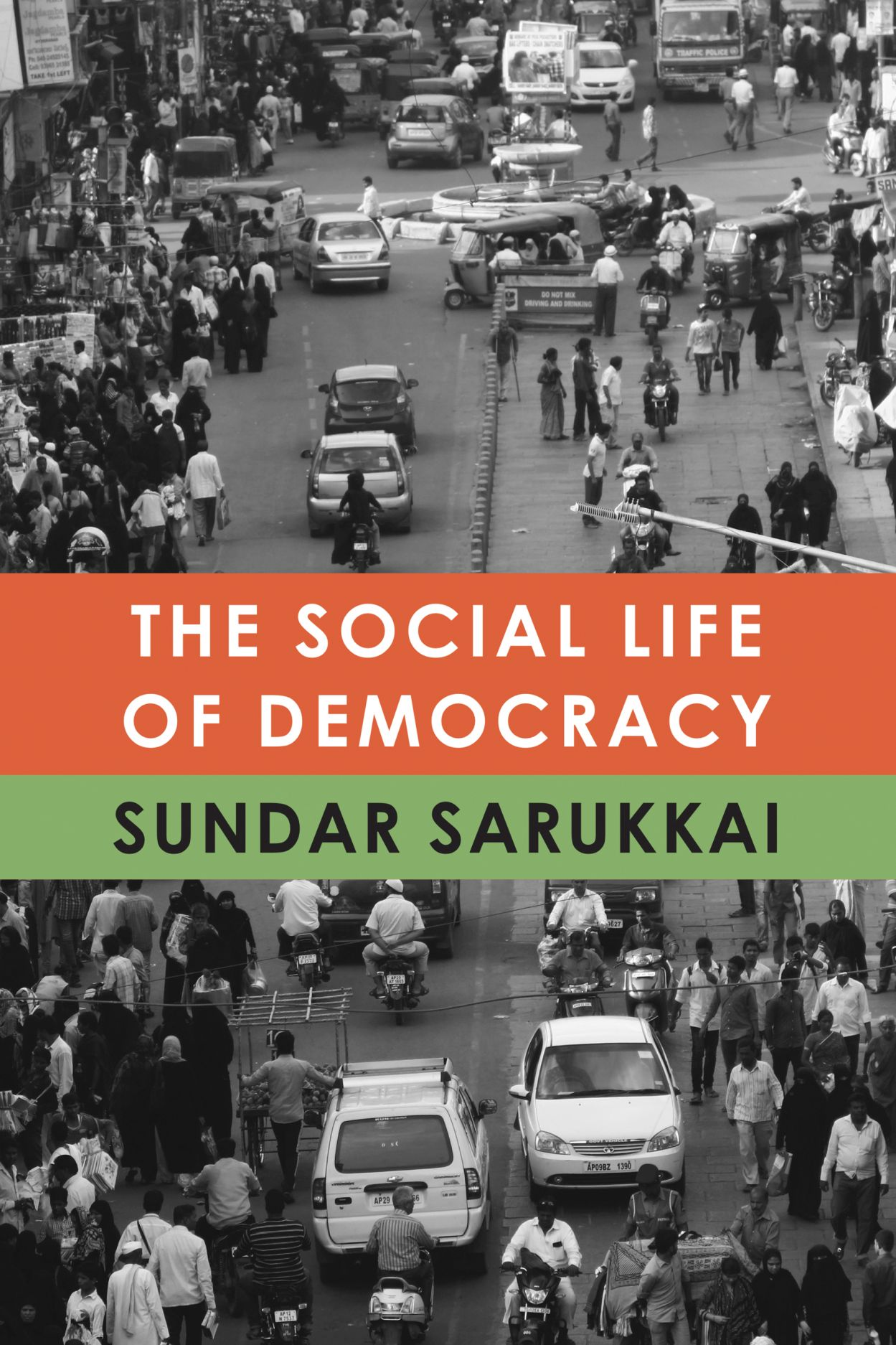
In The Social Life of Democracy, noted philosopher Sundar Sarukkai (2022) makes a compelling argument for the inculcation of what he calls a democratic self in everyone’s daily life. This, for him, is essential for achieving a society that is democratic both in spirit and in practice. In the book, Sarukkai attempts to fill out the contours of Dr Ambedkar’s imagination of social democracy, highlighting that democracy can function the way it is intended to only if it becomes part of our everyday lives. In the introduction, Sarukkai clearly spells out the main aims of the book: 1) to understand what it means to be democratic in our day-to-day actions, 2) to attempt to discover the obstacles, the possibilities and the ways to achieve Ambedkar’s ideal of a democratic society and 3) to reflect on how we can produce our own democratic selves (p. xiii). It is these three aims that chiefly guide the substantive chapters of the book.
Through the book’s six chapters, Sarukkai undertakes a careful examination of the concept of democracy, underpinning its differential meanings, its nature, and its ethical processes. He also looks at its multidimensional relationships with labour, science, and religion. Finally, he deals with the question of truth and its centrality to democracy, before concluding with a discussion on the idea of freedom that is inextricably embedded in the idea of democracy. Its chief contribution, however, is to sew together the political life of democracy and its social imperatives, with the latter being a necessary condition for a democracy that works towards the best interests of the worst-off in society.
Chapter 1 is titled The Nature of Democracy. Here, Sarukkai argues that the political life of democracy is not just incomplete, but impossible without a social life that complements it. He contends that “democracy is a lifeworld and has to be part of the lived experiences of our everyday lives” (Sarukkai, 2022, p. 6). Crucially, for him, this premise is the only guarantee for the survival of democracy. Sarukkai maintains that the idea of democracy itself is not positioned democratically – this is only exacerbated by digital technology and social media, as they are “produced in a regime of secrecy and are closely related to hegemonic power” (Sarukkai, 2022, p. 8). It is against these backdrops that Sarukkai develops his further arguments in the book.
The second chapter, The Concept of Democracy, sees Sarukkai undertake a thorough examination of the popular, Americentric conception of democracy, which he pits against the Indian and Chinese models. Drawing upon multiple influential scholars, Sarukkai shows that the idea of democracy being intrinsic to the West and antithetical to the East is but a myth. However, he takes the successes of democracy in India with a pinch of salt, positing that “political institutions are deeply integrated with social institutions” (Sarukkai, 2022, p. 25) – in institutionalising the personal lives of people, families, caste and religious identities have all become a part of politics. Here, Sarukkai also tackles what he calls the myth of the people. For him, the idea of the ‘people’ is not simply a collective of individuals; it is “a term that is produced through political and moral categories” (Sarukkai, 2022, p. 46). His central thesis here is that we must learn to be democratic not merely as a government, but more importantly, as a society.
The next chapter, entitled Domains of Democracy, deals with the concept of the democratic self. Sarukkai argues that the “production of a democratic self is the way a social life of democracy is produced” (Sarukkai, 2022, p. 58). For him, the democratic self refers to an ethical, everyday practice rather than just a political identity based on voting. Rather, it is a mental disposition -a philosophy of life in which individuals cultivate deep empathy, equity, and a responsibility to the marginalised, transforming democracy from a mechanism into a way of life. Sarukkai then turns his attention to democracy’s interactions with labour, religion and science and technology, discussing in detail how these interactions shape its contours in contemporary societies. Here, he also discusses the difficulties in formulating the ethical principles that underlie democratic action, which segues smoothly into the next chapter.
Chapter 4 concerns itself with the ethical processes of democracy. These include the ethical acts of voting, trusteeship and the creation of an experience of the public. Sarukkai crucially argues that for real democracy to be possible, voting has to be seen less as a transactional enterprise and more as an ethical duty – one must vote on behalf of those worse off than oneself. This, for him, is the ethical rationality of democratic voting. In addition, it is the experience of “being together among those who are different from us” (Sarukkai, 2022, p. 114) that produces a true, ethical sense of democracy. Sarukkai also underscores the importance of reservation and minority group support as ethical imperatives of democracy, as these mechanisms are the only way for marginalised groups to enter public spaces and claim their rightful (emphasis mine) share of public resources.
The fifth chapter deals with the relationship between democracy and truth. Invoking D.Y. Chandrachud, Sarukkai argues that democracy needs the power of truth to survive. His key insight here is that truth, in its relation to democracy, is deeply embedded in social realities and structures. Further, he also posits that “trust itself is related to truth when understood as a public entity and not a psychological state” (Sarukkai, 2022, p. 119). The central argument Sarukkai puts forth in this chapter is the notion that the ethics of truth-action and truth-making are the primary qualities of democratic politics.
Chapter 6 looks at the association between democracy and the value of freedom, primarily with the freedom of speech and the freedom to dissent. Here, Sarukkai explicates the paradoxical tension between free speech and democracy, emphasising that free speech must be free only under reasonable restrictions and self-constraint. Turning to dissent, Sarukkai underscores its ethical significance to democratic systems, arguing that it is the “conceptual glue that holds the logic of democracy together” (Sarukkai, 2022, p. 152). The takeaway from the final chapter, then, is that a nation is truly democratic only when it produces a society where its citizens can live without fear of being persecuted for ideological reasons.
The Social Life of Democracy offers an urgent reimagining of democracy as an ethical and lived practice rather than merely a political system. Sarukkai’s emphasis on ethical self-formation and the idea of a “democratic self” offers a thought-provoking perspective, though it remains somewhat abstract in relation to real-world constraints. While Sarukkai’s framework is intellectually rich and normatively appealing, its reliance on ethical transformation as the primary engine of democratic life risks underestimating the persistence of structural inequalities that may somewhat limit the practical applicability of his vision. Nevertheless, the book is a timely reminder that we have a long way to go towards creating a society that is truly democratic – in every sense of the word.
References:
Sarukkai, Sundar. 2022. The Social Life of Democracy. Seagull Books.
***
Author Bio: Abhijay Rambabu is currently pursuing his Integrated M.A. in Sociology from the University of Hyderabad, in which he is in the final year. His work has appeared in The Quint, The Polis Project, Maktoob Media, Feminism in India, Countercurrents, The Ambedkarian Chronicle and Doing Sociology, among other platforms.