
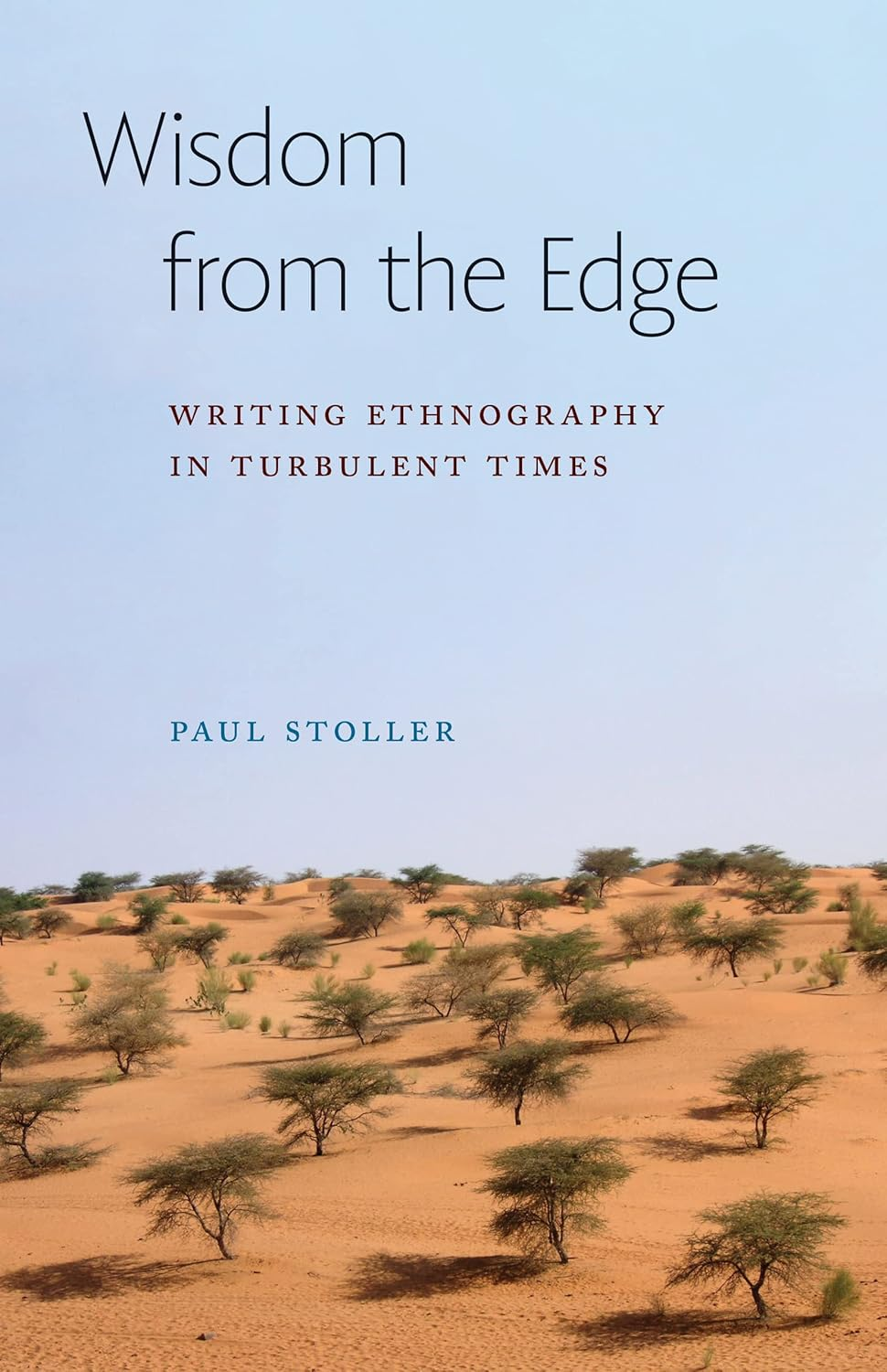
“Wisdom from the Edge is my attempt to transform Adamu Jenitongo’s work into my work. In this book, I hope to demonstrate what anthropologists might do to contribute to the social and cultural changes that can shape a social future of well-being and viability. In the following pages, I attempt to show how anthropologists can use sensuously described ethnographic narratives to powerfully communicate their slowly developed insights to a wide range of audiences” (Stoller, p.11).
Paul Stoller’s Wisdom from the Edges: Writing Ethnography in Turbulent Times (published by Cornell University Press in 2023) is an invitation for anthropology to return to its roots — to the edges, or simply margins. In his own language, to the slow, patient, and deeply embodied craft of listening, writing, and thinking with indigenous wisdom. I believe anthropology, as a discipline that has constructed and flourished on the shoulders of such “indigenous elders’ wisdom”, needs such a go-back. Though the subtitle suggests the book is about writing in “turbulent times,” its theme is much larger: Stoller is asking how anthropology might shape a future grounded in well-being, humility, and care, especially in an age of intellectual and ecological crisis.
The book is divided into two parts: The Senses in Artful Ethnography and Evoking Indigenous Wisdom. Together, these essays offer both a guide for writing ethnography and a reflection on how to think and live as an anthropologist in modern times.
In Chapter 1, Imaging Knowledge: Artful Vision in Slow Research, Stoller calls for a slow ethnographic practice that values deep attention over speed. Through the work of visual anthropologists Jean Rouch and Lisbet Holtedahl, he shows how visual storytelling can communicate the complexity of human life, especially when shaped by the slow, patient epistemology of the Songhay and Fulani peoples. The chapter highlights the ethical and intellectual value of lingering, observing, and resisting the rush of academic production. Chapter 2, In the Shade of the Jujube Tree, takes us into the world of West African divination. Here, Stoller uses his own experience with Fatouma Seyni in Mehanna, Niger, to explore how knowledge is learned not through abstraction, but through the senses — through the smell of perfumes like Bint el Hadash and Bint el Sudan, the sounds of the environment, and the shared silences between teacher and student. The chapter contrasts this deeply embodied learning with the pressures of modern academic life, which often leaves little space for slowness or wonder. In Chapter 3, Sensory Dimensions of Spirit Possession, Stoller turns to Songhay spirit possession ceremonies. He argues that many anthropological theories — functionalist, psychoanalytic, symbolic — often miss the point by reducing such practices to systems of meaning or social function. Spirit possession, Stoller insists, is an experience of the senses. The sounds, smells, and sights of the ceremonies are not unimportant side details, but they are very central to understanding the phenomenon. Chapter 4, Tasting Harmony in the World, focuses on the often-neglected senses of smell and taste. Drawing from Songhay social life, Stoller shows how food and flavour shape social relations, memory, and belonging. He also reflects on why anthropology has long ignored the senses, especially taste, and points to emerging work that takes these experiences seriously as analytical tools.
The second part of the book moves from the senses to knowledge itself. Chapter 5, Peripheral Knowledge and the Imponderables of the Between explores what it means to dwell in the “in-between” spaces of knowledge— where certainty is suspended, and ambiguity becomes productive. For Stoller, artful storytelling, grounded in dialogue, place, and character, allows anthropologists to capture this peripheral knowledge, which is often dismissed by conventional academic analysis. Chapter 6, The World According to Rouch, returns to Stoller’s long relationship with Jean Rouch. Here, Stoller highlights Rouch’s belief in art as a remedy for the disruptions of modernity and colonialism. He discusses Rouch’s idea of “ethnofiction” — a blend of ethnography and art — as a method for engaging the world not just as it is, but also as it might become. The chapter also talks of the importance of friendship, spontaneity, and curiosity in “practising” anthropology. Chapter 7, Wisdom from the Edge of the Village, closes the book with a reflection on the wisdom of elders like Adamu Jenitongo, who taught Stoller to see the world not as a resource to be extracted, but as a web of relationships to be cared for. Stoller suggests that such indigenous wisdom — especially its respect for limits and balance — offers valuable guidance in the face of contemporary crises such as climate change and pandemics. He argues that anthropologists must write in ways that are accessible and emotionally engaging so that this wisdom can reach a wider audience.
Reading Stoller’s work reminded me of a question I used to ask during my ethnographic fieldwork: Why do you write? I asked this question to almost every one of my interlocutors, thinking it to be a simple question to answer. Only when someone turned the question back at me did I realize it was not that simple to answer. Reading Wisdom from the Edges felt like following Stoller through his attempt to answer such a question, throughout a life shaped by the elders, friends, and teachers he met in West Africa, during his decades-long career as an anthropologist.
But reading the book closely, I could not avoid a question: while Stoller writes about his aim of writing is to “reach a wide range of audiences” and move beyond conventional academic writing methods to achieve that aim, I wonder did he ever thinks whether the “indigenous elders” he learned from ever aimed for such things. Were they concerned about reaching audiences, publishing books, or earning academic degrees? Or are these goals themselves part of the same fast-paced, achievement-driven world that Stoller is trying to critique? Of course, I am not suggesting that we should all leave behind our professions and escape to the mountains. My point is that we cannot find a way out of these “turbulent times” simply by writing using the same tools, methods, and ways of thinking that belong to this very time, or post-normal time, as Ziauddin Sardar (2010) would call it. When indigenous wisdom is taken as an object of study, even with the best intentions, it risks being shaped by the same academic and institutional logic it is supposed to challenge. This is why I find Amira Mittermaier’s( 2019) suggestion important: in her essay The Unknown in the Egyptian Uprising: Towards an Anthropology of al-Ghayb, she argues that instead of treating ghayb (the unseen) as an object to study, it should be approached as a method of knowing. I believe the same can be said about indigenous wisdom. Anthropology must learn to see with(in) it. Only then might it fully break free from its own inherent colonial and capitalist habits.
On a final note, Stoller’s Wisdom from the Edges: Writing Ethnography in Turbulent Times is not just a book about ethnography, but a deeply personal reflection on the ethics of writing itself. Ultimately, the ‘after-thought’ (similar to the ‘aftertaste’ we have after eating something), this book leaves us with an important yet uncomfortably haunting question: Can we, as anthropologists, truly unlearn the world we are trained to master? Without that, can we ever go back to the “edges”— or roots?
Works Cited:
- Sardar, Ziauddeen. (ed.). 2019. The Postnormal Times Reader. Kuala Lumpur: International Institute of Islamic Thought.
- Mittermeir, Amira. (2019). ‘The Unknown in the Egyptian Uprising: Towards an Anthropology of al-Ghayb’. Contemporary Islam. 13(1): 17-31.
Acknowledgements
The reviewer wishes to thank Prof. Tesnim Khirji of the Department of Sociology and Dr. Sana Ghazi of the Writing Centre, Ibn Haldun University, for their insightful comments on an earlier draft of this review.
***
Muhammed A. Tahir is currently pursuing his Master’s in Sociology at the Department of Sociology, School of Humanities and Social Sciences (SHSS/ITBF), Ibn Haldun University, Istanbul. He writes articles in both Malayalam and English and also translates from Arabic and English for various Malayalam periodicals.
It feels like a melting freeze on my face — soothing, constantly reminding. Slowly, it’s grappling to the roots, raising questions. After all the rounded inner heat, I eventually realise: without the ‘edges’ and ‘roots’, a tree would have no definition. And I ask myself, ‘How will I ever get out of this labyrinth of discipline (anthropology)?”
Honestly, it was so good — I really enjoyed reading it.
[…] Sociology reviewed Wisdom from the Edge Paul […]