
Introduction: Revisiting the Village, Rethinking the Toilet
Over the past few years, I have had the opportunity to visit my ancestral village several times. Although my grandfather migrated from Uttar Pradesh to Punjab decades ago, and all of my upbringing and education took place in Punjab, my father wanted us to remain connected to our roots. So, we often travelled to our native village, tucked away about 12 kilometres from Karihya, across the Sai river, in Pratapgarh district of Uttar Pradesh. The village has a predominantly Scheduled Caste population, and spending time there, sitting with neighbours, walking through the fields, listening to stories, allowed me to observe the subtle yet striking contrasts between rural life in Uttar Pradesh. These visits became windows into the lived realities of village women, and into the everyday beauty and burdens of rural existence.
On my first visit, I noticed that our ancestral home did not have its own toilet. Since we visited only occasionally, we made do with a shared facility at a relative’s home. It was during my second visit that we finally had a toilet built in our own house. But in the process of spending longer periods in the village, something else caught my attention.
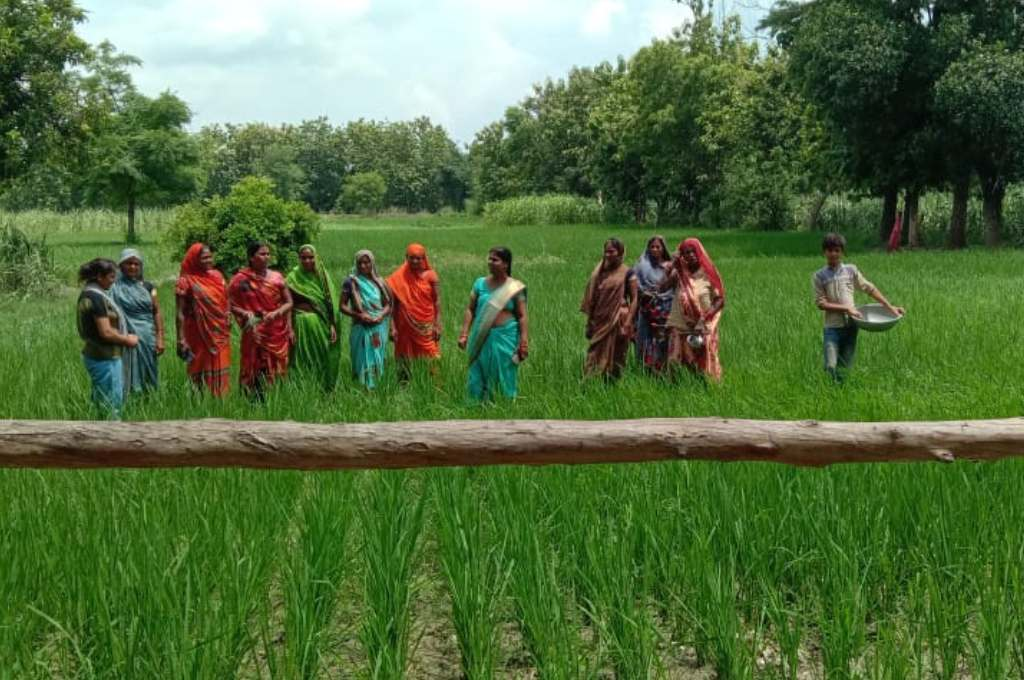
Every morning and evening, I noticed a group of women, including a local “chachi” with whom we often sat and chatted, gathering near the common handpump. With lots of empty plastic bottles in hand, they would fill water and head toward the fields. At first, I assumed they lacked toilets at home. But upon inquiry, I realised that most of them did, in fact, have washrooms within their homes.
One evening, as I watched another small group walking together toward the fields, chatting and laughing, I finally asked Chachi why she still went to the fields when she had a functional toilet at home. She laughed and said, half in jest, “Arey bitti, tanik sair hoi jaat hai aur dui-chaar baat batiya li jaat hai. Nahin to kahe ka time yahi hai ki baith jawa jaye dui ghadi?”
(“Child, we go to stretch our legs a bit and have a few words with each other. Otherwise, where is the time for ourselves, to sit and relax even for a moment?”)
That moment shifted something in me. I began to see the daily walk to the fields not as a failure of sanitation infrastructure, but as a deliberate practice, one that creates space for leisure, intimacy, and freedom. In these walks, women carved out a domain of their own, away from the demanding gaze of domestic life, beyond the walls of duty, and free from the presence of men. The lota, then, became more than a vessel; it became a symbol of community, belonging, autonomy and a sense of freedom.
In a country that celebrates the Swachh Bharat Mission and constructs toilets in every village household as a marker of development and dignity, these women were quietly re-signifying that very space. Their everyday practice offered a counter-narrative, one where sanitation infrastructure meets social life, and where toilets, rather than just being sites of hygiene, also become landscapes of gendered freedom and collective rest. When I began to observe more closely, a seemingly simple question emerged: if women merely wanted to go for a walk, they could do so without carrying anything, why, then, were lotas and plastic bottles so central to what was described as “leisure time”?
As I reflected further, the layers gradually unfolded. What became visible was not the presence of strict surveillance within the household, but the subtle regulation of women’s mobility through social expectation and moral reasoning. For newly married women, “the bahu”, stepping outside the house without a “legitimate” purpose is often frowned upon. There are more restrictions on her, and they use toilets. For women who have been married for several years but are still considered young, the regulation operates differently. Their movement is not explicitly restricted, yet it must be justified. A reason is required: Where are you going? Why now? Carrying a lota or a bottle offers that justification. It transforms leisure into necessity and movement into duty, rendering their presence in public space morally defensible. But the question is, what is the quest, where the notion of using toilets to not using them is shifted? Why are they comfortable with it? The fight has been fought for so long for the basic needs, but when it is finally achieved, they are continuously rejecting it.
In contrast, older women enjoy a different relationship with space and surveillance. Their mobility is rarely questioned. They can sit, walk, and engage in conversation without attracting scrutiny. Interestingly, many among them prefer using household toilets rather than going out, yet they continue to claim the freedom to socialise openly, suggesting that age itself functions as a form of social immunity from moral policing.
Time also structures these practices. Women who go out for open defecation tend to do so in the early morning, a period tightly bound to domestic labour. Mornings are filled with household chores, leaving little opportunity for extended outdoor interaction. Meanwhile, younger girls are more likely to use toilets, a choice shaped by growing concerns around safety, risk, and respectability in public spaces.
Ethnographic Vignettes: Mahua, Mangoes, and the Bagiya
My observations extended across seasons. During the Mahua flowering months, women would set out alone or in pairs to collect the fallen flowers, spending long hours in the undergrowth. Similarly, in the mango season, groups would head toward the bagiya (orchard), ostensibly to gather raw mangoes (amiya), but also to exchange gossip, laugh, rest, and reclaim moments of leisure. Among teenage girls in the village, mobility is closely watched and quietly negotiated. They are often discouraged from going outside simply to play or spend time with friends. Stepping out without a clear purpose invites questions—Where are you going? Why? With whom? Yet, during certain seasons, these same girls find small openings. When mahua flowers begin to fall, or mangoes ripen in the bagiya, they can ask to go out for collection. Similarly, taking goats (bakri) or buffalo out to graze or going to cut fodder becomes a legitimate reason to leave the house. These tasks, framed as duty, provide what open leisure cannot: socially acceptable movement.
In these moments, necessity becomes opportunity. Walking together to gather mahua, pluck raw mangoes, or graze animals allows them to linger, to talk, to laugh without constant supervision. The field, orchard, or grazing ground becomes a temporary social world of its own. What appears to be routine rural labour carries another meaning; it is negotiated freedom. For these young women, the “reason” to go out is essential. Enjoyment must be wrapped in usefulness. Leisure must travel in the language of responsibility.
Seen this way, infrastructural refusal is not dramatic resistance. It is the subtle crafting of autonomy within constraint. Teenage girls do not openly challenge restrictions on their movement. Instead, they work within them, using seasonal work and everyday tasks as cover to create time for friendship and selfhood. Their freedom is not declared; it is carefully arranged. These small excursions, like the walk to the fields, created time and space that were otherwise inaccessible to them in their daily routines. They marked a rare inversion of domestic life: here, women were not labouring for others but finding space for themselves, often for the first time in the day.
I propose the term infrastructural refusal to describe this phenomenon, a quiet, everyday decision not to fully subscribe to the state’s developmental vision. Women are not rejecting toilets out of ignorance or lack of awareness. Rather, they are engaging in what Michel de Certeau calls “tactics” of everyday life, repurposing state provisions while crafting spaces of collective joy and autonomy. When I describe this as “Infrastructural refusal,” I do not mean protest or ignorance of sanitation campaigns or a rejection of hygiene. It is something quieter and more subtle. It is a form of everyday politics in which women carve out time for themselves within the limits imposed on them. They do not dismantle infrastructure; they tactically inhabit it. They accept the toilet as part of the household, but they do not surrender their need for collective time and shared movement. Henri Lefebvre’s idea of the “production of space” helps frame how the home toilet, intended as a site of privacy, is experienced instead as an extension of the household’s disciplinary gaze. In contrast, the field, orchard, or roadside becomes a space of freedom, a gendered geography where surveillance recedes. These acts also resonate with Sara Ahmed’s writing on affect and feminist lifeworlds. What appears as mundane bodily necessity is also saturated with emotion: laughter, gossip, resentment, tenderness. The sanitation campaign may have targeted hygiene, but these women are pursuing something far more elusive—relief, respite, relation.
In several neighbouring villages, the presence of toilets was often only partial. Walls had been erected under state schemes, yet no functional seats were installed. In other instances, completed toilets had been converted into storage spaces. These were not merely cases of “misuse” but reflected deeper infrastructural and economic anxieties. Poor drainage systems, irregular water supply, and concerns about septic tanks filling too quickly shaped patterns of selective non-use, particularly among men, who frequently cited maintenance costs as a deterrent. The fear that “frequent use” would translate into financial burden reframed sanitation as an economic liability rather than a public good. Yet these patterns were not uniform across caste locations. In upper-caste-dominated hamlets, where access roads were paved, drainage systems were functional, and houses were structurally secure, restrictions on women’s movement were less visibly tied to infrastructural deficits. Sanitation use was more regular, and the built environment itself facilitated the incorporation of toilets into everyday life. In contrast, in settlements inhabited by lower social strata, infrastructural fragility, kachcha houses, poor drainage, and distance from main roads intersected with caste marginality. Here, the toilet did not emerge as an integrated element of domestic architecture but as an imposed structure, often incomplete and poorly serviced.
Proximity to urban centres further shaped these dynamics. Villages located 12–15 kilometres from the city enabled young women to access part-time skill-based courses, computer training, stitching, beautician work, creating alternative spaces for self-reflection and social mobility. Those in more remote areas remained spatially and socially constrained, with fewer opportunities for leisure beyond sanctioned practices such as collective visits to the fields.
Thus, Infrastructural refusal operates at two registers: first, as a tactical gendered negotiation; second, as the quiet consequence of uneven state implementation. Infrastructure refusals cannot be read solely as gendered resistance. It is embedded within caste hierarchies, uneven urbanisation, and differential access to development. The toilet, in this context, becomes a diagnostic site revealing how state infrastructure interacts with stratified rural realities rather than transforming them uniformly. These observations complicate the idea of infrastructural refusal. Not all non-use emerges from tactical autonomy. In some instances, non-use reflects incomplete implementation, poor design, or economic calculation. The presence of a toilet structure does not necessarily mean functional infrastructure.
At the same time, patterns varied across villages. In some upper-caste dominant villages nearby, women did not continue open defecation once toilets were constructed. This suggests that sanitation practices are shaped not only by gender but also by land ownership, drainage systems, spatial layout, and possibly caste-based settlement structures. However, without systematic comparative data, these observations remain indicative rather than conclusive. Toilets, when viewed only as structures, miss the layered textures of rural women’s social worlds. The idea that leisure must be hidden within labour, that women must use bodily functions as a pretext to find space, is itself a telling critique of how rural patriarchy compresses women’s time.
Sanitation policy, when framed solely as a material provision, risks overlooking the social uses of space that shape actual uptake. Through “infrastructural refusal,” these women are not merely resisting development; they are teaching us to see beyond it. They offer a feminist rethinking of space, one walk at a time.
References:
Agarwal, B. (1994). A field of one’s own: Gender and land rights in South Asia. Cambridge University Press.
Ahmed, S. (2010). The promise of happiness. Duke University Press.
Chatterjee, P. (2004). The politics of the governed. Columbia University Press.
de Certeau, M. (1984). The practice of everyday life. University of California Press.
Lefebvre, H. (1991). The production of space. Blackwell.
Rao, N. (2018). Gendered time, seasonality and nutrition: Insights from two Indian districts. IDS Bulletin, 49(1).
***
Neelima is a Research Scholar at the K.R. Narayanan Centre for Dalit and Minorities Studies, Jamia Millia Islamia, New Delhi. Her research focuses on gender, caste, public policy, and transgender health in India. She works at the intersection of ethnography and policy analysis, examining how state welfare and infrastructure shape everyday social life.