
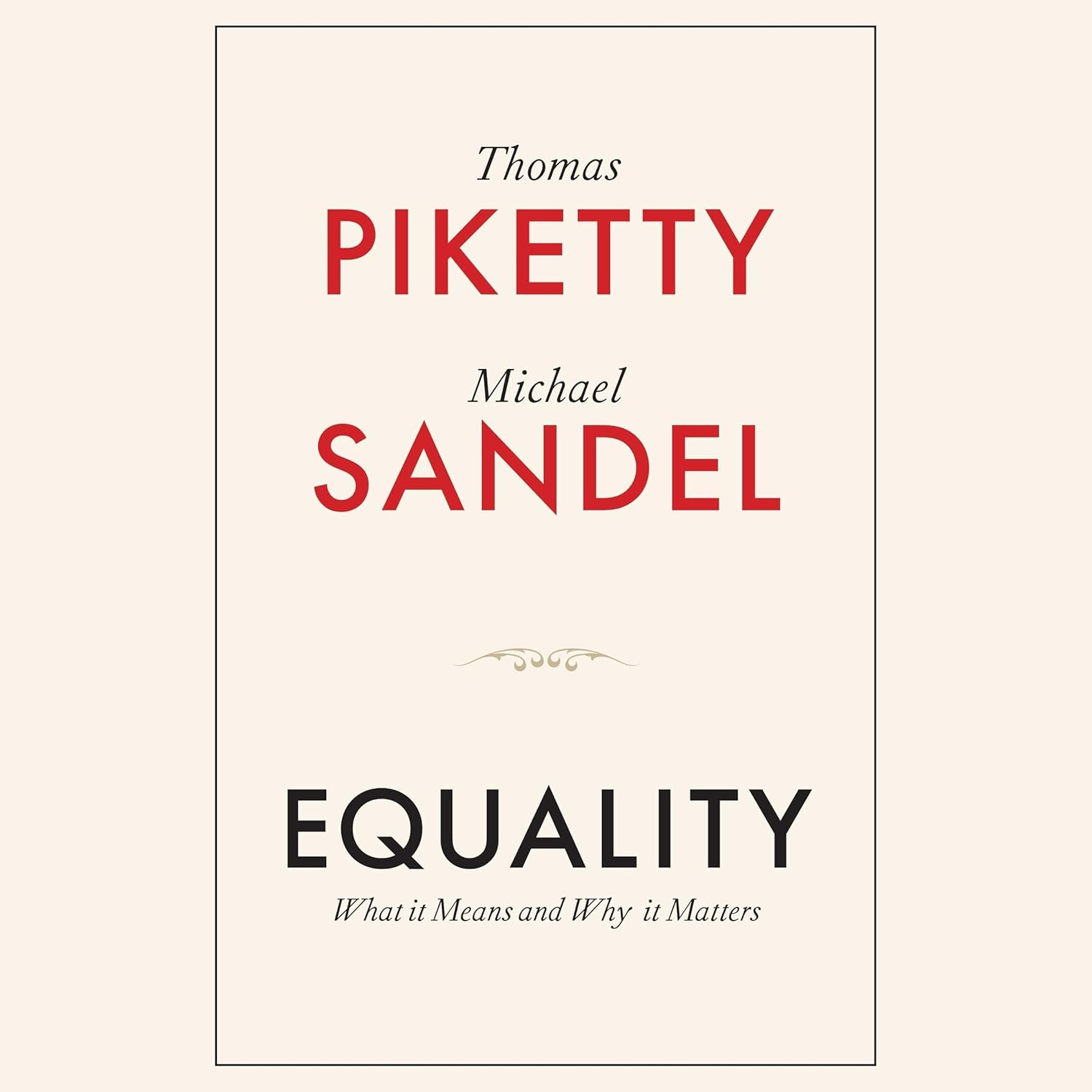
Equality: What It Means and Why It Matters by Thomas Piketty and Michael Sandel, published by Polity Press in 2025, is a timely contribution to the larger discussion of the meanings of equality and its value in the contemporary world. It raises the fundamental yet equally current concern that confronts us all: what does equality mean and why does it matter? The book is actually an edited version of the conversation at the Paris School of Economics between two renowned intellectuals, Thomas Piketty, a political economist (In the book, he prefers to call himself a social and economic historian) and Michael Sandel, a philosopher. They try to engage with the various ways in which equality is discussed and understood both in the academic world and outside, and how to centralise public discourse and policy around the concept of equality. The book covers a wide range of interrelated issues including chapters on the dangers of inequality, the importance of money and markets and their moral limits, the effects of globalisation and populism, conundrum of meritocracy as well as matters of policy such as lottery system in higher education, taxation, solidarity and community, borders, immigration and climate change and the future of the left. The book also raises calls to political action and suggests ways to address the inequality in place and emphasise equality.
The conversation begins with Sandel’s inversion of the book’s subtitle, from why equality matters to why inequality matters. Piketty responds by striking an optimistic note that equality has increased across the globe in all spheres over the period of a century. He mentions that inequality today is still better in reference to what it was a century ago. However, inequality today, Piketty argues, still affects a wide range of public life, from access to basic goods (economic) and participation in politics (political) to dignity and the nature of human relations (social). He points out that monetary distance among people also engenders social distance, which proves detrimental to human relations in general.
The authors then discuss the limits of money in the context of redistribution and decommodification of social life in the second chapter. Piketty argues that both redistribution of resources and decommodification are interrelated concepts and have worked historically in countries of Europe. Decommodification here means the gradual movement of commodities outside of the market/profit logic and to become freely accessible. In such a scenario, access to basic goods like education, health and other public services reaches a universal level. The authors see the nature of the state as a potential enabler of such possibilities rather than being intrinsically unequal or equal. In the third chapter, Sandel raises a moral concern when he asks whether there is another downside to commodification in that it corrupts or degrades the intrinsic value of goods. Commodification of goods such as education and health makes humans approach them instrumentally. It leads to a utilitarian approach where goods lose their intrinsic quality to a market-profit relation. This is reminiscent of Marx’s argument that objects in the capitalist mode of production are not objects with intrinsic value but are social relations. Sandel anchors the conversation in the political domain by asking about the intrinsic value that humans attach to goods. The system of valuation of everything social is determined by public discourse. It is a political valuation based on political deliberation. It asks which products are valuable. Such political valuation, the authors argue, should work beyond market logic and seek to redefine the value system which attaches a relative worth to goods.
In the fourth chapter, concomitant to the markets and their limits, the authors point out the limits of globalisation and where it requires careful consideration. Piketty elucidates that the rise of Trumpism or other variants of hypernationalist politics can be explained in terms of faulty hyperglobalisation, which allowed for the flow of goods and capital without any sincere consideration of the flow of labour. Immigration, therefore, requires careful consideration with regard to social integration and the security of the immigrants. It requires better funding of civic and public infrastructure. On the topic of immigration and the politics that emerge around it, the authors disagree on the use of the term ‘populism’ to define different ends of the political spectrum. While Sandel argues that Trump and Marine Le Pen can be equated with Bernie Sanders as they both represent an active resentment against the establishment and seek popular support for radical changes, Piketty argues that populism as a term is riddled with the risks of delegitimising political opponents and should not be used in a discussion and understanding of politics.
The crux of the book lies in the fifth chapter, with the conversation on meritocracy and its present role in not just widening inequalities but creating a system where hubris and humiliation are assigned to winners and losers, respectively. Sandel argues that while globalisation and financialisation led to increased inequalities, meritocracy provided the ideological rationale for it. It became, as Sandel argues, “the moral companion of the neoliberal globalisation” (p. 40). Meritocracy, even after ensuring a properly functioning one, is detrimental to the common good of society. It creates a “credentialist prejudice” (p. 44). It is based on the notion of deservance in such a way that it convinces the winner of her bounty and the loser of her lot. Substantiating the point further in chapter sixth, Sandel recommends, as an example, a lottery system of admission in the higher education where after crossing the minimum threshold of marks, the students are to be chosen from a lottery system to ensure not only a fairer representation of students from various income classes but also discarding the judgement of deservance as part of the meritocratic ideology. The lottery system discredits two judgments that meritocracy engenders: reassurance in the successful and regret in the loser.
In chapter six, Sandel and Piketty also agree on a point that sociologists have been trying to make for a long time. They argue that individual upward mobility is not an adequate response to the social inequality in place. Sociologists (see Jodhka et al., 2017) have been arguing for the need to look at the social determinants of inequalities and their intersections to understand the socially entrenched nature of existing inequalities. The book, while acknowledging the social dimensions, does not take it further to make any substantial argument. Due partly to its conversational style, the book does not dwell deep into developing the arguments further.
Piketty’s calls to action include progressive taxation, including inheritance tax, expanding the education and health sector, increasing political participation, as well as better North-South redistribution and parity and equitable global division of labour.
The book is a continuation of the idea that Sandel has discussed in his last book, The Tyranny of Merit (2020). Piketty’s work on inequality makes an important contribution to this debate, and the present book offers a view of inequality which is multidimensional and therefore more comprehensive. It furthers the point that any discussion on equality or inequality must transcend disciplinary boundaries and must be studied from a multidisciplinary approach, just like the nature of inequality itself. The approach to the problem must mirror the nature of the problem. The book urges conversations and discussions from different vantage points to study inequalities the world over, not only to understand but to change.
References:
Jodhka, S. S., Rehbein, B., & Souza, J. (2017). Inequality in capitalist societies. Routledge.
***
Vikash Sharan is a research scholar at the Centre for the Studies of Social Systems (CSSS), Jawaharlal Nehru University (JNU), New Delhi.
Really enjoyed reading this—especially how you simplified a complex dialogue between Piketty and Sandel into something very accessible. The part on meritocracy and dignity stood out for me.
It also made me think about the Indian context, where inequality is not just economic but also social (caste, education access, etc.).