

The ‘nature vs. nurture’ debate, the question of whether human behaviour is determined by inherent biological predispositions (nature) or shaped through learning and environmental influences (nurture) has been discussed for centuries, dividing philosophers, scientists and academicians into two opposing camps. This debate can be traced back to ancient Greece, where Plato argued in favour of nature, while his student Aristotle emphasized nurture. During the Middle Ages and the subsequent Renaissance and Enlightenment periods, the discussion took on a religious-philosophical dimension, as the question of ‘free will’ became entangled with ideas about human nature and moral responsibility. From the 19th century onward, this debate increasingly acquired a scientific character, evolving alongside discoveries in anatomy, physiology, psychology, and, eventually, genetics. Even today, this foundational debate between inherited nature and learned experience continues to inform and animate contemporary discussions across the disciplines of philosophy, psychology, genetics and broader social sciences.
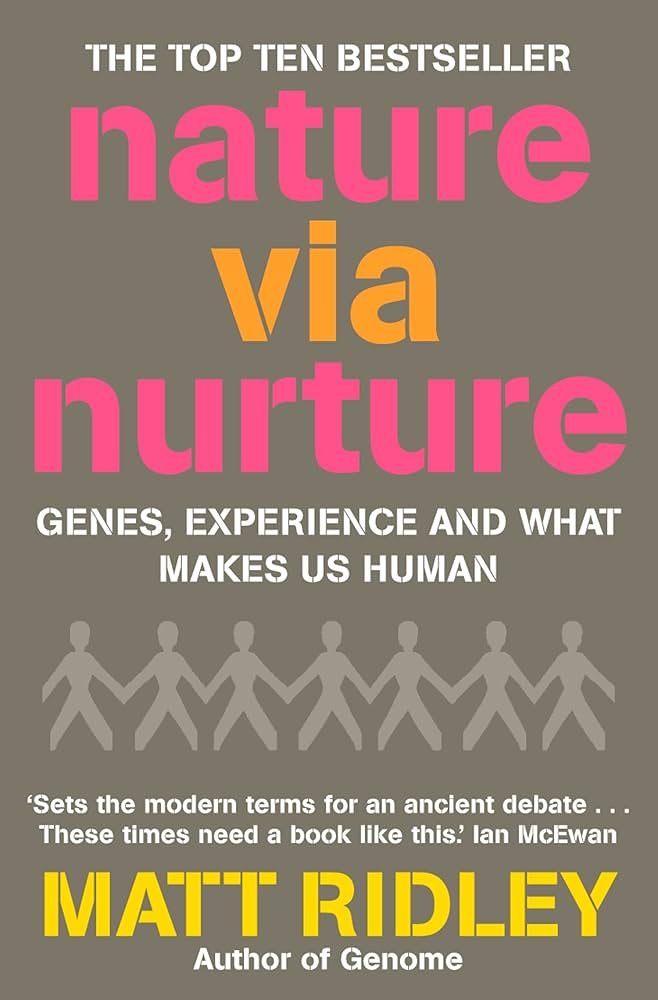
Matt Ridley’s book Nature via Nurture: Genes, Experience and What Makes Us Human (published by HarperCollins in 20110 as the title suggests, is an argument to resolve this long-standing debate by taking a middle-of-the-road compromise between nature and nurture. Ridley does this through the concept of genes – a term, along with its adjective genetic, that has become commonplace in everyday conversation. Whether referring to a behavioural trait, a physical or mental condition, or simply to someone’s appearance, the word is typically used to mean something inherited, predetermined, and unchangeable. This everyday usage often provides a convenient explanation for why people are the way they are, reinforcing the belief that biology alone dictates human traits and choices. In doing so, it grants biology dominant explanatory power over environment, upbringing, and social context – in other words, it privileges nature over nurture. This deterministic understanding reflects early scientific ideas about genes and has percolated deeply into popular thinking. As Ridley writes: “When genes were discovered… they [came to represent] destiny and determination, the enemies of choice. They were [considered] constraints on human freedom. They were the [considered] gods… they got stuck with the label ‘first cause’” (p. 249); they were thought to constrain human behaviour (p. 64).
It is precisely this reductive ‘common sense’ view that Ridley seeks to challenge by weaving together insights from philosophy, anthropological studies, neuroscience, psychological and genetic research, to present a powerful case backed by the wealth of data drawn from studies not only on humans but also on animals and birds, to demonstrate that nature (genes) and nurture (experience) are not opposing forces but deeply interdependent. Explaining the interdependency Ridley writes; “It is genes that allow the human mind to learn, to remember, to imitate, to imprint, to absorb culture and express instincts. Genes are not puppet masters, nor blueprints. Nor are they just carriers of heredity. They are active during life; they switch each other on and off; they respond to the environment. They may direct the construction of the body and brain in the womb, but then they set about dismantling and rebuilding what they have made almost at once – in response to experience. They are both cause and consequence of our actions” (p. 6).
The basic mechanism goes like this: The switching on or off of genes happens in response to internal signals (like hormones) or external factors (like nutrition, stress, learning etc.). Once activated, a gene can trigger other genes to turn on or off – creating complex networks of interaction. This dynamic switching allows the same genes to produce different effects in different contexts and life stages, and even in different species. Ridley illustrates this gene-environment interplay with diverse examples ranging from physical conditions like body weight, diabetes, and heart disease, to psychological aspects such as mental health disorders, and socio-psychological traits like intelligence and personality, extending even to social behaviors like criminality and sexuality. In doing so, Ridley systematically challenges several binaries like; nativism vs. empiricism, mentalism vs. behaviorism, instinct vs. learning, and, most significantly, the simplistic dichotomy of cause and effect (p. 101).
Let us take the example of schizophrenia, discussed in Chapter Four titled ‘The Madness of Causes’ (pp. 98-124), to understand how all these binaries reveal only one side of the story, with proponents from each camp attempting to explain the phenomenon solely within their domain. Schizophrenia, in particular, has attracted the attention of psychoanalysts, neurologists, and geneticists alike, each seeking to account for its causes according to their respective theories and biases. Derving from the theories of Freud the psychoanalyst tradition blamed the bad mother for the mental disorder (nurture). With the developments in genetics research, the blame shifted to genes. Since the late 1980s and throughout the 1990s, researchers repeatedly claimed to have identified a particular Chromosome 5 with the disorder. The next decade was dominated by claims that schizophrenia was caused due to problems with synapse formation in the brain, resulting from some faulty operation of genes which control brain biochemistry. This claim was further strengthened in 1995 with the discovery of the ‘reelin’ gene, a gene responsible for the organization of the brain in the foetus. When researchers found out the quantity of the reelin gene was almost half in the schizophrenic brain as compared to the normal brain, they were quick to blame the gene. Another group of scientists blamed influenza viral infection on the pregnant mother during the second trimester for schizophrenia. Yet another group of researchers blamed diet (nurture). They claimed that a developing brain needs certain essential fatty acids; when denied the adequate amount, the effect of schizophrenia.
None of these factors alone, as Ridley shows, have been able to explain the causes of schizophrenia, with each factor only contributing to another. For example, bad parenting might result from having to care for a demanding or difficult child, rather than causing the disorder in the first place. Similarly, not everyone whose mother contracted a viral infection during pregnancy develops schizophrenia; however, the probability increases when additional environmental conditions – such as poor maternal diet or stressful circumstances – are present. The reelin gene, for instance, illustrates how genetic vulnerability interacts with developmental and environmental factors; lower reelin production might disturb proper synapses formation, but whether this leads to schizophrenia depends on a host of other influences throughout the individual’s life. As Ridley aptly concludes, “Environmental and genetic influences seem to work together, to require each other, till it is impossible to say which is cause and which is effect” (p. 101).
Coined by the British polymath Francis Galton, a cousin of Charles Darwin, the ‘nature vs nurture’ paradigm has long dominated studies in sciences and social sciences. Ridley’s work is part of an emerging literature which seeks to move beyond this rigid binary, demonstrating instead how genes and environment interact dynamically, shaping and reshaping human traits through continuous feedback throughout life. Genes, as Ridley says are the “means by which nurture expresses itself, just as surely as they are how nature expresses itself” (p. 118). A paradigm shift, in the Kuhnian sense, is required today to replace this outdated binary with a more holistic framework, that recognizes that human behaviour, personality, and social life are best understood as the co-product of a constant, lifelong interplay between biological inheritance and experiential context.
***
Harshvardhan Tripathy is currently working as an Assistant Professor at the University School of Liberal Arts, Guru Gobind Singh Indraprastha University (GGSIPU), New Delhi. His research interest focuses on sociology of religion, sociology of modernity, neoliberalism and culture among others.