
“Our homes are not just where we live. They are how we live.” – Kieran Yates
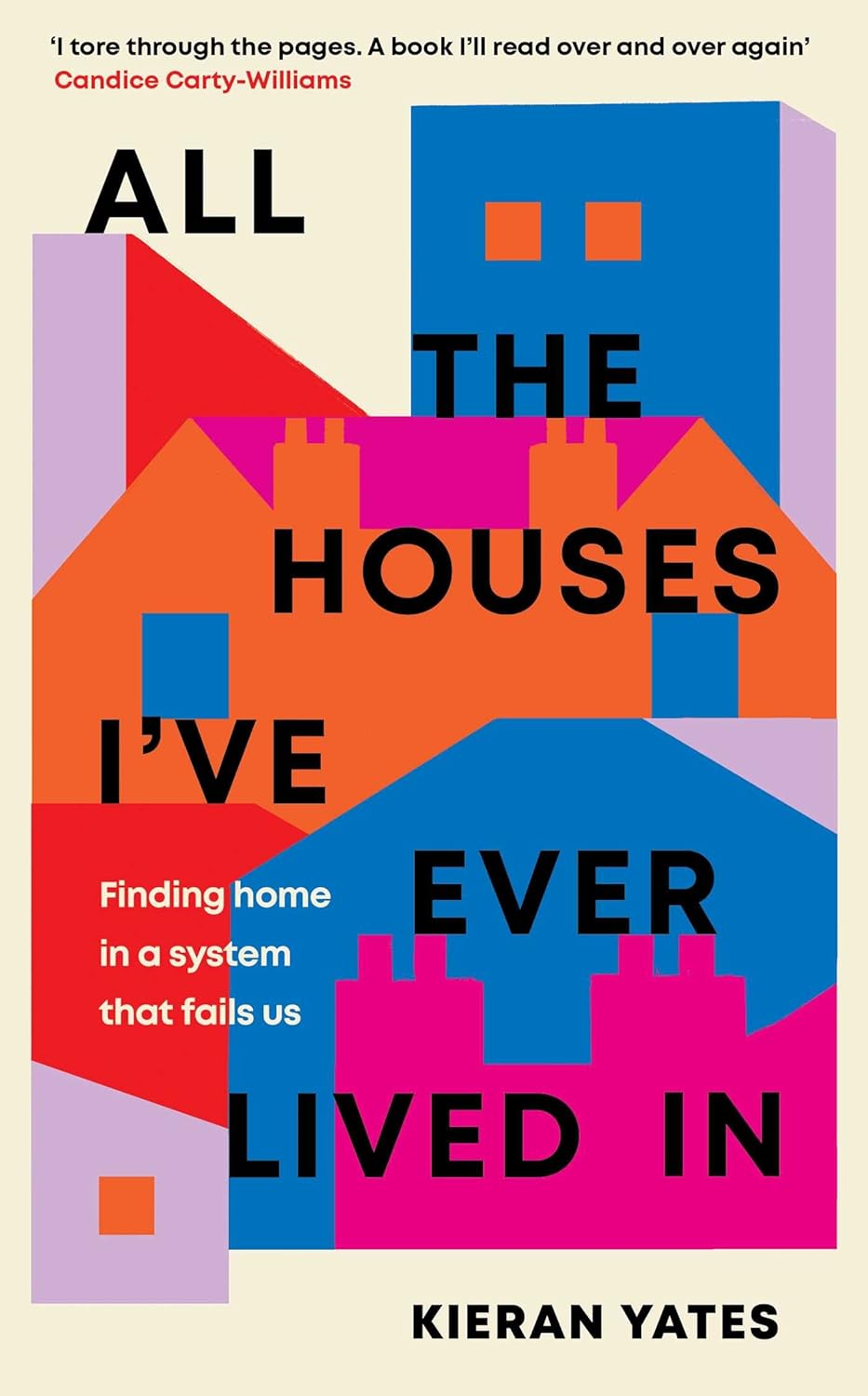
All the Houses I’ve Ever Lived In: Finding Home in a System that Fails Us by Kieran Yates (published by Simon & Schuster in 2023) is a mirror held up to contemporary Britain. Through a vivid recounting of her journey across over twenty homes, Yates dissects the failures of a broken housing system while offering an intimate portrait of a life lived at its margins. The book’s strength lies not merely in its sociological richness: it blends memoir, journalism, oral history and cultural critique into a singular, influential text. For those of us working on migration, homemaking and urban inequality, this book offers more than a case study; it offers a vocabulary for survival.
Yates begins in Southall, west London, tracing the arrival of her maternal grandfather from Punjab in the 1960s. This early section sets the tone, where the symbolic and the material are entwined, from the global South Asian tissue box décor to the lingering spectres of the National Front. In this and subsequent chapters, Yates is at her best when the personal becomes political. The memory of her nanaji[1] placing milk bottles along the garden wall as a form of self-defence during the 1979 Southall riots speaks volumes about how immigrant families negotiated safety and belonging in hostile environments.
Throughout the book, Yates carefully documents the places she’s inhabited, social housing blocks, temporary accommodations, friends’ couches, university halls and finally, after years of migration, a home she can claim as her own. She renders these dwellings as affective landscapes, sites of memory and struggle. The Green Man Lane Estate in West Ealing, where she lived in the 1990s, becomes a central case in point. Targeted for demolition and redevelopment, the estate becomes symbolic of how working-class and racially minoritised communities are routinely displaced under the rhetoric of “regeneration.”
What Yates uncovers, deliberately and with rigour, is that housing in the UK is not just a policy area. It is an ideology. Her writing prompts us to see how housing policy reproduces inequality, not accidentally, but systemically. This is a society where the value of a person’s life is often indexed to their postcode and where “desirable” neighbourhoods are constructed through a language that codes whiteness, affluence and sanitised histories of place. In contrast, places like Southall, Ealing and Hackney are problematised through narratives of crime, disorder and overcrowding, terms that conveniently justify state neglect or redevelopment.
Yates’s account of gentrification is telling. This serves as a reminder to the reader that displacement encompasses more than just eviction or demolition; it also involves erasure. In addition to being cut off from physical locations, communities are also cut off from the prevailing narrative that Britain tells itself about who belongs where and why. Urban change is presented as natural, inevitable and apolitical. What Yates does is de-naturalise this logic. She names the mechanisms, economic, racialised, often deliberately opaque, through which people like her and her family are moved, marginalised or made invisible.
In doing so, she joins a tradition of writers, among them Doreen Massey, Stuart Hall and Lynsey Hanley, who have insisted that spatial politics are central to understanding inequality in Britain. But what sets Yates apart is her insistence that we also feel these structures. There are pages in this book that sting with emotional truth, the quiet humiliation of letting agents, the psychological labour of domestic upkeep in someone else’s flat, the anxiety of damp walls and bailiff letters. These are not just anecdotes. They are data points in a wider cartography of systemic failure.
The book also unpacks the emotional economy of renting. Yates writes with humour and candour about landlord horror stories, the indignities of housemate auditions and the subtle codes of middle-class performance encountered during her university years at Goldsmiths. But these anecdotes always return to the central theme: how the housing system humiliates, excludes and commodifies. The repetition of experiences, mouldy ceilings, aggressive bailiffs, and unaffordable rents becomes a deliberate narrative strategy. This cyclical structure mirrors the reality faced by millions; precarious housing is not an exception but a pattern.
Yet, for all its analytical force, the book does not claim academic detachment. Yates is emotionally present in every chapter, and this is her greatest strength. She does not pretend at neutrality. Her anger is palpable, but so is her tenderness. When she describes the joy of watching Bollywood films on pirated VHS tapes or the intimacy of sharing bedrooms with family members, the text opens up to the micro-practices of homemaking that so often go undocumented. As a reader and researcher invested in the politics of domesticity, I found this attention to detail refreshing. It reminds us that home is a structure, but it is also a series of acts, rituals and relationships.
That said, there are moments where the book stumbles. The final chapter on “how to fight” feels underdeveloped compared to the emotional and analytical heft of earlier sections. While Yates gestures towards solidarity, activism and the human right to housing, the solutions offered feel somewhat surface-level. This is perhaps inevitable given the scope of the book, but it leaves the reader wanting a clearer sense of how systemic change might be envisioned. Moreover, while the hybrid genre works well overall, there are times when the balance between memoir and reportage becomes uneven. The strength of Yates’s narrative occasionally overshadows the voices of others, and a more sustained ethnographic engagement with fellow residents or housing campaigners might have enriched the sociological depth further. Yet these are minor critiques in a text that otherwise does so much.
All the Houses I’ve Ever Lived In sits within a growing corpus of contemporary housing literature, from Lynsey Hanley’s Estates to Anna Minton’s Big Capital, but what sets Yates apart is her unapologetic centring of a British Asian, working-class, female voice. She brings a sensibility shaped by diaspora, journalism and activism, and fuses them into a storytelling practice that is evocative and politically urgent. For students of sociology, urban studies, migration or cultural studies, this is required reading, not only for its content but for its form. It shows us what it means to write from inside the problem, rather than about it.
In closing, Yates offers no easy answers. But perhaps that is the point. In an era where “home” is sold as both investment and aspiration and where marginalised communities are pushed ever further to the peripheries, her book asks us to reckon with the fundamental question:
What does it mean to belong in a country that refuses to house you?
As sociologists of migration and place, how might we write our own home stories, honouring personal detail without forsaking structural vision? And if every house “keeps us as much as we keep it”, how do we tell stories that allow homes to speak without confining their inhabitants?
Yates, K. (2023). All the houses I’ve ever lived in: Finding home in a system that fails us. Simon & Schuster UK.
[1] Grandfather
***
Devika Bahadur is a PhD candidate in Material Culture Studies at De Montfort University (UK). Her research explores homemaking and migration in India, alongside queer fashion in workplace contexts. She also uses visual methodologies to study South Asian migrant experiences in the Belgrave area of Leicester. She is a published poet; her work appears in SwimPress, Overachiever Magazine and Critical Studies on Security. She is active in teaching, research and community-based volunteering initiatives.
Good review which covers all the aspects both positive and well as a tinge of constructive specially about how the book tapers away at the end. Well written
The work stands out for its honest portrayal of societal challenges in sports, urging readers not just to observe but to introspect and respond.