
In India, the strength of democracy rests on its diversity, where each community adds an exceptional thread to the national tapestry. It calls for active participation of citizens in all aspects of society, economy and polity to unite them collectively. In the recent political landscape, simultaneous elections for the Lok Sabha, state assemblies and local bodies gained significant support from a high-level committee led by former President Ram Nath Kovind. Although supporters cite expenditure, governance, and administrative convenience, they must also consider the risks to regional representation, accountability, and operational feasibility.
Constitutional Challenges and Regional Disruption
One of the primary reasons that simultaneous elections in India would face challenges as it requires major Constitutional amendments. The Kovind Committee recommendation mentioned 15 constitutional amendments, including Article 356, which states that Presidential Rule can be applied to any state in India if there is a breakdown in the functioning of the constitutional system. This closes options for democratic negotiations where governments can be formed, particularly since India follows a multi-party system, where coalition plays a crucial role in government formation, reflecting diverse voices ( Debroy & Desai, 2017).
Furthermore, this will possibly lead to the abrogation of articles like 244 (A) that aim to establish an autonomous ‘state within the State’ as the tribal areas specified in the Sixth Schedule. It will also need to change Article 371, which grants some temporary, transitional and special autonomy for twelve States of India, because both articles confer special powers that are specific to certain administrative aspects. For instance, the autonomous councils in Northeast India under the Sixth Schedule have their legislatures separate from the state government. This could lead to a loss of state autonomy and regional representation, potentially causing social, political, and economic turmoil.
Federalism at Risk: Promotion of National over Regional Interests
Moreover, the policy deliberately attacks on federal system of India, where both the states and the centre have certain rights to enjoy without any legal external disruption. While Indian democracy is recognised as the world’s largest democracy because of its wide and active participation of political parties, engagement of citizens and distribution of power between the centre and states. This move allows the centre to overrule regional concerns.
Statistics on the electorate have shown that national issues affect their behaviour more in proportion. In other words, the dominance of national issues over regional ones brought a negligent attitude to their behaviour, where the current important local issues are ignored and overthrown. For instance, issues based on tribals, castes, cultures and opportunity remained silent, and the real face of representation cannot emerge due to the huge dominance of the national political parties over the regional ones (Chakravarty, 2016).
Analysis of Lok Sabha & Vidhan Sabha results under simultaneous elections
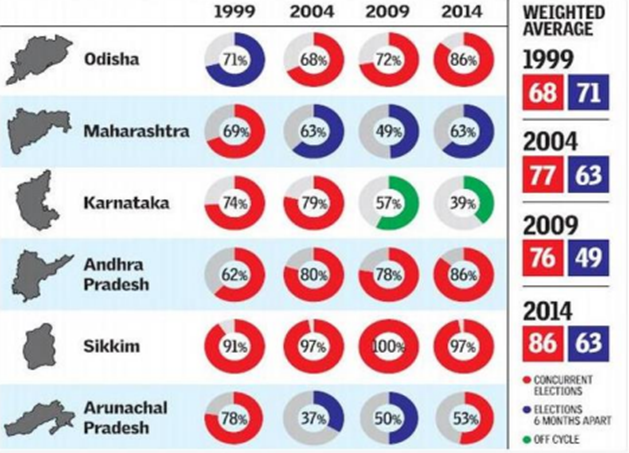
Source: Study published by IDFC Institute (http://www.thehindu.com/opinion/op-ed/state-assemblyelections-nudging-the-voter-in-one-direction/article8438114.ece)
Accountability and Representation Challenges
The recommendations raise questions of accountability and representation. Firstly, the voter may be unable to differentiate between candidates in multiple elections simultaneously, which leads them to cast a vote based on party performance and popularity. Consequently, local issues are overshadowed by national agendas, which largely weaken the connection between constituents and their representatives. Although simultaneous elections aim to simplify the electoral process, they pose significant hazards to accountability, which is essential for a healthy democracy in India.
Electoral Costs vs. Constitutional Integrity
Some may argue that simultaneous elections in India reduce overall national expenditures, as holding separate elections encounters massive recurring expenditure for the State and the Central government as well. Despite lower costs, we must still address the large-scale purchase of electronic voting machines (EVMs) and voter-verifiable paper audit trail (VVPAT) machines.
According to the assumption of the Election Commission of India, a total of rupees 9284.15 crore will be needed for conducting simultaneous elections to procure the EVMs and VVPATs. Further, the need to replace those machines every fifteen years not only incurs additional costs but also increases warehouse expenses due to the necessity of storing them (Debroy & Desai, 2017).
Thus, this slight small-scale reduction in cost cannot be a higher logical and reasonable choice as compared to the importance of those amendments which violate the root principles of the federal system as well as its democratic policies. India, as the fourth-largest global economy, should not expect benefits from reducing election expenditure; instead, it should increase spending to strengthen its federal structure and improve key developmental measures for its diverse socio-cultural infrastructure.
Efficiency Arguments and Structural Realities
Secondly, proponents primarily argue that Simultaneous election increases efficiency in governance and administration. Frequent elections in various states compel authorities to focus on campaign activities and adhere to the Model Code of Conduct, negatively impacting government efficiency in policymaking and project implementation.
Despite this, questions arise about the reasonableness of this cause in India’s current political and legal landscape, where the Supreme Court faces a backlog of over 82,000 cases, even with 34 judges working consistently over the past two years (Rajagopal, 2024). Why are there large numbers of pending cases? Are they disrupted by elections, campaigns or legal restrictions? Certainly not, India’s diverse socio-political and cultural landscape, along with its growing population, can be seen as a valid reason for this.
Global Comparisons and the Fallacy of Uniform Models
As can be seen in the report that a comparative analysis of countries that hold simultaneous elections, such as Sweden, South Africa, Japan, Indonesia, the Philippines and Belgium, was accomplished to adopt best practices for the system. Nevertheless, it’s essential to conduct a comparative analysis at the foundational level, examining how the socio-political factors of a country significantly impact its governance and electoral processes. This involves a preliminary assessment of how these factors in various countries differ from those in India (Debroy & Desai, 2017).
In India, the governance structure is a federal parliamentary democracy characterised by a highly centralised distribution of power between the central government and the states. Unlikely South Africa, Japan, and Sweden operate under a unitary parliamentary system, where power is more centralised and local governments have less autonomy compared to Indian states. Meanwhile, Indonesia and the Philippines function as unitary presidential democracies, where the central government holds significant authority.
Diversity, Identity, and the Impracticality of Uniform Elections
The implementation of simultaneous elections in India, with its diverse multi-socio-political and cultural landscape, erodes accountability, is impractical and offers an unrealistic and ineffective approach to address the issue of cost reduction and governance inconvenience. As we wrap up, let us reflect on the procedure of the implementation of simultaneous elections in India from the Northern hilly areas to the southern coastal, from western deserts to the eastern tribals.
References:
Bhatia, G. (2023, September 13). Drop the bad idea of simultaneous elections. The Hindu. https://www.thehindu.com/opinion/lead/drop-the-bad-idea-of-simultaneous-elections/article67300317.ece
Debroy, B., & Desai, K. (2017). Analysis of Simultaneous Elections : The “What”, “Why” And “How.” In NITI Aayog, Election Commission of India, Law Commission of India, Parliamentary Standing committee on Personnel, Public grievances, Law and justice, & Union Government, A Discussion Paper (pp. 1–36). https://legalaffairs.gov.in/sites/default/files/simultaneous_elections/NITI_AYOG_REPORT_2017.pdf.
Kumar, A. (2024, April 10). Understanding simultaneous elections. The Hindu. https://www.thehindu.com/news/national/understanding-simultaneous-elections-explained/article67592051.ece.
Rajagopal, K. (2024, August 31). Supreme Court’s pendency crosses 82,000 despite full force of 34 judges most of the time in past two years. The Hindu. https://www.thehindu.com/news/national/supreme-courts-pendency-crosses-82000-despite-full-force-of-34-judges-most-of-the-time-in-past-two-years/article68590487.ece.
Chakravarty, P. (2016, September 8). State Assembly elections: Nudging the voter in one direction? The Hindu. https://www.thehindu.com/opinion/op-ed/state-assembly-elections-nudging-the-voter-in-one-direction/article8438114.ece.
***
Jeherul Bhuyan is a Postgraduate Student at Darul Huda Islamic University, Kerala, with a bachelor’s degree from Swahid Sowarani College, Bamunbori (Gauhati University), Assam, India. He is a Fellow of Cohort 4 of the Aspire Leaders Program, founded at Harvard University.
Very insightful article. Also the question is why there is a call for Simultaneous election. The federal structure involves overlapping of Nationalism and State-ism (belonging to ones own province) as Identities. The centripetal force of nationalism is overshadowing the Indian politics in last few decades which is promoting centrality to all the processes . The echo of same can be heard in political slogans e.g. One Nation- One Tax; One Nation One Election etc.