
Introduction
In the Indian cultural imagination, ageing is often narrated through family bonds, bodily decline, and spiritual reflection. Yet, alongside relationships and rituals, the ordinary objects that older adults keep that are often worn, familiar, and emotionally charged and these objects deserve equal attention. This paper explores such “ageing objects”: possessions that travel through decades of use, acquiring layers of memory, affection, and meaning. Drawing on in-depth interviews with elderly individuals in North India, we examine five such objects: a sinhora (vermillion box), a saree, a spiritual book, a pair of spectacles, and a khaini (tobacco) box to show how they act as mnemonic devices, emotional companions, and moral anchors. Situating this conversation in the intersection of memory studies, material culture studies, and critical gerontology, and inspired by Appadurai’s (1986) “social life of things” and Miller’s (1998) work on the emotional force of materiality, we ask: what happens when things grow old alongside people? How do they bear witness to life events, relationships, and loss?
We organise the narratives into two parts. Part One: Memory, Family, and Objects traces how women’s intimate attachments to a sinhora and a saree preserve kinship and longing. Part Two: Friendship, Spirituality, and Everydayness, turns to men’s enduring relationships with a spiritual book, spectacles, and a khaini box, revealing ageing as a deeply material, affective, and relational process.
Part One – Memory, Family, and Objects
Malti Devi’s Sinhora
The rain tapped lightly against the tin roof on her side of the call, its sound carrying faintly through the speaker. Malti Devi, whom we quickly began to call dadi (Grandmother), was speaking from Kangra, Himachal Pradesh, though her voice still carried the lilting rhythm of Siwan, Bihar, where she was born and raised. She had insisted that chai and snacks be set at the table before our conversation, though we could only imagine their warmth from our end of the line. At first, there was a silence between us, not unfriendly but heavy, as if both of us were measuring the distance that a phone call can never fully close. Then, almost suddenly, she began telling small, funny stories from her childhood, for instance, climbing mango trees in the monsoon, sneaking sweets during festivals, drawing us into her world. Our nervousness ebbed.
After a while, she excused herself. We heard the faint shuffle of footsteps and the rustle of fabric. When she returned, she carried something wrapped in a soft, faded cloth. She sat down, unwrapping it slowly. Inside was a small wooden box, the sinhora, its edges worn smooth, the wood darkened with age.
“Ee sinhora,” she said, pausing for a breath, “sirf sindoor ka dibba naa ba, hamaar jeevan ke bahut badaa hissa baa.”
[This sindoor box is not just a container of vermillion; it’s a large part of my life.]
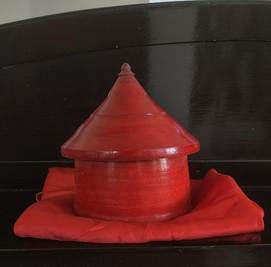
Figure 1: Sinhora wrapped in a cloth. Image by author.
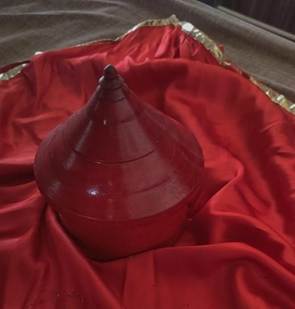
Figure 2: Sinhora wrapped in a cloth. Image by author.
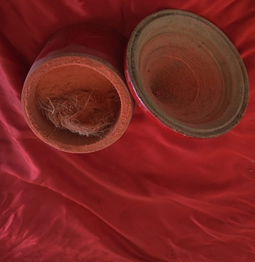
Figure 3: Sinhora opened, displaying the Sindoor. Image by author.
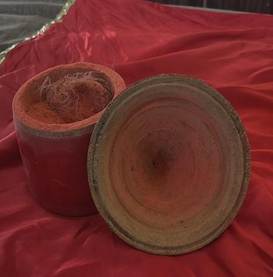
Figure 4: Sinhora opened, displaying the Sindoor. Image by author.
Her mother-in-law had placed it in her hands on her wedding day, along with words about duty, ritual, and the care of a household. For decades, it travelled with her: from the early days of married life in her husband’s village, to the busy years of motherhood, and into the quiet of widowhood.
After her husband’s passing, the sindoor inside remained untouched, but she still kept the box close. Sometimes, she opened it just to breathe in the faint scent of sandalwood and pigment, and to remember.
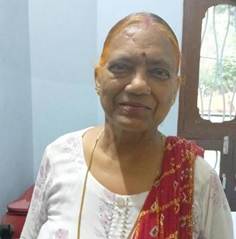
Figure 5: Malti Devi. Image by author.
“Log chale jaate hain,” she murmured, “par in chhoti cheezon mein unka pyaar zinda rehta hai.”
[People pass on… but in these small things, their love remains alive.]
The box is more than a keepsake. It is, in Turkle’s (2011) sense, an evocative object, a companion that holds the biography of a marriage and the quiet persistence of affection. In Appadurai’s (1986) terms, it has acquired a “biography of value,” deepened by decades of ritual touch. Such things are not just symbols, but they live with us, carrying the weight of our relationships in their material form.
Usha Mishra’s Saree
The call connects at 6:07 pm. On the screen, Usha Mishra sits with a cup of tea in hand, the evening light softening the lines on her face. She admits, with a small laugh, that she is nervous because this is the first interview of her life. We reassure her, and she relaxes when she remembers that we are friends of her grandson. Soon, the conversation flows.
She disappears for a moment and returns holding a neatly folded, faded green saree. The paisley print, once vibrant, is now muted with time. She holds it close to her chest before laying it across her lap.
“This,” she says, her fingers tracing the fabric, “is my special thing. Meri wo khaas cheez meri ek purani saree hai. Kapde toh roz ke hote hain… lekin kuch kapde dil ke itne kareeb ho jaate hain ke lagta hai jaise unmein ek poora jeevan bas gaya ho.”
[Clothes are everyday things… but some become so close to the heart that it feels as if a whole life is stitched into them.]
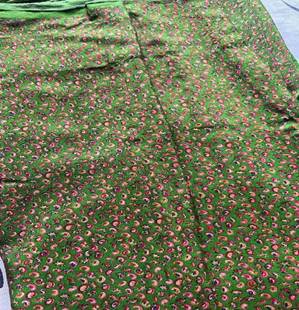
Figure 6: A saree spread on a table. Image by author.
The saree was a wedding gift from her younger brother, Sumesh, in 1971. They were just two siblings, bound closely in the absence of an often-busy father.
“Papa kaam mein rehte the, toh Sumesh mere liye sab kuch tha: dost, dushman, teacher bhi.”
[Father was always busy with work, so Sumesh was everything to me: friend, rival, even teacher.]
When her wedding was fixed, Sumesh secretly saved part of his first salary to buy her the saree. On the eve of her wedding, he placed it in her hands, wrapped in a box, and said:
“Shaadi ke baad, nayi dulhan ban kar sabse pehle isko pehnna. Mere taraf se.”
[After your wedding, as a new bride, wear this first. From me.]
She remembers breaking into tears as she touched it.
In the years that followed, the saree became a companion. In her new home, among unfamiliar faces, it offered comfort. Whenever difficulties arose, she would keep it beside her pillow, as though Sumesh’s presence was stitched into its threads.
“Yeh saree mujhe humesha ek alag samay mei le jaati hai… lagta tha mera bhai paas hai.”
[This saree always takes me to another time… it felt like my brother was right there.]
When Sumesh passed away in 2015, the saree became even more precious. It was no longer just clothing, but an anchor to a sibling bond that distance and death could not sever. On his birthday, she still wears it, despite friends and relatives urging her to choose something new.
“Log kehte hain, ‘naye kapde pehno.’ Par is ek saree mein meri poori kahani hai.”
[People say, ‘Wear new clothes.’ But this one saree holds my entire story.]
Holding it now, she is transported back to the rooftop of her childhood home, a 22-year-old bride-to-be, henna still drying on her palms, laughing as Sumesh teased her:
“Shaadi ke baad mujhe bhool mat jaana, didi.”
[Don’t forget me after your wedding, sister.]
His eyes, she recalls, carried both mischief and an unspoken sadness, as though he already knew their lives would never again be as intertwined.
For Usha Mishra, this saree is not merely a relic of the past; rather, it is a participant in her life, a mnemonic device that allows her to re-enter moments of joy, intimacy, and loss. Miller’s (1998) reminder that objects are not passive symbols but active participants in relationships is vividly true here. In fact, the saree has witnessed her sorrows, her celebrations, and her everyday survival.
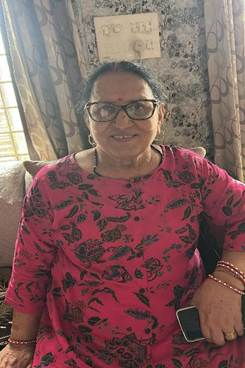
Figure 6: Usha Mishra. Image by author.
“Aaj kal ke kapde factory-made hote hain,” she says, “sundar toh hote hain, lekin usme dil nahi hota.”
[Clothes today are factory-made; they may be beautiful, but they don’t have a heart.]
She speaks without sentimentality, only certainty: as long as she lives, the saree will remain with her. And when she is gone, she hopes her daughter will keep it—not as fabric, but as the material form of a sibling’s love, carried forward.
Part Two – Friendship, Spirituality, and Everydayness
Shri Pal Mohan’s Spiritual Book
The house announces itself before words are exchanged. The air carries the faint strains of flute music from the puja room, accompanied by the sweet scent of incense. The walls are crowded with framed portraits of Shri Radha and Krishna, each image bathed in the soft glow of filtered afternoon light. Shri Pal Mohan’s wife greets us warmly, setting chai and samosas on the table, her gentle small talk easing us into the space.
When he enters, dressed in a simple kurta-pajama, he smiles and sits beside us. Without prompting, he opens the drawer to his left and carefully lifts out an object wrapped in red cloth.
“Yeh kitab sirf shabd nahi, mere jeevan ki saathi hai.”
[This book is not just words; it is a companion to my life.]
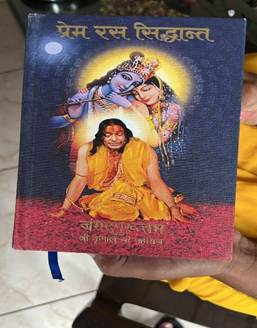
The book Prem Ras Siddhant is worn in the way only long-cherished things are. Its binding has loosened, a few pages have yellowed, and the corners are rounded from years of handling. Between its covers are not just verses but marginal notes in his own hand, tracing his engagement with it over time.
He first received it from his guruji at the age of sixty-eight.
“Kaam se free hone ke baad bhi shaanti nahi milti thi… har samay ek bechaini si rehti thi,”
[Even after retiring from work, I could not find peace… There was always a restlessness.]
It was during a visit to an ashram near Rishikesh that his guruji handed him the book, saying:
“Isse bas padhna mat, isse samajhna aur jeena.”
[Don’t just read this—understand it and live it.]
At the time, he didn’t fully grasp the meaning. “Aaj lagta hai woh ek line meri poori zindagi par bhaari pad gayi,” he reflects. [Today, I feel that one line has outweighed my whole life.]
The book became a steadying presence—his anchor when friendships faded, and especially when his daughter married and the house felt empty.
“Meri patni kehti hain, ‘Tumhare liye yeh kitaab kisi insaan se kam nahi.’ Aur sach poochho, toh yeh sahi hai.”
[My wife says, ‘For you, this book is no less than a person.’ And if you ask me, that’s true.]
For Mohan, this text is not only a repository of teachings but an active participant in his emotional life. Its tactile weight, the faint smell of old paper, and the red cloth that enfolds it all carry the charge of what Turkle (2011) calls an evocative object, something whose materiality cannot be replaced by a digital edition.
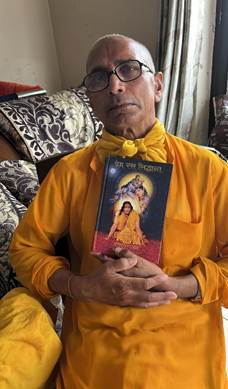
His guruji’s gift also reflects over the years, the book’s significance has deepened, entwining with his own life story. Objects are participants in relationships resonates here. The book has been his silent companion in grief, change, and contemplation.
HBN Mishra’s Spectacles and Khaini Box
The screen flickers to life, revealing an elderly man adjusting the objects on the table before him. His daughter-in-law leans into the frame briefly, asking if the sound is clear. Once settled, HBN Mishra begins to speak, his voice carrying the steady cadence of someone accustomed to long storytelling.
He recalls leaving his native Baliya, Uttar Pradesh, for Gwalior in search of work and stability, eventually putting down roots with his family. When we ask about the belongings closest to his heart, he reaches for a pair of spectacles.
“Darasal meri aankhein kamzor hain, beta… uss zamaane mei chashme ki zarurat badi cheez thi.”
[The truth is my eyesight is weak… in those days, the need for spectacles was a big thing.]
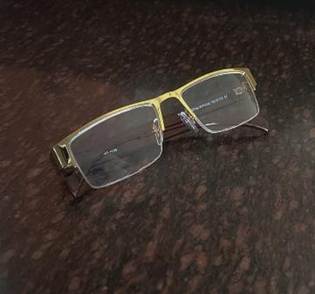
Figure 7: Reading glasses. Image by author.
His wife had bought them during a trip to the city, a rare and treasured acquisition at the time.
“Ab toh wo nahi rahi, lekin uske diye ye chashme jeevansathi se kam nahi.”
[Now she is no more, but these spectacles she gave me are no less than a life partner.]
Even now, decades later, he wears them occasionally, not out of necessity, but to relive the memories they hold.
When the glasses rest on his nose, the past comes into focus: evenings spent listening to Lata Mangeshkar songs his wife loved, her voice playfully singing “Baahon mein chale aao” to coax him out of sulking, her eyes lighting up when he smiled.
The second object he shows us is a small metal khaini box. As it appears, its surface is worn smooth by decades of handling.
“Ye khaini ka dibba aapke dada ji ne mujhe diya tha… hum dono railways mei sath kaam karte the.”
[This khaini box was given to me by your grandfather… we both worked in the railways together.]
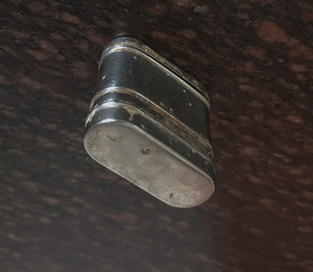
Figure 8: Khaini box to store tobacco. Image by author.
He grins as he recalls his friend gifting it on his 26th birthday.
“Aaj bhi jab isse khaini banaata hoon, toh unki yaad aati hai… aur main muskura leta hoon.”
[Even today, when I prepare khaini from it, I remember him… and I smile.]
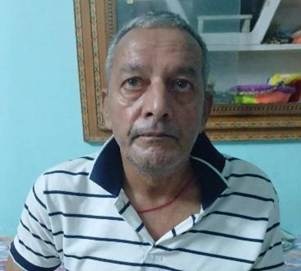
Figure 9: HBN Mishra. Image by author.
These two items, whose stories he generously shared: one from a beloved wife, the other from a steadfast friend, are what Turkle (2011) would call evocative objects: carriers of emotional charge that summon relationships into the present. Their worth is not measured in currency but in the way they tether him to moments of intimacy, care, and camaraderie.
Conclusion
The stories shared here reveal the layered emotional, cultural, and temporal lives of ageing objects. Far from being inert remnants of a bygone past, these objects are active participants in the narration of life stories. A sindoor box becomes a widow’s confidante; a saree becomes the embodiment of a brother’s love; a spiritual text becomes a moral compass; a pair of spectacles, a trace of love; and a khaini box, a testament to male friendship and solidarity. Through these narratives, we see that ageing, as mediated through material culture, is not simply a physiological or social process but a deeply affective and relational one. These objects help older adults resist forgetting, anchor themselves amid change, and sustain emotional bonds across time. They offer a counter-narrative to dominant discourses of decline, showing late life as a space of rich meaning-making, through and with things.
References:
Appadurai, A. (1986). The social life of things: Commodities in cultural perspective. Cambridge University Press.
Lamb, S. (2000). White saris and sweet mangoes: Ageing, gender, and body in North India. University of California Press.
Miller, D. (1998). Why some things matter. In D. Miller (Ed.), Material cultures: Why some things matter (pp. 3–21). University of Chicago Press.
Turkle, S. (2011). Evocative objects: Things we think with. MIT Press.
Woodward, I. (2007). Understanding material culture. Sage.
***
Vanshika Raghuvanshi is an undergraduate student at the Thapar School of Liberal Arts and Sciences, currently serving as a Research Intern on the project Ageing Care and Migration: An Ethnographic Study of Older Adults and Migrant Careworkers in Punjab.
Jayaprakash Mishra is an Assistant Professor of Cultural Studies and Anthropology at the School of Liberal Arts in Thapar University, Punjab, India. As the Principal Investigator of both Ageing in Punjab (Thapar Seed Grant) and Ageing, Care, Migration (ICSSR major grant) projects, he leads the team of researchers doing literature review, ethnographic fieldwork and archival research in the project.
The article reminds of similar objects which most of us might have have kept secured as a memory in some corner of our almirahs, suitcases or old boxes and we get deeply nostalgic just by seeing them.
Also it reminds of Mangalesh Dabral’s popular poem Bachi hui Jagehein explaining how people get departed during the life journey, yet their spaces exist in the memories of their loved ones.
Wonderfully, how well our social sciences and poetry- literature is interconnected!
Here is the youtube link of the poem :
https://www.youtube.com/watch?v=5rr6EzgjrfI
and here is the poem:
रोज़ कुछ भूलता कुछ खोता रहता हूँ
चश्मा कहाँ रख दिया है क़लम कहाँ खो गया है
अभी-अभी कहीं पर नीला रंग देखा था वह पता नहीं कहाँ चला गया
चिट्ठियों के जवाब देना क़र्ज़ की क़िस्तें चुकाना भूल जाता हूँ
दोस्तों को सलाम और विदा कहना याद नहीं रहता
अफ़सोस प्रकट करता हूँ कि मेरे हाथ ऐसे कामों में उलझे रहे
जिनका मेरे दिमाग़ से कोई मेल नहीं था
कभी ऐसा भी हुआ जो कुछ भूला था उसका याद न रहना भूल गया
माँ कहती थी उस जगह जाओ
जहाँ आख़िरी बार तुमने उन्हें देखा उतारा या रखा था
अमूमन मुझे वे चीज़ें फिर से मिल जाती थीं और मैं खुश हो उठता
माँ कहती थी चीज़ें जहाँ होती हैं
अपनी एक जगह बना लेती हैं और वह आसानी से मिटती नहीं
माँ अब नही है सिर्फ़ उसकी जगह बची हुई है
चीज़ें खो जाती हैं लेकिन जगहें बनी रहती हैं
जीवन भर साथ चलती रहती हैं
हम कहीं और चले जाते हैं अपने घरों लोगों अपने पानी और पेड़ों से दूर
मैं जहाँ से एक पत्थर की तरह खिसक कर चला आया
उस पहाड़ में भी एक छोटी सी जगह बची होगी
इस बीच मेरा शहर एक विशालकाय बांध के पानी में डूब गया
उसके बदले वैसा ही एक और शहर उठा दिया गया
लेकिन मैंने कहा यह वह नहीं है मेरा शहर एक खालीपन है
घटनाएँ विलीन हो जाती हैं
लेकिन जहां वे जगहें बनी रहती हैं जहां वे घटित हुई थीं
वे जमा होती जाती हैं साथ-साथ चलतीं हैं
याद दिलाती हुईं कि हम क्या भूल गया हैं और हमने क्या खो दिया है।
Memories and Nostalgia rising from the aging objects is well described by the article.
Thank you!! This is such a heartwarming/breaking poem. Thanks for sharing.