
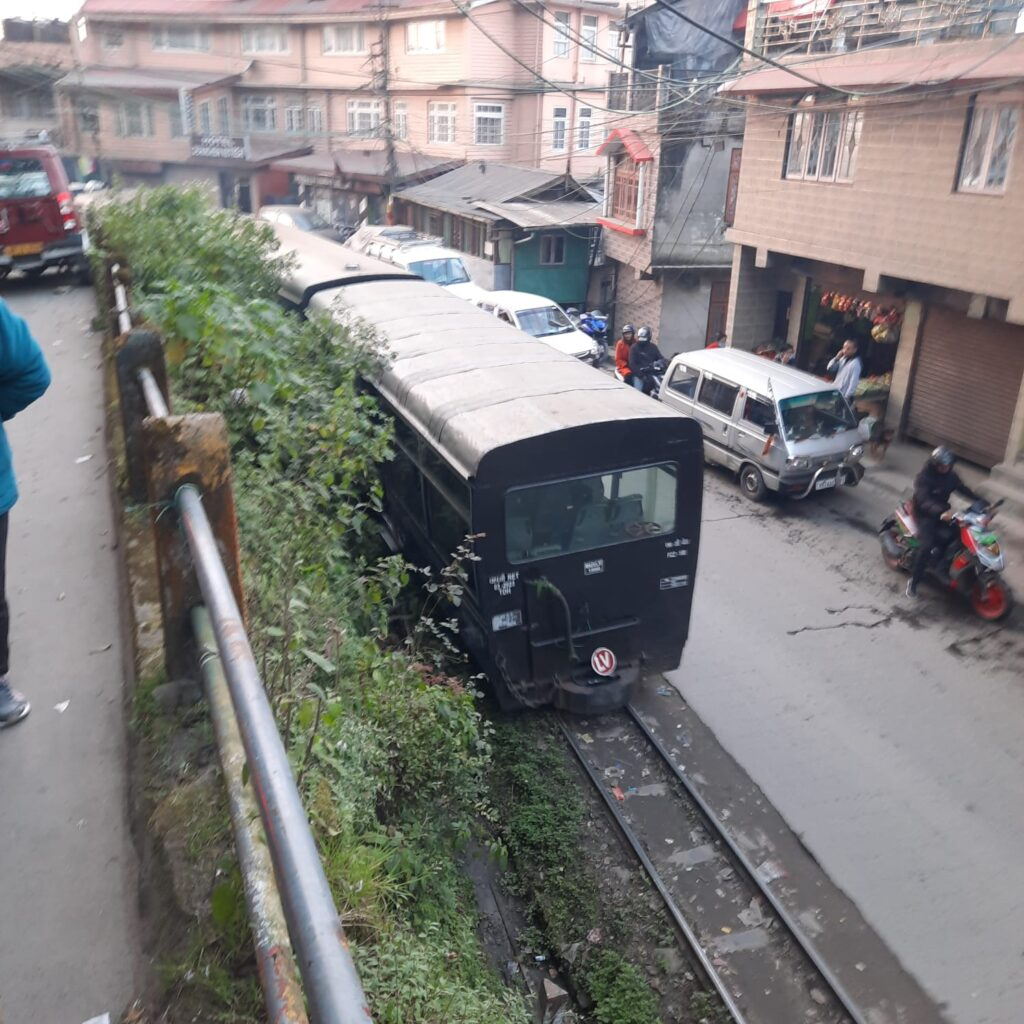
As researchers, our engagement with the field is often marked by a complex interplay of anticipation and apprehension. Fieldwork—especially in a post-pandemic world—presents not only methodological challenges but also new forms of social negotiation. The pandemic has redefined the social fabric and recalibrated relationships with “outsiders,” compelling scholars to reconsider how they enter and interact with research sites. Between October 2021 and September 2022, I conducted two extended periods of fieldwork in the Darjeeling region of West Bengal, focusing on the Gorkhaland movement[i]. This region had recently experienced a volatile phase of mobilisation in 2017, triggered by the Government of West Bengal’s controversial language bill proposing Bengali as the sole official language across the state.
This policy move—suggested despite Nepali’s recognition in the Eighth Schedule of the Indian Constitution in 1992 as one of the official languages—ignited resentment among Nepali-speaking Gorkhas, who form the demographic majority in this region[ii]. The legislation was perceived as an act of cultural domination, reviving debates about the coexistence of subnational identities within a larger national identity and challenging the perception that such assertions were parochial. The resulting 104-day strike transformed local political alignments, fragmenting those political parties into splinter groups—a phenomenon I examined through the lens of political process theory in the course of my doctoral research.
The decision to research a politically charged and historically sensitive movement inevitably raised fundamental questions regarding access and representation. Anthropological discourse has long grappled with the relationship between the researcher (“self”) and the researched (“other”), raising philosophical inquiries about authority, positionality, and legitimacy. Who is entitled to study whom? How are the boundaries between “self” and “other” drawn, and by whom? To what extent can a researcher without direct lived experience of a community claim to interpret its narratives and struggles? Moreover, can there be authentic empathetic understanding in the presence of entrenched power asymmetries, or must scholarship accept the limitations of heuristic models and partial perspectives?
While methodological textbooks may offer frameworks for addressing these concerns, such texts themselves are products of particular epistemic and institutional hierarchies. The legacy of modernity and coloniality has entrenched a scholarly gaze that privileges certain sites, subjects, and forms of knowledge over others, often under the guise of objectivity. Post–World War II political transformations and the rise of the modern nation-state have generated a proliferation of studies on contentious politics, yet such academic attention remains uneven, shaped by geopolitical and disciplinary priorities.
My own intellectual trajectory—shaped by a Bengali upbringing in a politically vibrant region long associated with leftist movements—has been deeply embedded in political discourse since adolescence. Initially, my engagement with social movements was observational and journalistic, reflecting a curiosity about the dynamics of political life. It was only during my transition from journalism to sociology, and later into doctoral research, that my approach gained the critical depth necessary for scholarly analysis. Choosing to study the Gorkhaland movement thus brought me face-to-face with my own positionality and the necessity of conscious reflexivity.
In the field, I made an intentional effort to distance myself from the romanticised, tourist-centred view of Darjeeling that circulates within mainstream Bengali imagination. This required recognising the town beyond its colonial heritage—as a place facing acute water scarcity, widespread drug use, and infrastructural deficits—ironically, despite being the second-highest revenue-generating district in West Bengal after Kolkata. I consciously moderated my Bengali identity, refraining from habitual complaints about the long monsoons or cold winters during my stay there. I learned conversational Nepali to communicate with respondents, including my landlady and her family, and navigated neighbourhoods beyond the tourist-heavy city centre.
In this process, language became more than an object of study; it became a tool for transforming my positionality. I began learning conversational Nepali, not only as a research instrument but as a way to bridge the symbolic distance between “researcher” and “respondent.” Speaking in Nepali with community members, political leaders, and my landlady allowed me to enter spaces of trust and access narratives that might have remained closed in another language. My landlady became an informal cultural guide in this process. Our early interactions were in Hindi, a language that served as a neutral bridge between us, but over time, she began gently correcting my Nepali, offering new words, and explaining idioms. These exchanges, often over tea in her kitchen, opened up more than linguistic proficiency—they allowed me to see how language was woven into everyday acts of hospitality, negotiation, and trust. When she later introduced me to a local journalist, she did so in Nepali, framing me to him as “Humro Baini” (our sister). That single phrase collapsed the distance between “researcher” and “researched” in a way months of formal explanation could not.
Some of my most revealing interviews began not with structured questions but with shared frustration over the practical disadvantages of linguistic marginalisation. It allowed me to gain the trust of political leaders and community members, who articulated their grievances about the state government’s neglect of their cultural and linguistic context. I learned, for example, that knowledge of the Nepali language—despite its constitutional recognition—was not considered a qualification in departmental promotions for West Bengal Civil Services’ officers from the region. They had to learn and clear an examination in the Bengali language for the same, something the Bengalis in the service were exempted from doing (even if they were posted in the Darjeeling region). Nepali was only recently introduced as an optional subject in the WBCS mains examination, decades after other languages such as Bengali and Santhali had been included, in June 2025.
Respondents also pointed to historical grievances, such as the alleged manipulation of census data in 1951, ahead of the first State Re-organisation Commission’s recommendations in 1956. That census classified only 19% of the region’s population as Nepali-speaking, thus justifying its incorporation into West Bengal under the Absorbed Area Act, 1956. This was, in part, a consequence of individuals reporting their mother tongues in terms of their specific community languages rather than Nepali, even though Nepali functioned as a shared lingua franca across various Himalayan ethnic groups in this region. By 1961, census figures reflected a more accurate linguistic profile, confirming Bengali was not the majority language.
These narratives resurfaced during the 2017 Gorkhaland mobilisation, with language framed as an existential marker of identity. The movement’s resistance eventually forced the withdrawal of the state government’s language policy. For many Gorkhas, the erosion of their language’s institutional presence was seen as a precursor to the erosion of their collective identity. Ironically, Darjeeling’s colonial legacy has made it an educational hub for West Bengal, attracting students from across India and neighbouring countries to prestigious schools like Loreto Convent, North Point, St. Paul’s, and Mount Hermon—all founded in the pre-independence era. Even many state-run schools, such as Bethany, have English as the medium of instruction, creating tensions between the practical demands of economic mobility and the preservation of Nepali linguistic heritage. Respondents noted that while local children increasingly lack proficiency in Nepali grammar and lexicon, the imperative to learn English for employment outside the hills has become dominant.
Reflecting on this fieldwork reveals that language in Darjeeling is not merely a tool of communication but a deeply political symbol—one that mediates access to resources, recognition, and rights. The Gorkhaland movement’s linguistic dimension exemplifies how state policies can amplify or suppress minority identities, thereby shaping the contours of political mobilisation. My own journey—navigating between insider-outsider identities, adopting linguistic adaptation as a methodological strategy, and confronting the layered histories of census politics and educational policy—underscored the entanglement of power and knowledge production.
In this sense, fieldwork in Darjeeling was both an empirical inquiry and an exercise in self-reflexivity. It compelled me to interrogate the privileges and limitations inherent in my positionality, as well as the broader structural forces that condition research encounters. Ultimately, studying language, identity, and power in Darjeeling is not simply about documenting a movement—it is about engaging with the ongoing negotiation between history, policy, and lived experience, and recognising that these negotiations are themselves shaped by the act of research.
[i] “Gorkhaland Movement” is rooted in the century long demand existing in northern parts of West Bengal (specifically Darjeeling hills region consisting of Darjeeling, Kurseong and Kalimpong) for separation of the region from the administrative set-up of the Bengal province (in colonial times). The movement reiterates the importance for a separate state for the Nepali speaking Indian citizens (Gorkhas) in India within its federal structure. The first recorded demand is traced back historically to 1907 followed by four phases of mobilization activities between 1986 and 2017 when the demand took the shape of a social movement demanding separate statehood in academic sense of the term.
[ii] Nepali was already accorded the status of the second official language for administrative communication under the State Act of 1962, in recognition of the region’s distinct demographic composition.
***
Debbani Bhattacharya is a Ph.D. candidate in Sociology at Indian Institute of Technology (IIT) Kanpur, specializing in Identity politics and electoral transformation in demand for statehood movements. Her research examines the Gorkhaland movement through ethnography and qualitative analysis focusing on the role of local political parties and their interaction with government through electoral coalition. She has presented at national and international conferences and has recently submitted her PhD thesis.
Nice