
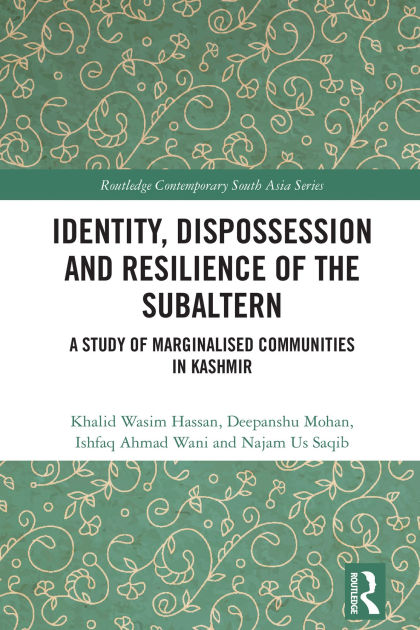
Identity, Dispossession and Resilience of the Subaltern: A Study of Marginalised Communities in Kashmir by Khalid Wasim Hassan, Deepanshu Mohan, Ishfaq Ahmad Wani, and Najam Us Saqib (published by Routledge in 2025) centres upon the dispossession, exclusion, and resilience of the valley’s marginalised communities of certain identities. Hassan et al. point out the gaps in historical scholarship concerning Kashmir’s subalterns. They specify that most pre-1947 works follow a “binary of marginalised [Muslim majority] and elite [Dogra ruling class] in terms of land rights, education and employment” (p. 10). However, while doing so, they don’t address the intersections of ethnicity, caste, language, and nationality that operate within the same. They write that even after significant politico-economic shifts in Kashmir, certain ethnic, caste, and linguistic groups still faced othering. By giving examples of Hanjis and Watals amongst the Sunni Muslims, the Pashto community, and the Tibetan Muslims, Hasan et al. deal with the themes of caste and marginalisation, identity and belongingness, culture and resilience, citizenship and assimilation. They not only situate these communities within Kashmir’s broader socio-cultural and economic matrix, but also note the impact of decades-long militarisation on them. Conducting sociological research, especially fieldwork in Kashmir, comes with a series of security and ethical concerns. On this point, Hasan et. al share how during their field work,
“…the threat of state surveillance, whether real or perceived, was so high that it was difficult for researchers and research participants to articulate the shared experience and impact of conflict on everyday life. Nevertheless, the discussions on the socio-economic life and the marginalisation of these communities couldn’t escape the mention of the violent episodes which the members have witnessed in their respective localities in the last three decades” (p. 13).
Taking the case of Kashmir’s Pashto or Pathan community, living in District Ganderbal, Hasan et. al at length describe their traditional-distinct cultural practices, mechanisms, and signifiers. They emphasise the community’s resilience against constant pressures for cultural assimilation, threatening the sustenance of their identity, culture, and language. This study demonstrates how, due to the Pashto community’s “subalternity” and the valley’s “changing political and economic landscape,” they face numerous socio-economic and political challenges, including inaccessibility to resources such as employment and education, as well as a lack of political representation (pp. 29-33). Moving from Ganderbal to Srinagar, Hasan et. al engage with Kashmir’s Tibetan Muslims, discussing their history, migration and settlement, and the citizenship conundrum they deal with. Being labelled and treated as the ‘non-state subjects’, the community encounters many spatial and socio-economic difficulties like buying and owning property, enrollment in educational institutions, and applying for jobs. It was only in 2019, Hasan et. al write “…they [Tibetan Muslims] were recognised as the ‘state-subjects’, which is the recognition of being a citizen of Kashmir with property and employment rights” (p. 41). Further, to maintain their “hybrid identities” of being a Kashmiri, a Tibetan, and a Muslim, the community has largely adopted a “…policy of limited acculturation as opposed to assimilation” (p. 53).
Considered ‘impure’ and ‘unclean’ in Kashmir’s social hierarchy, Hasan et al. take us to Srinagar’s Sheikh colonies. Often referred to as Watals in Kashmir, most members of this community do not like this label, preferring the term Sheikh over it. Regarding this, Hasan et. al comment that “the preference for ‘sheikh’ can reflect an individual’s responses to the hierarchical structure of Kashmiri society, where increasing aspirations for upward mobility influence identity selections” (p. 66). They emphasise the Sheikh community’s caste-based stigmatisation, ostracisation, and exclusion from social spaces, gatherings, interactions, and rights. In response to discrimination, they reveal how the community has relied on its local networks, formed informal conflict resolution mechanisms, and devised ways to provide support, promote collaboration and collectivity amongst its members. Hasan et. al also cover Kashmir’s displaced Hanji community in Srinagar’s Rakh-e-Arth colony, specifically writing about their everyday navigation and negotiation with state institutions and upper-caste Muslim communities; therefore, exposing the “intricate manifestations of caste-based prejudice in modern urban environments” (p. 83).
Departing from the dominant theories of dispossession, which mostly focus on economic determinants, Hasan et al. contend that because of their ethnicity and caste, the marginalised communities also face dispossession, both material and non-material losses. On the whole, this rigorous study presents a counter to the monolithic understanding of Kashmiri society. By employing ethnographic sensibilities, it shows the intersecting, multi-layered nature of exclusion and marginalisation faced by Kashmiri communities of Pashtos, Tibetan Muslims, Hanjis, and Sheikhs and their resistance against erasure, discrimination, and disempowerment as well.
***
Sabahat Ali Wani is an independent researcher and a Fellow in Ideas at Harrison Middleton University.