
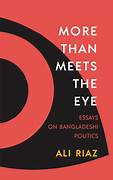
More Than Meets the Eye: Essays on Bangladeshi Politics by Ali Roaz (University Press Limited, 2022) emphasises the role of Sheikh Hasina and her political party, Bangladesh Awami League, in Bangladesh, which was responsible for the widespread abuse of state power that deteriorated the country`s democracy since 2009. This book was published in an era when a fascist regime was in power in Bangladesh, while the then Sheikh Hasina and her regime were considered dictatorial. But the recent student-led movement ousted the Bangladeshi Prime Minister from Bangladesh`s politics.
Following the development of military authoritarian rule, Bangladesh had expected electoral democracy, but it has turned to a path of democratic backsliding. In a powerful introduction, Riaz emphasised that the country is witnessing acrimonious politics between two major parties, which has led to military intervention in politics. Chapter one provides a historical account of the emergence and collapse of the political settlements, arguing that the current crisis in Bangladeshi politics was the result of the breakdown of the political settlement among the political elites that emerged during the 1990s (pp. 11). Focusing on the scholarly engagement about the political settlement, the author highlighted one or more of three ways that the elites in Bangladesh maintained the political settlements, such as coercion, co-optation, and building legitimacy with time. The author argued that the Bangladeshi political settlement brought the elites together and shaped an agreement on the system of governance, regime transition, and continuation of economic policies, and delivered continued economic growth to create enough rent to share the spoils of the system, developing a neo-patrimonial system (pp. 23). Chapter two focuses on the manipulation of the legislature as a tool to control executive power and the development of a civilian authoritarian regime following the 2009 national election in Bangladesh. In this chapter, the author explained in what ways the ruling Awami League established “a de facto one-party parliament after the 2014 election, boycotted by the opposition” (pp. 35). The author provided several examples that stated the legislative actions have resulted in facilitating the ultimate power of the executive branch and transforming Bangladesh from a democracy to authoritarianism.
Chapter three emphasised that the level of social cohesion affected Bangladeshi society based on the empirical survey findings conducted by the Asian Social Cohesion Radar, locating Bangladesh at the bottom tier of the 22 Asian countries (pp. 51). Following the development of neopatrimonialism and patriarchy, the author argues that the country experienced jobless growth, but the Bangladesh Awami League (BAL) and the Bangladesh Nationalist Party (BNP) maintained a “clientelist political structure which have distributed benefits supported by its institutions, consistent with the distribution of power in the society” (pp. 63). Within this background, chapter four discusses the vision of democracy in Bangladesh and looks at the peripheral status of the country in terms of the democratic transformation hindered by anti-democratic forces, questioning the validity of democratic ideals, the effectiveness of democratic institutions and suggesting an undemocratic system of governance as a new kind of democracy (pp. 83). Along with a rich academic discussion on the foundational principles of democracy, the author mentioned numerous survey findings which stated the aspiration of the democratic rule in Bangladesh by its people following the establishment of a “powerful independent election commission and the restoration of some mechanism of non-partisan government in the Constitution” (pp. 92).
Chapters five, six, and seven illustrated the contemporary debate around the narratives of secularism and Islam in Bangladesh, tantamount to the radicalisation of Bangladeshi society and politics, favouring religious radicalisation in the country. The author interestingly articulated the ways Islam, secularism, and secularisation stand together in Bangladesh, while Islam or Islamic politics firmly exist in the society. It is also true that the Constitution of Bangladesh maintained both secular and Islamic versions of it when the subsequent amendment took place, during the BAL and BNP regimes. On hand, secularism becomes a contested term; on the other, the functions of Islam prevail in the existing political landscape. Therefore, the author stated that the extant popular perception regarding the relationship between religion and politics in Bangladesh has more than met our (the Bangladeshi) eyes” (pp. 108). In chapter six, the author focused on understanding the radicalisation of Bangladeshi society and politics experienced from the post-liberation period of the country. During the regime of Sheikh Mujib to the latest Sheikh Hasina, Bangladesh has undergone a series of radicalisation processes where the ruling parties, in different episodes of time, took advantage. In contemporaries, with the emergence of the Shahbag and Hefazat, the mainstream media adopted a binary framework that normalised radicalisation by the actions of the ruling political parties (pp. 125). Similarly, in chapter seven, the author problematized the existing models of radicalisation following the development of an alternative framework. The author also mentioned factors associated with radicalisation in Bangladesh, mentioning its connection to the Bangladeshi political environment because of the growing violence faced by the people when they had personal loss and trauma.
The last two chapters of this book raise the historical aspects of the Bangladesh-India relationship, considering India as a hegemonic superpower in South Asia. In these chapters, the author was interested in discussing the Bangladeshi-India relationship as “history is open to interpretations (pp. 147). On the one hand, the author acknowledged the role of India during the Bangladeshi liberation war in a positive manner. On the other hand, the author became critical of the dominating role of India in the post-liberation war, especially during the regime of Sheikh Hasina from 2009 onwards. Professor Riaz mentioned that Indian allegations of illegal migration, presence of insurgents camps in Bangladesh irked the Bangladeshi government, while Bangladesh`s insistence of ratification of the Long Border Agreement, demarcation of the maritime boundary, the treaty for water sharing of common rivers, such as Teesta, reducing barriers on Bangladeshi goods to the Indian market to reduce the trade deficit was not well received in New Delhi (pp. 154). Against this backdrop, when Sheikh Hasina came to power, Bangladeshi counterparts fulfilled “a tsunami of expectations” made by the Indian government, which helped to develop anti-India sentiments in the country. Here, the author argued that India`s lack of sensitivity toward the legitimate claims over shared resources, such a transborder waters, portrayal of Bangladesh as a threat to India`s security, perceived interjections in domestic politics, particularly adopting an open partisan position and supporting BAL alone, and unwillingness to act as equal partners with greater responsibilities; figured out as “Neighborhood Lost” policy against the previously known “The Neighborhood First” policy (pp. 168). Finally, chapter nine depicted the long-standing border politics between the countries, which has become one of the deadliest borders in the world, killing hundreds of Bangladeshis by the Border Security Force (BSF). The author presented Indian narratives for building fences while exploring the lived experiences of the Bangladeshi living on the margins. He argued that both of the narratives undermine the lived experiences of the inhabitants of the borderland.
Professor Riaz is one of the Bangladeshi scholars who has consistently been a vocal critic of the Bangladesh Awami League regime in particular. Therefore, his call to the Bangladesh audience to acknowledge the political situation that occurred in the recent decade is historically important. Similarly, it is also true that he holds a U.S. passport along with a Bangladeshi one. One could argue that this is why he tried to write and publish political issues of Bangladesh without any prejudice, while intellectuals living in Bangladesh remain silent. However, this book is important for the students of Bangladesh studies, political science, sociology, border studies, international relations, and so on. If someone reads this book, the reader can understand the overall socio-political background of Bangladesh, indicating the recent fall of the Bangladeshi Awami League regime.
***
Md Niamot Ali is a Graduate Teaching Assistant at the Department of Comparative Studies, Florida Atlantic University.