
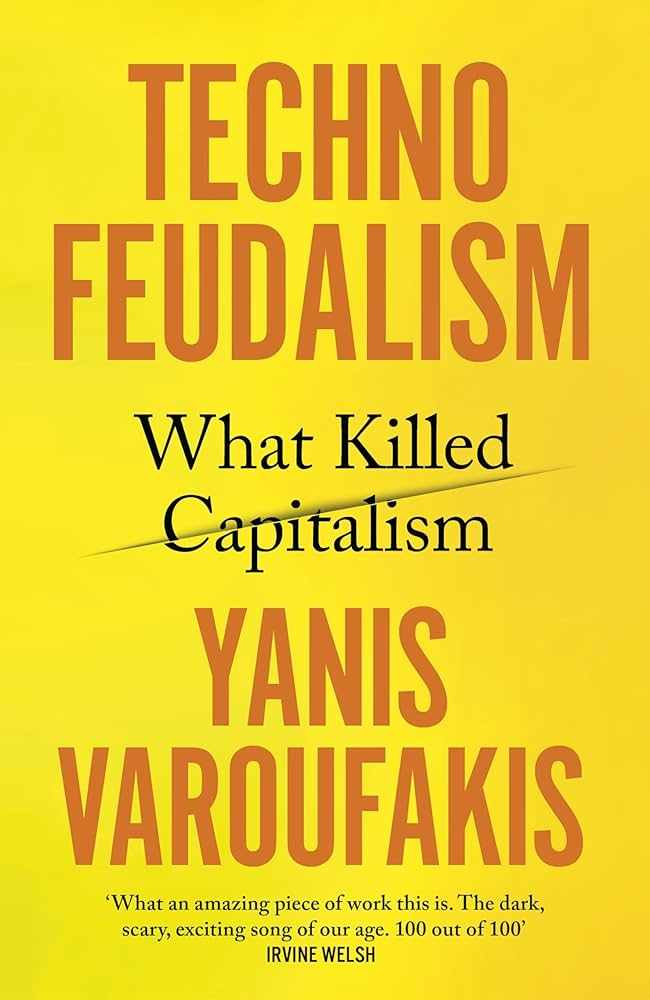
The entry of digital technology and its growing role in the social-economic-cultural-political sphere have sparked conversations in several academic disciplines, as scholars grapple with its transformative effects on labour, governance, social relations, and modes of production. Technofeudalism: What Killed Capitalism (Bodley Head, 2023) by Yanis Varoufakis, the former Greek finance minister, professor of economics, and a self-described libertarian Marxist, is one such work which attempts to address the implications of digital technology’s growing dominance and the concomitant rise of Big Tech companies for the organisation of production in the contemporary world. Framed as dialogue between Father and Son, the author invokes ancient Greek myths and characters to tell the story of the evolution of capitalism, its various transformations and most importantly, the interaction between technology, economy and society.
In this work, Yanis draws on themes from his earlier books Talking to My Daughter About the Economy (2013) and Another Now (2020), and seeks both to diagnose and to provide a prognosis for some of the most pressing questions of our time, like are we still living under a capitalist mode of production, or have we entered a new historical era? Is the economic crisis of 2008 an event of the past, or are we still living through it? How has the rise of Big Tech and the arrival of the age of Data transformed labour relations? What does it mean to live in a reality shaped by impersonal algorithms and AI which manufacture unending desires? In what ways has the global pandemic reshaped the organisation of the world economy? And, most importantly, what kind of effort and politics is required to come out of the situation?
After introducing capitalism and explaining how its key variables – capital, labour, value, and money – function, the author traces its trajectory from the end of the Second World War through the global financial crisis of 2008 to the post-pandemic era. To capture this eighty-year-long evolution of capitalism, Yanis employs the concept of ‘metamorphosis’ – a deliberate choice over the more conventional term ‘transformation’. While the latter denotes some kind of change in form and structure, the former denotes a radical change of qualitative nature leading to the emergence of something new, which fits with the overall schema of Varoufakis’ thesis of capitalism evolving into what he calls technofeudalism.
According to Yanis, metamorphosis is to capitalism what camouflage is to a chameleon: both its essence and its defence mechanism (p. 24). He identifies the metamorphosis of capitalism post-Second World War. The first metamorphosis of capitalism was the creation of the Bretton Woods institutions in the immediate aftermath of the Second World War, which sought to regulate capitalism from its own logic. Also known as the ‘golden age of capitalism’, or welfare capitalism, which lasted from 1945 to the early 1970’s resulted from a compromise between labour and capital brought about by the devastation of Europe and the presence of the Soviet Union as a counterbalance to Capitalism. This phase of capitalism was characterised by technostructure, a concept coined by the economist John Kenneth Galbraith to denote the hierarchical organisation of segmented specialists and experts to control any enterprise, which dominated this phase of planned capitalism.
The second metamorphosis of capitalism was triggered by the collapse of the Bretton Woods system through the Nixon Shock of 1971, which ended the U.S. dollar’s convertibility into gold, dismantling the framework of fixed exchange rates. This rupture paved the way for the financialization and deregulation of capitalism, as the economy shifted from industry and commerce toward the financial sphere. The second metamorphosis of capitalism was assisted by the entry of computers, growth of the internet, the rise of neoliberalism and fall of the Soviet Union, and most importantly with the growth of advertisement industry (told by Yanis through the fictional character Don Draper of TV series Mad Men [2007-2015]), in the late 1960’s, which was based on the mass commercialization of nostalgia (p. 25), and skilful manufacture of desire. The entry of television sets into homes and commercials commodified human experience (p. 26), and ushered in the attention economy as companies competed to attract the attention of consumers. This phase of capitalism was characterised by the paradoxical growth of the US Dollar as the currency of international trade, despite the increasing U.S. trade deficits caused by the rise of German, Japanese and Chinese manufacturing from the 1970s onwards. Dominated by bonds, stocks, hedge funds, and derivatives- the instruments of finance capitalism, this era, according to Yanis, came to an end with the global financial crisis of 2008.
The seeds for the third and, according to Varoufakis, the final metamorphosis of capitalism were conceived in the womb of the 2008 financial crisis and, after a gestation period of nearly twelve years, came to birth during the global pandemic, aided by the ascendency of digital technology and data. In the immediate aftermath of the crisis, the central banks of several nation-states opened the floodgates of state money to capitalists, in the hope that the latter would re-invest and restart the capitalist engine. Instead, much of this money was diverted into asset purchases and share buybacks, inflating stock prices rather than being invested back into productive activity in the wider economy (pp.100-103). Crucially, a significant portion of this cheap money fuelled the rise of Big Tech, enabling corporations like Amazon, and Tesla and others used this money to pay for server farms, fibre optic cables, AI research, software developers (p. 108), thereby consolidating their infrastructures of data, algorithms, and digital platform, which led to the birth of what Yanis calls cloud capital. This new form of capital, in turn, heralded the emergence of a new ruling class, the cloudalists (p. 114), and the establishment of a new economic order, technofeudalism by killing capitalism!
The conceptual machinery of technofeudalism is described by Yanis in the third chapter, in which he introduces several new terms-cum-concepts that hold the potential to become keywords in the study of digital technology’s impact on economy and society. For instance, the term cloud capital denotes the data-based digital-technological architecture embodied in organisations such as Amazon, Meta, Google, and Apple. Unlike traditional capital, which is generated through wage labour in the marketplace, cloud capital possesses the capacity to reproduce itself without wage labour by commanding whole of humanity to chip into its production for free (p. 80), through cloud proles (short for cloud proletariat), referring to waged workers driven by cloud-based algorithms – such as Uber/Ola drivers and Amazon/Flipkart/Zomato/Swiggy delivery agents (p. 81), and cloud serfs, which designates all of us who, whether by choice or compulsion, integrate ourselves into digital networks, thereby augmenting cloud capital simply through our everyday use of various digital platforms, often without direct compensation. The cloudalists, or the new ruling class, are those who own and control digital-technological infrastructure like Amazon, Apple’s App Store, Google Play store, Alibaba, which are described as cloud fiefs as they do operate as open markets – but as centralized, algorithm-managed domains presenting choice to their users depending upon the whims and fancies of the cloudalists and their complex algorithms. Having laid out this vocabulary of technofeudalism, Varoufakis then turns to differentiating it from capitalism.
The difference between technofeudalism and capitalism is discussed in the fifth chapter, aptly titled ‘What’s in a Word’. Varoufakis, taking a nominalist position, argues for the adoption of the word cum concept ‘technofeudalism’ in place of alternatives such as platform capitalism, hyper-capitalism, or rentier capitalism, which have been used to describe the contemporary economic order. He insists that the term capitalism no longer captures the essence of our current socio-economic system, and by retaining it in hyphenated forms, we risk misrecognizing its dynamics and, therefore, misunderstanding both its dangers and possibilities for change. The key argument presented here is that the current economic order has transcended the logic of profit that defines capitalism to enter into the era of rent, (the defining economic trait of feudalism) as cloudalist extract cloud rent not only from traditional capitalists – who have been reduced to mere vassals dependent on digital platforms to sell their products, but also from the cloud proles for working in exchange of a cut from their earnings, while cloud serfs continue to add value to cloud capital without any kind of wage. While rent certainly survived within capitalism, it did so under the dominance of profit; in technofeudalism, Varoufakis argues, rent has decisively triumphed over profit (p. 118).
The novel thesis presented by Varoufakis has generated much debate within academia as well as the left political circle, and it remains to be seen if his thesis can provide a sustainable framework for the analysis of the current economic system. However, if one accepts that a good theory has the potential to predict future trajectory, then it seems that for the time being Yanis’s framework is holding its ground. At the time of writing this review, we can cite at least three novel developments that align with the framework. First, the introduction of marketplace fees by Amazon and platform fees by Zomato and the likes is nothing but a ‘rent’ extracted from us, the cloud serfs, for using the services. Apart from adding the cloud capital of Amazon by browsing, searching, and reviewing products, we are not paying rent to do the same! Second development can be cited in the way X (formerly Twitter) has evolved under Elon Musk, who, according to Yanis, bought to join the elite club of cloud giants like Apple, Amazon and Google. Musk is not only charging a ‘rent’ from us for using it, but has also turned it into a marketplace. Thirdly, we can see the rush by Indian capitalists like Reliance and Airtel, which have missed the AI and cloud-capital train, are now hyper-speeding to catch up!
***
Harshvardhan Tripathy is an Assistant Professor of Sociology at University School of Liberal Arts, Guru Gobind Singh Indraprastha University, New Delhi.