
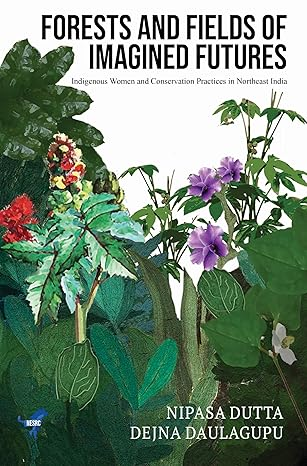
Nipasa Dutta and Dejna Daulagupu, in Forests and fields of imagined futures: Indigenous women and conservation practices in Northeast India (published by North Eastern Social Research Centre in 2024), have woven a beautifully crafted ethnography that maps the ecological, cultural, and political environments of the indigenous women of Northeast India. Focusing on fieldwork among Dimasa, Karbi and Khasi communities, the book explores how women in their day-to-day associations with land, water, forest and non-human kin build persistent practices of conservation. Although basing their argument on a feminist political ecology, the authors assume a balanced engagement with seed custodianship, food-producing practice and gendered relations instilled in these communities’ agrarian and ecological environments.
Within this context, it foregrounds how women are central agents in sustaining traditional ecological knowledge that holds food security, seed preservation, and socio-cultural identity in a location with an intersecting history of colonial forestry, post-Independence development policies, and market-driven transformations. Women’s roles in seed saving, sharing, and selecting crop varieties are not represented merely as biological or economic duties but as strongly cultural and political actions that form the foundation of food sovereignty. From their close involvement in jhum (shifting) cultivation, seed variety transmission across generations, and traditional brewing of ritual rice beer, to being custodians of homesteads and multi-species kinship relations, the authors demonstrate that food production and ecological stewardship cannot be separated. Yet, in doing so, the authors have also brought out the contradiction where, despite all these important roles assumed by the women, they are often excluded from formal decision-making and barred from access to sacred ecological sites.
A particular strength of the book lies in the way it portrays “everydayness” as the essence of conservation practice, concentrating on actions that fall short of the mainstream conservation science. It renders how traditional seed networks emerge as vital practices that preserve agrobiodiversity and sustain local food systems against encroaching market forces and land commodification. The authors show these with fine ethnographic detail, for instance, in the Karbi farmer’s singing with her co-workers under the shade of a wild tree during foraging breaks; a Dimasa woman identifying the exact insect calls that signal it is time to sow; households whose courtyards double as multi-species habitats for chickens, pigs, frogs, and occasional wild visitors, etc.
These recurring, modest-seeming interactions bind human livelihood, ecological regeneration, and cultural meaning in ways that formal policies often overlook. Equally compelling is the book’s engagement with indigenous knowledge systems and orality. Origin myths, folktales, songs, and ritual narratives are shown to be not frozen relics but dynamic vehicles for transmitting ecological norms, seasonal cues, and ethical codes for interaction with animals, plants, rivers, and spirits. At the same time, the authors do not shy away from pointing out the contradictions inherent in these worlds. While female figures often occupy the role of origin mothers or nature goddesses in myth, such symbolic elevation does not necessarily translate into equitable status or access in daily practice. This irony further gets sharpened when women are forbidden entry to spaces they are said to have created.
Importantly, the book also contextualises women’s roles and food practices within the broader transformations of land ownership, global markets, and religion, illuminating how capitalist modes of production and state policies reshape indigenous agrarian realities. The analysis is enriched through a sustained awareness of the historical and political forces transforming these landscapes. The narrative connects the shift from upland jhum cultivation to cash-crop plantations like areca-nut and oil palm, and the gendered implications of such transformations, from the prohibition on women ploughing in wet-rice systems to the loss of communal decision-making power under land privatisation. It highlights the erosion of communal land and seed commons under privatisation and the reconfiguration of women’s food labour in response to market demands and neoliberal conservation agendas.
By situating this paradox within wider debates in feminist political ecology, the authors allow for a complex layering of gendered experiences in food production, which challenges any romanticisation of essentialist ideas that women have an innate closeness to nature. This highlights how gendered roles, access, and exclusion are both socially produced and historically contingent, along with political forces that transform these landscapes. As such, it neither idealises nor isolates these from patriarchal and caste dynamics that shape land access, ritual exclusion, and economic marginalisation. At the same time, the authors have also traced adaptive strategies, solidarities, and subtle resistances among women, such as preserving certain food crops alongside cash crops or maintaining gendered seed custodianship despite structural change.
Additionally, one of the strengths of this book is its ability to embed these specifics in wider comparative reference. Forests and Fields resonates with other landmark works in the field, such as Aiyadurai’s Tigers Are Our Brothers (Aiyadurai, 2016), Govindarajan’s Animal Intimacies (Govindarajan, 2018) and classic feminist political ecology texts by Agarwal Agarwal, 1994) and Rocheleau (Rocheleau, Thomas-Slayter, & Wangari, 1996) et al. Its thematic overlaps with studies of sacred groves in Meghalaya and with global debates on common-pool resource governance situate the work alongside scholarship from South and Southeast Asia while keeping its ethnographic focus grounded in the distinct ecological histories of Assam and Meghalaya’s hill districts (Ormsby & Bhagwat, 2010).
Nevertheless, the book is not without its limitations. The portion on the Khasi community, which has been drawn primarily on pilot research and secondary sources, is consequently less detailed than the sections on the Dimasa and Karbi communities. This ends up lending a certain unevenness to conducting a cross-community analysis. Moreover, although the book has intentionally emphasised the voices of the women, it also means that the role played by the men, as collaborators, gatekeepers, or challengers in these conservation processes, receives less sustained exploration.
Regardless, these are minor reservations in relation to the book’s substantial contributions in offering a textured, respectful portrayal of indigenous women’s ecological labours and in insisting that conservation is not an imported moral imperative but a lived practice. It challenges “fortress” models and techno-scientific framings by showing that sustainability is co-produced through local livelihoods, cultural memory, and shared stewardship, rather than bestowed through top-down interventions.
In conclusion, Forests and Fields of Imagined Futures is an invaluable resource for engaging South Asian foodways from the intersecting perspectives of gender, indigeneity, ecology, and politics, in a geographical and cultural area which has remained rather ignored and unexplored. The book offers an implicit but forceful lesson: to imagine a just ecological future, one must begin by recognising the intricate, embodied expertise of those already living it. Crucially, the conceptual focus on “imagined future” is a notable contribution which goes beyond evocative framing to open analytical and political space for articulating alternate futures foundationally based on indigenous women’s ecological engagements. This focus transforms the work from a descriptive ethnography into a forward-looking pathway for food sovereignty and ecological justice, which is co-created with indigenous knowledge holders.
References:
Aiyadurai, A. (2016). Tigers are our brothers: Anthropology of wildlife conservation in Northeast India. Oxford University Press.
Agarwal, B. (1994). A field of one’s own: Gender and land rights in South Asia. Cambridge University Press.
Dutta, N., & Daulagupu, D. (2024). Forests and fields of imagined futures: Indigenous women and conservation practices in Northeast India. Guwahati: North Eastern Social Research Centre.
Govindarajan, R. (2018). Animal intimacies: Interspecies relatedness in India’s Central Himalayas. University of Chicago Press.
Ormsby, A.A. & Bhagwat, S.A. (2010). Sacred forests of India: a strong tradition of community-based natural resource management. Environmental Conservation, 37(3), 320–326. doi:10.1017/S0376892910000561
Rocheleau, D., Thomas-Slayter, B., & Wangari, E. (1996). Feminist political ecology: Global issues and local experiences. Routledge.
***
Rakesh Saikia is a fourth-year BA LLB student at the National Law School of India University, Bengaluru.